Why Mars Looks So Red
In this post
- Mars Is Rusty, Just Like An Old Nail
- Red Places On Earth: A Comparison
- The Names People Gave A Red World
- The Old Story: Dry Rust From A Dry Planet
- What The Old Story Got Right
- The New Finding: Rust That Needed Water
- How Dust Painted A Whole Planet Red
- Why Mars Looks Red Everywhere
- Why Earth Is Not Red All Over
- What The Red Colour Tells Us About Ancient Mars
- You may also like
Look up on a clear night, and one “star” stands out by refusing to twinkle white. It glows steady and orange-red, like an ember held far away. People noticed it thousands of years ago, long before telescopes, and they named it for what its colour suggested to them. The Romans named Mars for their god of war because its colour was reminiscent of blood, while Egyptians called it “Her Desher”, meaning “the red one”. The colour earned it a nickname that has lasted ever since: the Red Planet. But a name is not an explanation. Why is Mars red, and why is it red everywhere, all over, all the time?
Thanks to the fleet of spacecraft that have studied Mars over the last decades, we know that the red colour is due to iron minerals in the soil rusting. That is, iron bound up in the chemistry of Mars’s rocks has at some point reacted with water and oxygen in some form, just like everyday rust forms on Earth. Over billions of years, this rusty material, iron oxide, has been eroded down into dust and spread all around the planet by winds, a process that continues today. Mars is red, in short, because Mars is rusty. This post explains that rust, the wetter history scientists discovered in 2025, and why a whole planet wears the same colour.
Mars Is Rusty, Just Like An Old Nail
Rust is familiar. Leave an iron nail outside in the rain, and within weeks it turns orange-brown and rough. Leave an old car in a field, and the same colour creeps across its body. Rust is what happens when iron meets water and oxygen: the iron changes chemically, forming iron oxide, and the new substance is reddish, crumbly, and very different from the shiny metal it came from. Everyday rust on Earth needs water, air, and time. Martian rust needed the same ingredients, and Mars, long ago, had them in abundance.
Martian dust is mostly rust. That single fact, confirmed by spacecraft studying the planet for decades, explains the colour that anyone can see with the naked eye. The iron in Mars’s rocks reacted with water and oxygen in some form, forming iron oxides. Those oxides are red. They did not stay where they formed. Wind, over billions of years, ground the rusty rock into fine dust and carried it everywhere, coating plains, hills, craters, and valleys in the same reddish powder. From space, Mars looks uniformly red because its surface is uniformly dusted with rust. From the ground, rovers photograph red soil, red rocks, and a sky that often glows pinkish with suspended dust.
Red Places On Earth: A Comparison
The comparison with Earth helps here. Earth also has rust-red places: red deserts, red cliffs, red soils in warm, wet regions. But Earth has oceans, forests, ice caps, and cities, which break up the colour, and Earth’s rust is only one colour among many. Mars has no oceans and no forests to hide its soil. Its rust is the whole landscape, seen from millions of kilometres away, glowing red in the night sky.
The Names People Gave A Red World
Long before anyone knew about iron oxide, people read meaning into the colour. The Romans named Mars for their god of war because its colour was reminiscent of blood. A red planet in the sky, steady and unblinking while other stars twinkled white, seemed warlike, and the name stuck in the language of astronomy, in the days of the week in some languages, and in the planet’s permanent nickname. The Egyptians called it “Her Desher”, meaning “the red one”, a simpler and more accurate name: they described what they saw, without inventing a god to explain it.
Those ancient names are worth remembering, because they show that Mars’s redness is not a discovery of the space age. It is one of the oldest facts in astronomy, visible to every civilisation that watched the sky. What the space age added was the cause. For centuries, people could say Mars was red. Only in the last few decades, with orbiters, landers, and rovers examining the soil directly, could scientists say why: iron, water, oxygen, time, and wind, working together over billions of years.
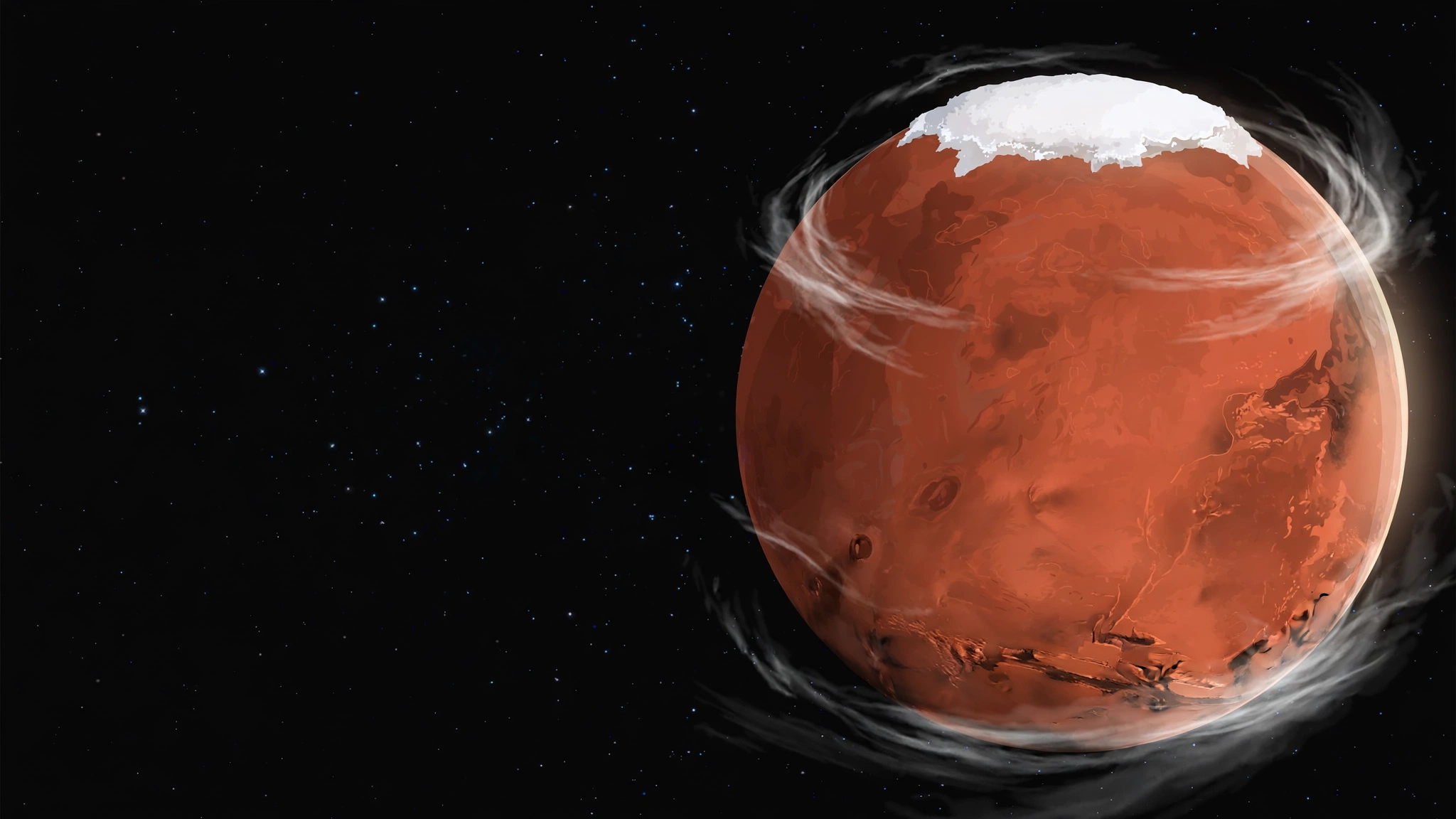
The stunning image that accompanies the European Space Agency’s explanation shows off the Red Planet’s renowned colour from the viewpoint of ESA’s Rosetta mission as it flew past on 24 February 2007, en route to a comet. It is a composite image created by combining near-infrared, green and near-ultraviolet colour information. The polar ice cap at the south pole is particularly bright, and wispy clouds are seen most clearly around the planet’s curved horizons. Even in that scientific image, made from light our eyes cannot see in the same way, the message is the same: a red world, with bright ice and thin clouds at its edges.
The Old Story: Dry Rust From A Dry Planet
For many years, scientists told a tidy story about Martian rust. Mars today has almost no liquid water on its surface, so its rusty red minerals were thought to arise from dry iron oxides present in the dust, such as hematite. In that story, Mars rusted slowly, in dry conditions, over enormous stretches of time, without needing much water at all. The rust was a product of a dry planet, and its redness told us little about Mars’s past climate, beyond the fact that iron was present in the rocks.
The tidy story made sense, because Mars today is cold, dry, and thin-aired. Liquid water cannot sit on its surface for long: it would freeze or evaporate quickly in the low pressure and freezing temperatures. If rust needed liquid water, how could a dry planet rust so thoroughly? The answer, in the old story, was that it did not need much water. Dry chemical processes, over billions of years, could produce dry rust, and the hematite in the dust was the evidence.
What The Old Story Got Right
That story was not wrong about the ingredients. Iron oxide is indeed the colouring agent, and hematite is indeed present. But new research, published in February 2025, has shown that the rusty dust has a much wetter history than previously thought, and the wetter history changes what Mars’s colour tells us about the planet’s past.
The New Finding: Rust That Needed Water
Exciting new research, published in February 2025, has shown that the rusty dust has a much wetter history than previously thought. Because of the absence of liquid water on Mars’s surface today, its rusty red minerals were thought to arise from dry iron oxides present in the dust, such as hematite. However, new analysis of spacecraft observations in combination with novel laboratory techniques suggests that Mars’s red colour is better matched by iron oxides containing water, known as ferrihydrite.
Ferrihydrite typically forms quickly in the presence of cool water, and so must have formed early on ancient Mars when the planet was still wet. It has remained stable under present day conditions on Mars. That sentence carries a large claim in a small space. If the dust that colours the whole planet is ferrihydrite, then the rust formed when Mars had cool, liquid water on its surface, in its early history, billions of years ago. The redness we see today is therefore a fossil of wetness: a colour created in water, preserved in dust, long after the water vanished.
The finding does not mean Mars is wet today, or that the old dry oxides are absent. It means the best match for the dust’s colour and chemistry is a water-bearing rust, formed early and preserved ever since. Mars’s colour is no longer just a description of its soil. It is evidence about its climate, pointing to a time when the planet was warmer and wetter than it is now, when rivers and lakes may have shaped the landscapes that rovers photograph today as dry valleys and ancient lake beds.
How Dust Painted A Whole Planet Red
Forming rust is only half the story. The other half is spreading it. Mars is a windy planet, with a thin atmosphere that can still lift enormous quantities of fine dust. Over billions of years, rusty material has been eroded down into dust and spread all around the planet by winds, a process that continues today. Dust storms, some of them large enough to wrap the whole planet in a haze, pick up the fine, rusty powder and drop it somewhere else, smoothing out differences and painting new surfaces in the same colour.
That is why Mars looks red from every angle, in every season, and why its colour changes subtly with the dust in its air. When a global dust storm fills the sky, the planet looks redder and hazier from telescopes on Earth, because the dust in the air adds to the dust on the ground. When the air clears, the surface colour stands out more sharply, with dark patches where wind has swept dust away from darker rock beneath, and bright patches where dust has settled thickly. The planet’s colour is not painted on. It is weathered on, grain by grain, storm by storm, over geological time.
Why Mars Looks Red Everywhere
The dust also explains why Mars looks red even where the rocks underneath are different. A rover can scrape away the dust and find rock of another shade beneath, but the wind soon covers it again. On a planet with no rain to wash surfaces clean and no plants to hold soil in place, dust wins. Every rock, every hill, and every plain ends up wearing the same rusty coat, and from space, the coat is all we see.
Why Earth Is Not Red All Over
Earth has iron too, and Earth has rust. Why, then, is Earth blue and green from space, not red? The answer is water, life, and movement. Earth’s oceans cover most of the surface, and water absorbs and reflects light in blues and greens that overwhelm any red soil beneath. Forests and grasslands cover much of the land, hiding the soil under green. Ice caps cover the poles in white. Cities, clouds, and seasons add more colours. Earth’s rust exists, in deserts and cliffs, but it is only one voice in a chorus.
Mars has no such chorus. It has no oceans to hide its soil, no forests to cover it, and only small ice caps at its poles, bright white against the red, as in the Rosetta image. Its thin, dusty air often glows pink, adding to the redness rather than hiding it. The whole visible planet is, essentially, its soil, and its soil is rust. That is why a planet with the same basic ingredient, iron, looks so different from Earth: on Earth, rust is a detail. On Mars, rust is the landscape.
There is a lesson in that contrast for how scientists read planets. Colour is data. A planet’s colour, seen from far away, can tell us about its chemistry, its history, and its climate, long before any spacecraft lands. Mars’s redness told ancient watchers it was different. It told modern scientists it was iron-rich. And now, with ferrihydrite, it is telling them it was once wet. A colour that seemed simple has turned out to be a history book, written in dust.
What The Red Colour Tells Us About Ancient Mars
If ferrihydrite formed quickly in cool water, early on ancient Mars when the planet was still wet, then Mars’s redness is evidence of a lost climate. Early Mars must have had liquid water at or near its surface, long enough and cool enough for water-bearing rust to form in large quantities, before the planet dried out and the rust was preserved in dust. That fits with other evidence from orbiters and rovers: dry river valleys, lake beds, minerals that form in water, and rocks shaped by flowing liquid. The colour and the geology are telling the same story, from different directions.
This does not prove that Mars was warm and Earth-like, or that life existed there. It proves that water was present and chemically active in the planet’s early history, in a way that left a mark on the dust that still colours the whole world. For scientists searching for signs of past life, that matters: life as we know it needs liquid water, and a planet whose dust records a wet past is a planet worth searching. The red colour, once a curiosity, has become a clue in the search for whether Mars was ever habitable, and whether anything ever lived there.
The research also shows how science changes. A tidy story, dry rust on a dry planet, held for years because it fit what was known. New observations, combined with new laboratory techniques, challenged it, and the better match won: a wetter rust, formed early, preserved ever since. Mars did not change. Our understanding did. The planet stayed red throughout, patiently waiting for us to read its colour correctly.
You may also like
Frequently Asked Questions
Why is Mars red? Mars is red because its dust is mostly rust. Iron bound up in the chemistry of Mars’s rocks reacted with water and oxygen in some form, forming iron oxide, just like everyday rust forms on Earth. Over billions of years this rusty material was eroded into dust and spread all around the planet by winds, coating the surface in the same reddish powder, which is why Mars looks red from space and glows red in the night sky.
What is ferrihydrite and why does it matter? Ferrihydrite is an iron oxide containing water, and new research published in February 2025 suggests Mars’s red colour is better matched by ferrihydrite than by dry iron oxides such as hematite. Ferrihydrite typically forms quickly in the presence of cool water, so it must have formed early on ancient Mars when the planet was still wet, and it has remained stable under present day conditions. The finding means the rusty dust has a much wetter history than previously thought, and Mars’s colour is evidence of a time when the planet had liquid water.
Why did the Romans call Mars the god of war? The Romans named Mars for their god of war because its colour was reminiscent of blood. Mars glows steady and orange-red in the night sky, unlike the white stars around it, and that blood-like colour seemed warlike to ancient watchers. The Egyptians called it Her Desher, meaning the red one, a simpler name that described exactly what they saw, and the nickname Red Planet has lasted ever since.
Is Mars red everywhere? Almost everywhere we can see, yes, because wind has spread rusty dust all around the planet over billions of years, a process that continues today. Dust storms pick up the fine, rusty powder and drop it somewhere else, painting new surfaces in the same colour, and there are no oceans or forests to hide the soil. The polar ice caps stand out bright white against the red, and dark patches appear where wind has swept dust away from darker rock beneath, but the dominant colour, from space and from the ground, is rust red.
Does the red colour mean Mars has water now? No. The red colour is evidence of water in Mars’s early history, not of water today. Ferrihydrite must have formed early on ancient Mars when the planet was still wet, and it has remained stable under present day conditions, long after the surface dried out. Mars today has almost no liquid water on its surface, but its dust preserves the chemical record of a wetter past, which is why scientists study the colour as a clue to the planet’s climate history.
Sources
- European Space Agency, “Why is Mars red?”: https://www.esa.int/ESA_Multimedia/Images/2025/02/Why_is_Mars_red