How Long Mars Trips Take
In this post
- The Distance Is Not Fixed
- The Distance For Human Missions
- The Launch Window Opens About Every Two Years
- Why Mars Missions Cluster Together
- Aim Where Mars Will Be, Not Where It Is
- Why Seven To Eight Months, Not Faster
- Arriving Too Fast Is Dangerous
- Landing Is A Whole Other Challenge
- What Changes When People Are On Board
- The Journey In One Picture
- You may also like
If you want to send a spacecraft all the way to Mars, first you will need a fast rocket to escape the pull of Earth’s gravity. The heavier your spacecraft, the more powerful your rocket needs to be to lift off. That is the first problem, and it is the one most people picture. But the harder problems come after launch: when to leave, how far to travel, and where to aim. Mars is not waiting where you left it. It is racing around the Sun on its own orbit, and your spacecraft must meet it there, months later, after a journey of hundreds of millions of miles.
The total trip is 300 million miles. If all goes well, you will get to the Red Planet in about seven or eight months. That is the short answer NASA’s Jet Propulsion Laboratory gives in its “Mars in a Minute” guide: seven or eight months, for a spacecraft, travelling the long way round. This post explains why the trip takes that long, why you cannot simply leave whenever you like, why aiming is harder than it sounds, and why carrying people, rather than robots, makes the journey far longer than the flight itself.
The Distance Is Not Fixed
The first surprise is that the distance to Mars is not one number. Mars and Earth orbit the Sun at different speeds and distances, so sometimes they are really far apart, and other times they come closer together. When the two planets are on the same side of the Sun, the gap is at its smallest. When they are on opposite sides, with the Sun between them, the gap is at its largest, and a direct trip would be far longer and far harder.
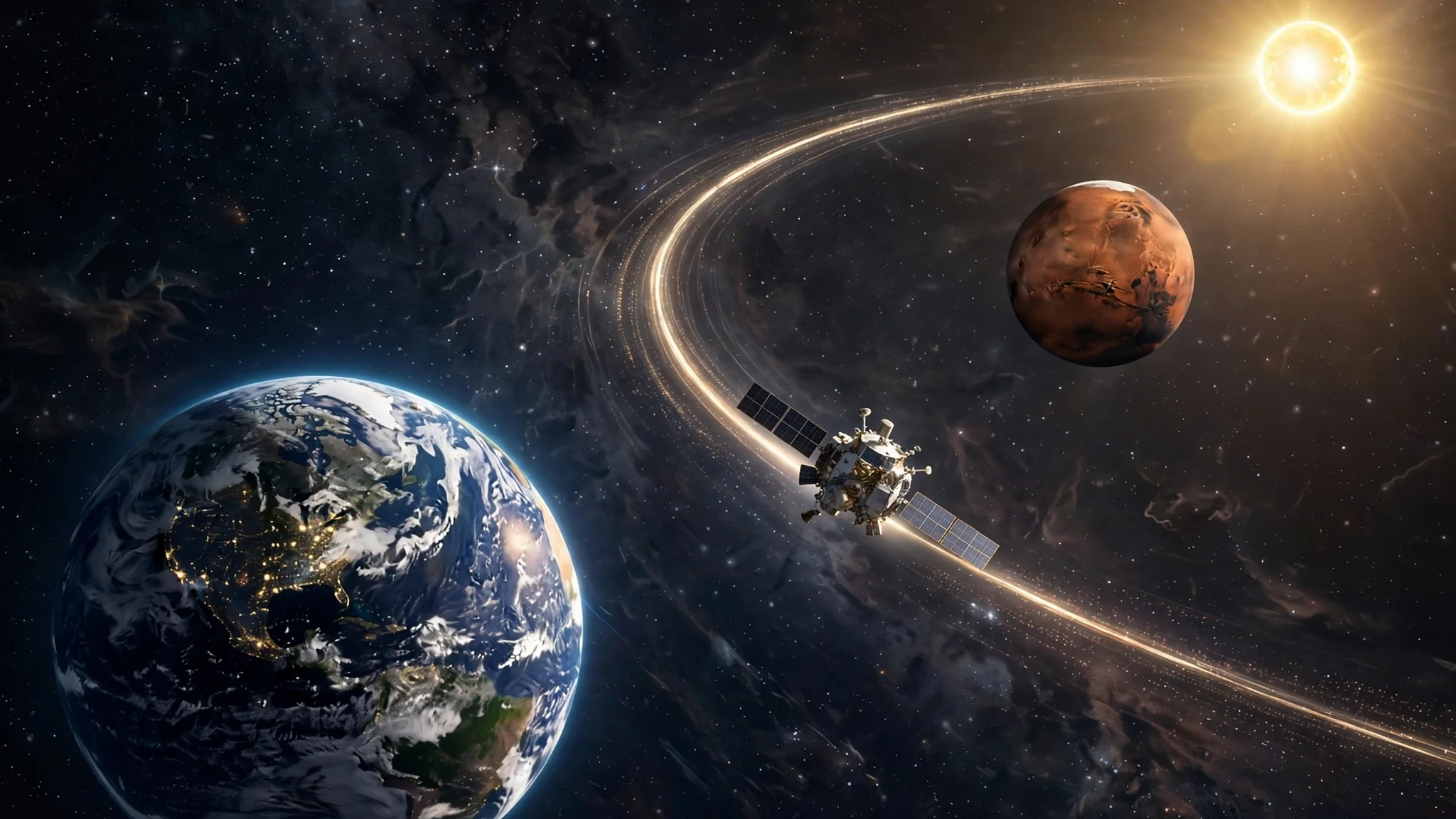
A spacecraft does not fly in a straight line from Earth to Mars, like a car driving down a road. It follows a curved path around the Sun, falling toward its target while the target moves. The shortest useful path is a long, curving arc, and the length of that arc depends on where the planets are when you leave and where they will be when you arrive. That is why journey times are quoted as a range, about seven to eight months, rather than a single exact figure. The exact length depends on the positions of the planets, the power of the rocket, and the weight of the spacecraft.
The Distance For Human Missions
For human missions, the same range appears in guides for the public: about seven to nine months one way, with the exact length depending on where Earth and Mars are in their orbits at launch. The difference between seven and nine months is not a rounding error. It is the difference between a favourable alignment and a less favourable one, and between a light spacecraft and a heavy one carrying people, supplies, and landing equipment.
The Launch Window Opens About Every Two Years
The second surprise is that you cannot leave whenever you like. About every two years, the two planets are in perfect positions to get to Mars with the least amount of rocket fuel. That matters enormously, because fuel is weight, and weight is the enemy of space travel. Every extra kilogram of fuel needs more rocket to lift it, and more rocket needs more fuel, in a spiral that quickly makes a mission impossible. Leaving at the right time, when the planets are aligned, is the difference between a mission that can fly and one that cannot.
The alignment works like this. Earth moves around the Sun faster than Mars, because it is closer to the Sun and its orbit is smaller. Roughly every 26 months, Earth catches up with Mars in a way that lets a spacecraft leave Earth, swing out on a curving path, and arrive at Mars just as Mars reaches the meeting point. Astronauts have to leave when the two planets are lined up favourably, which only happens about every 26 months. Miss that window, and the next one is more than two years away, which is why Mars missions are planned years in advance and launched on strict schedules.
Why Mars Missions Cluster Together
This is also why Mars missions cluster in time. When a launch window opens, several countries and companies may launch within weeks of each other, all aiming for the same arrival season months later. When the window closes, the launch pads go quiet for Mars, and attention turns to other targets. The planets set the timetable, and human plans must fit around it.
Aim Where Mars Will Be, Not Where It Is
The third problem is aiming, and it is the one that most surprises people. You cannot shoot for where Mars is at launch time. You have to aim for where it will be when you get there. NASA’s guide puts it in sporting terms: it is a lot like how a quarterback passes a football. The quarterback does not throw the ball at the receiver standing still. He throws it to the empty space where the receiver will be running when the ball arrives. A Mars spacecraft does the same, on a scale of hundreds of millions of miles.
Imagine Mars as a runner on a circular track, moving steadily around the Sun. Your spacecraft is a ball thrown from the inside of the track. If you throw directly at the runner’s present position, the runner will be long gone by the time the ball arrives, and the ball will sail into empty space. You must throw ahead, into the runner’s future path, judging speed, distance, and timing so that ball and runner arrive at the same point at the same moment. A small error in angle at launch becomes a huge error after 300 million miles, which is why spacecraft need course corrections along the way.
You may need a few thrusts to correct your direction along the way so you do not miss Mars. Small bursts from the spacecraft’s engines, made days or weeks into the flight, nudge the path back toward the target. Each correction uses a little fuel, so navigators plan them carefully, measuring the spacecraft’s position against the stars and against radio signals from Earth, and adjusting only as much as needed. The journey is not a single throw. It is a long, slow steering, across months of empty space, toward a moving target.
Why Seven To Eight Months, Not Faster
Why not simply fly faster and arrive sooner? The answer is energy. A spacecraft travelling to Mars is not powered like a car, with an engine running all the way. It is launched by a rocket, given a great push, and then coasts, falling around the Sun under gravity, with only small corrections. Going faster would need a far more powerful rocket, far more fuel, and a far heavier spacecraft, and the spiral of weight and fuel quickly becomes impractical with today’s rockets.
The seven-to-eight-month journey is therefore a compromise: fast enough to be practical, slow enough to be affordable in fuel. It is the time a coasting spacecraft needs to swing out from Earth’s orbit to Mars’s orbit, arriving with the right speed and direction to be captured by Mars’s gravity or to enter its atmosphere. A more powerful future rocket might shorten the trip, but it would need to carry far more energy, and that energy must be launched from Earth in the first place, which is the hardest part of the whole mission.
Arriving Too Fast Is Dangerous
There is another reason not to rush. Arriving at Mars too fast is dangerous. A spacecraft arriving at high speed must slow down, either by firing engines or by using Mars’s thin atmosphere to brake, and slowing down from interplanetary speeds is one of the riskiest moments in any mission. Arriving at the right speed, after a seven-to-eight-month coast, gives the spacecraft the best chance of slowing safely, whether it plans to orbit Mars or to land on it.
Landing Is A Whole Other Challenge
Getting to Mars is only half the mission. If you actually want to land on Mars, that is a whole other challenge, as NASA’s guide warns. A spacecraft arriving from deep space must slow from thousands of kilometres per hour to a gentle touchdown, in an atmosphere too thin to slow it much by parachute alone, and too thick to ignore. It must survive heating as it enters the atmosphere, deploy parachutes or rockets at exactly the right moments, and land on a surface of rocks, dust, and slopes, with no pilot on board to react in real time, because radio signals take minutes to travel between Earth and Mars.
Robotic missions have solved this problem many times, with a mixture of heat shields, parachutes, airbags, rockets, and, in recent missions, cranes that lower rovers to the surface on cables. Each landing is still a tense, automated sequence, often called “seven minutes of terror” by engineers, because the spacecraft must do everything itself, with no help from Earth, in the minutes between hitting the atmosphere and touching the ground. A human landing will be harder still, because the spacecraft will be far heavier, carrying people, habitats, and supplies, and every kilogram makes slowing down harder.
Orbiting Mars is easier than landing, but it is still not simple. A spacecraft must arrive at the right speed to be captured by Mars’s gravity without flying past it or crashing into it, and it must carry enough fuel to adjust its orbit once it arrives. For missions that plan to return to Earth, the spacecraft must also carry the fuel for the journey home, or make it on Mars, which adds weight and complexity to the whole design.
What Changes When People Are On Board
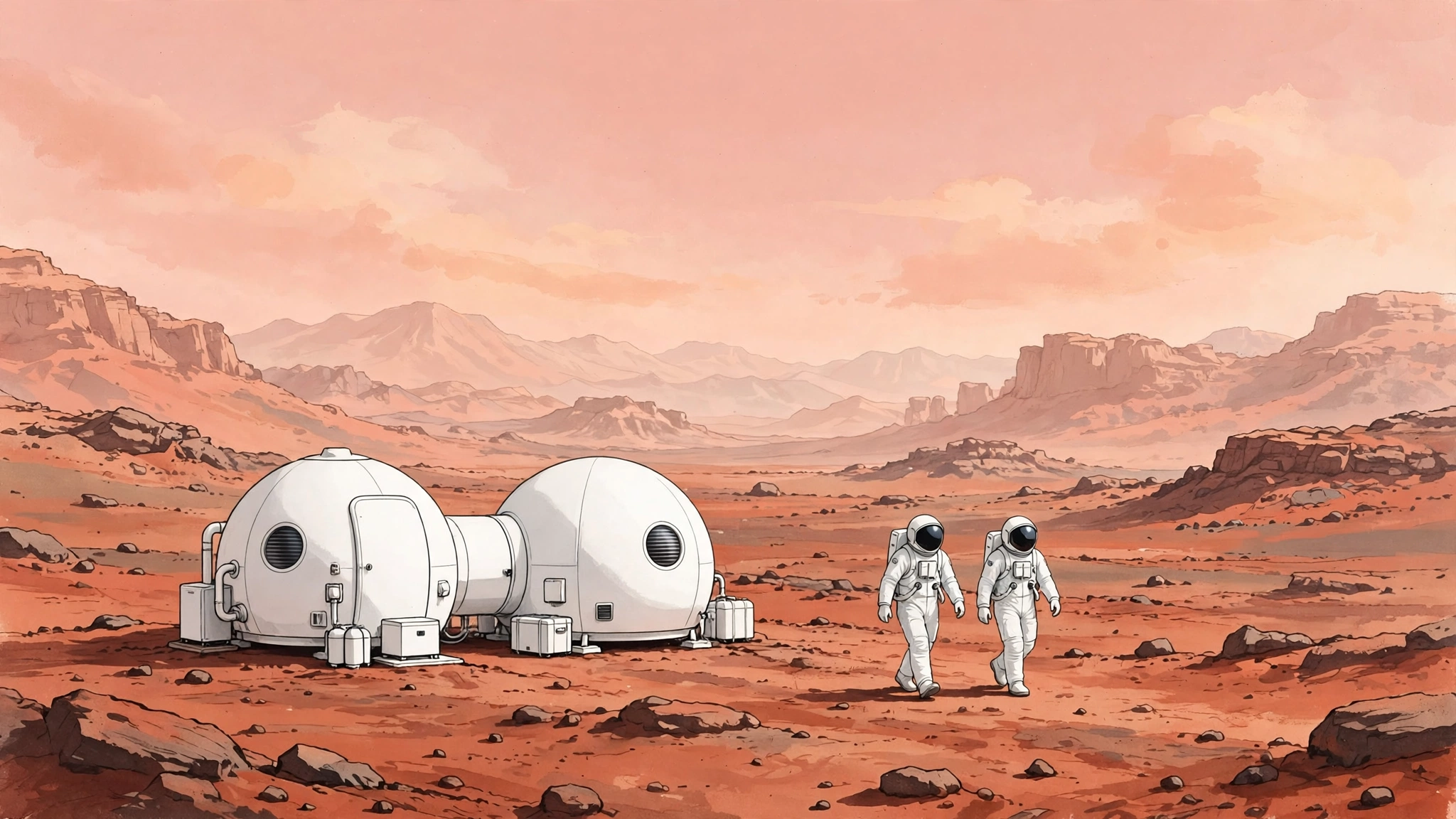
For robots, seven to eight months in space is a technical problem. For people, it is a human problem as well. Astronauts on a Mars flight would spend months in a small spacecraft, far from Earth, exposed to radiation from the Sun and from deep space, in low gravity that weakens bones and muscles, with no quick way home if something goes wrong. The trip itself takes about seven to nine months one way, and astronauts would have to wait on Mars another 18 months for Earth and Mars to line up again before flying home. So the very first crewed Mars mission would last around three years from launch to return.
That three-year figure changes everything about planning. Food, water, air, medicine, spare parts, and psychological support must last for years, not months. The spacecraft must shield its crew from radiation, recycle air and water, and provide exercise to slow the loss of bone and muscle. The crew must be able to repair anything that breaks, treat any illness that occurs, and cope with isolation, delay in communications, and the knowledge that Earth is a small, distant point of light. A robotic mission can be lost, and the loss is painful but survivable. A crewed mission cannot be lost, and that difference drives every design decision.
It is also why human Mars missions are planned for the 2030s, after more time on the Moon at upcoming bases, rather than immediately. The Moon is three days away, close enough for rescue and resupply, and a good place to test habitats, life support, and operations before committing to a three-year Mars voyage. Mars is the destination. The Moon is the rehearsal.
The Journey In One Picture
Put it all together, and the Mars trip looks like this. A powerful rocket lifts a spacecraft off Earth, escaping Earth’s gravity. The spacecraft coasts for seven to eight months, covering 300 million miles on a curving path around the Sun, with small corrections along the way. It aims not at Mars as it was at launch, but at Mars as it will be on arrival, like a quarterback passing to a moving receiver. It leaves only when the planets align, about every two years, to use the least fuel. It arrives, slows, and either orbits or lands, facing the separate challenge of touching down safely. And if people are aboard, the crew waits on Mars for about 18 months before the planets align again for the journey home, making the whole mission last around three years.
That is a long time, a long way, and a hard problem. It is also a solved problem, in the sense that robots have done it, repeatedly, and each successful landing has taught engineers more about how to do it again, more safely, with heavier loads. The question is no longer whether we can reach Mars. It is how we carry people there, keep them alive, and bring them home, and the answer to that question is being worked out, one launch window at a time.
You may also like
Frequently Asked Questions
How long does it take to get to Mars? About seven to eight months for a spacecraft, if all goes well. The total trip is 300 million miles, and the exact length depends on where Earth and Mars are in their orbits at launch, the power of the rocket, and the weight of the spacecraft. For human missions, guides give a range of about seven to nine months one way, with the exact length depending on the alignment of the planets at launch.
Why can spacecraft only launch to Mars every two years? Because Mars and Earth orbit the Sun at different speeds and distances, and only about every two years are the two planets in perfect positions to get to Mars with the least amount of rocket fuel. Astronauts have to leave when the two planets are lined up favourably, which only happens about every 26 months, and missing that window means waiting more than two years for the next one. Fuel is weight, and leaving at the right time is the difference between a mission that can fly and one that cannot.
Why do spacecraft aim ahead of Mars? Because Mars is moving. You cannot shoot for where Mars is at launch time: you have to aim for where it will be when you get there, like a quarterback passing a football to the empty space where the receiver will be running when the ball arrives. A small error in angle at launch becomes a huge error after 300 million miles, which is why spacecraft also need a few thrusts to correct their direction along the way so they do not miss Mars.
Is landing on Mars harder than getting there? Yes, landing is a whole other challenge. A spacecraft arriving from deep space must slow from thousands of kilometres per hour to a gentle touchdown, in an atmosphere too thin to slow it much by parachute alone, and it must do everything itself, with no help from Earth, because radio signals take minutes to travel between the planets. Robotic missions have solved this with heat shields, parachutes, rockets, and cranes, but a human landing will be harder, because the spacecraft will be far heavier.
How long would a human Mars mission last? Around three years from launch to return. The trip itself takes about seven to nine months one way, and astronauts would have to wait on Mars another 18 months for Earth and Mars to line up again before flying home. That is why human missions need food, water, air, medicine, spare parts, and psychological support for years, not months, and why NASA is targeting the 2030s, after more time on the Moon at upcoming bases, for its first crewed Mars mission.
Sources
- NASA Jet Propulsion Laboratory, “Mars in a Minute: How Do You Get to Mars?”: https://www.jpl.nasa.gov/edu/resources/video/mars-in-a-minute-how-do-you-get-to-mars/
- Planets for Kids, “Could Anyone Live on Mars?”: https://www.planetsforkids.org/planet/mars/life-on-mars.html