What Happens Inside a Black Hole
In this post
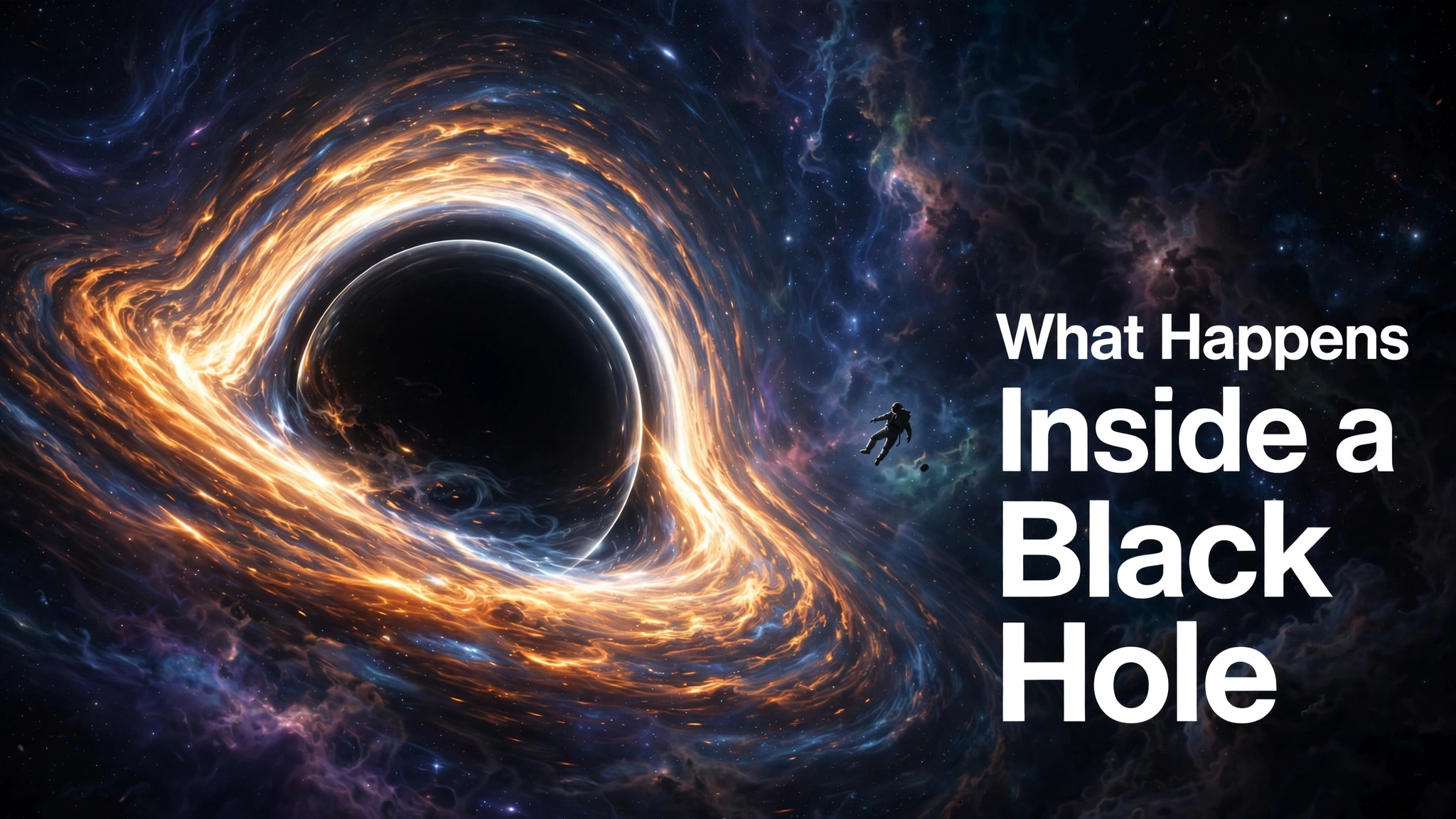
A black hole is a region of space where gravity is so strong that nothing, not even light, can escape from inside a boundary called the event horizon. That sentence is easy to write and hard to imagine. It means that everything we know about the universe, light, signals, and escape, breaks down at that boundary. What happens inside is one of the deepest questions in physics, and the honest answer has two parts: general relativity, Einstein’s theory of gravity, predicts a clear picture up to a point, and then it breaks down at a place called the singularity, where quantum physics must take over and we do not yet have a complete theory. This guide explains what is well established, what is inferred, and what remains unknown, without pretending that speculation is fact.
Black holes form in several ways. The most common are stellar black holes, formed when a massive star collapses at the end of its life, after it has exhausted its nuclear fuel and can no longer resist gravity. The core collapses, and if it is massive enough, no known force can stop it. Supermassive black holes, millions or billions of times the Sun’s mass, sit at the centres of most large galaxies, including our Milky Way, whose central black hole is called Sagittarius A*. How supermassive black holes grew so large, so early in the universe, is still debated, with theories involving direct collapse of gas clouds, mergers, and rapid accretion. Intermediate and primordial black holes are also hypothesised, but stellar and supermassive types are the best established.
The Event Horizon: The Point of No Return
The event horizon is not a physical surface, like the ground or a wall. It is a mathematical boundary in spacetime: once you cross it, all future paths lead inward, toward the centre, in the same way that, on Earth, all paths from the North Pole lead south, except here the direction is in time as much as in space. Outside the horizon, you can, in principle, escape by moving fast enough, though near the horizon that speed approaches the speed of light. Inside, escape would require moving faster than light, which relativity forbids. That is why nothing, not even light, escapes: light inside the horizon is still moving at light speed, but its path curves inward.
For a non-rotating, uncharged black hole, the simplest model, the event horizon is a sphere whose radius, the Schwarzschild radius, depends only on mass. For a black hole with the Sun’s mass, that radius would be about 3 kilometres, though the Sun itself will never become a black hole, because it is not massive enough. For Sagittarius A*, with about four million solar masses, the radius is about 12 million kilometres, roughly a fifth of the distance from Mercury to the Sun in scale terms, though exact figures depend on mass estimates. For a stellar black hole of ten solar masses, the radius is about 30 kilometres. These numbers show a counterintuitive fact: larger black holes have lower average density at the horizon, because volume grows faster than radius, and tidal forces at the horizon are weaker for supermassive black holes than for small ones. That difference matters for survival, as explained below.
An outside observer and an infalling observer disagree about what happens at the horizon, and both are right in their own frame, a consequence of relativity. To a distant observer, an object falling toward the horizon appears to slow down, redden, and freeze at the horizon, never quite crossing it, because light from the object takes ever longer to escape the deep gravitational field. This is gravitational time dilation and redshift. To the falling observer, crossing the horizon is, for a large black hole, unremarkable: no flash, no wall, no sudden jolt, just continued falling, with the horizon behind them. The two views do not contradict each other; they describe the same event from different spacetime perspectives, and reconciling them is one of the subtleties that makes black holes so fascinating and so confusing.
Spaghettification: Stretched by Tidal Forces
As you fall toward a black hole, gravity pulls harder on the part of your body closer to the centre than on the part farther away. That difference is called a tidal force, the same effect that creates ocean tides on Earth from the Moon’s gravity, but enormously stronger near a black hole. The result is stretching along the direction of fall and compression sideways, an effect vividly named spaghettification. For a small, stellar-mass black hole, tidal forces become lethal well before the horizon: a human would be stretched and torn apart long before crossing it. For a supermassive black hole, tidal forces at the horizon are gentler, because the horizon is farther from the centre and gravity changes more gradually across a body. A human falling into a supermassive black hole might, in theory, cross the horizon intact, only to be spaghettified later, closer to the centre, where tidal forces grow without limit in classical theory.
Spaghettification is not only a human concern; it happens to stars as well. When a star wanders too close to a supermassive black hole, tidal forces can tear it apart in a tidal disruption event, producing a bright flare as its material is heated and accreted. Astronomers have observed such flares, which provide evidence for black holes and a way to study them. The shredded star does not fall in whole; it is stretched into a stream, part of which escapes, part of which spirals into the black hole, forming a hot accretion disk. That disk, glowing in X-rays and visible light, is often how we detect black holes that would otherwise be invisible, since black holes themselves emit no light from inside the horizon.
Inside the horizon, tidal forces continue to increase as you approach the centre, in the classical picture. The stretching becomes infinite at the singularity, which is why classical physics breaks down there. Whether a real, physical object could survive to that point is moot, because it would have been destroyed long before by tidal forces, radiation, and collisions with infalling material. The question “could you survive inside a black hole?” therefore has a nuanced answer: for a supermassive black hole, you might cross the horizon alive, but you would not survive to the centre, and you could never return to report what you saw. Survival past the horizon is not survival in any useful sense, because the horizon is a one-way boundary.
The Singularity: Where Physics Breaks Down
At the centre of a non-rotating black hole, general relativity predicts a singularity, a point of infinite density and infinite spacetime curvature, where the equations cease to make sense. That prediction should not be taken literally as “there is a point of infinite density sitting there.” It is a signal that the theory has reached its limit. Physicists expect that a quantum theory of gravity, which we do not yet have in complete form, will replace the singularity with something finite, perhaps a highly curved region, a bounce, or a new state of spacetime. Candidate theories, such as string theory and loop quantum gravity, offer different pictures, but none is experimentally confirmed for black hole interiors, because we cannot observe inside a horizon and cannot create comparable conditions in a laboratory.
For rotating black holes, which are the realistic case, since stars rotate and black holes retain angular momentum, the singularity is predicted to be a ring, not a point, and the interior structure is more complex, with additional horizons. Some solutions suggest paths that avoid the ring singularity, at least mathematically, but whether those paths are physically traversable is highly doubtful, because they would require passing through regions of extreme instability and would likely be destroyed by infalling matter and radiation. Popular ideas about black holes as portals to other universes, wormholes, or time machines come from mathematical solutions to Einstein’s equations, not from observations. Those solutions are interesting, but they assume idealised, empty, eternal black holes that do not exist in the real universe, where black holes form from collapsing matter and are surrounded by material.
The singularity is therefore best understood as a placeholder: “here, our current theory stops.” That honesty is important. A guide that claims to know exactly what is at the centre, a new universe, a firewall, a bounce, is presenting a hypothesis as fact. The scientific position is that we do not know, and that the answer will require a theory that unifies general relativity and quantum mechanics, one of the greatest unsolved problems in physics. Black holes are valuable precisely because they mark the boundary of our knowledge, and studying them, through gravitational waves, accretion, and Hawking radiation, may help us cross that boundary.
Time, Light, and the View From Inside
Inside a black hole, the roles of space and time, in a sense, swap, according to the mathematics of general relativity. Outside, you can move freely in space but must move forward in time. Inside, the radial direction toward the centre becomes timelike: moving toward the centre is as unavoidable as moving toward the future, and the singularity lies in your future, not in a spatial direction you could avoid by steering sideways. That is why escape is impossible, not because a force holds you back, but because spacetime itself is structured so that all futures point inward. This is difficult to visualise, because our everyday intuition separates space and time, but in strong gravity, they are woven together in a way that makes the interior fundamentally different from the exterior.
Light inside the horizon behaves accordingly. A flashlight pointed outward from inside would still have its light fall inward, because the light cones, the set of possible paths for light, are tilted toward the centre. An infalling observer would still see light from outside, falling in behind them, and would see the outside universe in a distorted, blueshifted form, but they could not send a signal out. Time dilation also means that, from the infalling perspective, the outside universe appears to speed up, though the exact view depends on the black hole’s rotation and the observer’s trajectory. These effects are predicted by theory, not observed directly, because no observer has crossed a horizon and returned, and by definition, none can.
Hawking radiation adds another layer. Stephen Hawking showed in the 1970s that quantum effects near the horizon should cause black holes to emit a faint thermal radiation, and therefore to slowly lose mass and eventually evaporate, over timescales far longer than the age of the universe for stellar and supermassive black holes. Hawking radiation, if confirmed, would mean black holes are not perfectly black, and it raises the famous information paradox: what happens to information about what fell in, if the black hole evaporates into featureless radiation? Proposed resolutions involve quantum entanglement, firewalls, or information encoded in radiation, but the paradox remains unresolved. It is a reminder that black hole interiors touch on the foundations of physics, not only on astronomy.
How We Know Black Holes Exist
We cannot see a black hole directly, by definition, but we can see its effects, and those effects are now overwhelming. Stars orbiting Sagittarius A* move at speeds that require a massive, compact object at the centre, a conclusion supported by decades of tracking by telescopes. The Event Horizon Telescope, a global network of radio telescopes, produced the first image of a black hole’s shadow in 2019, for the supermassive black hole in galaxy M87, and later for Sagittarius A*. The image shows a bright ring of hot gas around a dark shadow, matching predictions from general relativity. Gravitational wave detectors, LIGO and Virgo, have detected ripples in spacetime from merging black holes, confirming their existence, masses, and dynamics in a completely independent way.
Accretion disks, jets, and X-ray emissions provide further evidence. Matter falling toward a black hole heats to millions of degrees and emits X-rays before crossing the horizon. Jets of particles, launched at near light speed from near the poles, can extend for thousands of light-years and shape entire galaxies. These phenomena are observed across the universe, in binary systems with stellar black holes and in active galactic nuclei powered by supermassive black holes. Together, they form a convergent case: different methods, different wavelengths, different black holes, all pointing to the same objects predicted by theory. That convergence is why astronomers are confident black holes exist, even though their interiors remain unobserved.
Wormholes, White Holes, and Other Speculative Ideas
Black holes inspire speculation about wormholes, white holes, and travel to other universes, and it is worth separating mathematical possibility from physical likelihood. Einstein’s equations allow solutions that connect two regions of spacetime, called Einstein-Rosen bridges or wormholes, but the simplest versions are not traversable: they collapse before anything can pass through, and stabilising them would require exotic matter with negative energy, which has not been observed in the required form. White holes, the time-reverse of black holes, which expel matter but cannot be entered, are mathematically possible but have never been observed, and they would be unstable in a real universe filled with matter and radiation. These ideas are valuable as theoretical tools, because they test the limits of general relativity, but they should not be presented as travel options or as established features of real black holes.
Similarly, ideas about using black holes for time travel, energy extraction, or communication rely on idealised conditions that do not match real, messy black holes surrounded by accretion disks, magnetic fields, and infalling matter. The Penrose process, which in theory allows energy extraction from a rotating black hole, is physically plausible in principle, but it requires precise conditions and technology far beyond anything humans possess, and it does not offer a way inside and out. Science fiction uses these ideas creatively, and that creativity can inspire real research, but readers should keep a clear label: speculative theory, not observed fact. The observed facts, orbits, disks, jets, gravitational waves, and shadow images, are already extraordinary enough without adding portals.
My Take:
My view is that black holes are humbling in a way few other objects are, because they expose the limits of both our intuition and our theories. Intuition says: if you fall in, you should be able to climb out, or at least look out. Physics says: no, spacetime itself prevents it. Intuition says: there must be something solid at the centre. Physics says: our equations break down there, and we do not know what replaces them. That double humility, about the world and about our knowledge, is valuable. It teaches us to trust mathematics and observation over common sense when they conflict, while also admitting that mathematics, pushed to its limit, signals its own incompleteness. A field that can do both, make precise predictions confirmed by images and gravitational waves, and admit ignorance at the centre, deserves more trust than a field that claims certainty everywhere.
I also think black holes are a useful antidote to the idea that science has explained everything. Popular culture often presents black holes as portals, time machines, or gateways, as if we had solved them. We have not. We have solved the exterior, the orbits, the disks, the waves, with remarkable precision, but the interior remains a frontier. That frontier is not a failure; it is an invitation. The next breakthrough in physics, a quantum theory of gravity, may well come from trying to understand what happens inside a black hole, or what happens to information when one evaporates. If that breakthrough comes, it will not only explain black holes; it will change our understanding of space, time, and matter everywhere. The most interesting places in science are often the places where theories break, and black holes are the most dramatic breaking point we know.
There is also a human lesson in the event horizon. It is a boundary beyond which communication is impossible, not because of distance, but because of structure. That is a stark image for other one-way boundaries in life: decisions that cannot be undone, words that cannot be unsaid, damage that cannot be reversed. A black hole makes that abstract idea concrete and absolute. It reminds us to think carefully before crossing thresholds that have no return, whether in personal life, in environmental damage, or in technology. Not every threshold is an event horizon, and most mistakes can be repaired, but some cannot, and recognising which is which, before crossing, is wisdom. Black holes do not teach that wisdom directly, but they give us a vivid metaphor for it, and metaphors, used carefully, help us act more thoughtfully.
Finally, I find black holes strangely hopeful. They are places where stars die, yet their deaths shape galaxies, trigger star formation, and produce the elements and energy that make life possible elsewhere. A black hole is not only an end; it is part of a cycle. Matter falls in, energy radiates out, jets stir gas, and new stars form from that stirred material. The universe recycles, even through its darkest objects. That cycle does not answer what happens inside, and it does not make falling in safe or survivable, but it does place black holes in a larger story: not as cosmic monsters alone, but as engines, regulators, and markers of the limits of knowledge. To study them is to study the universe at its most extreme, and to admit, with wonder rather than fear, that some questions remain open, and that openness is itself a reason to keep looking.
I want to add a caution about science fiction, because it shapes how most people first meet black holes. Films and novels need drama, so they show characters surviving inside, travelling through, or escaping from black holes, often by inventing technology that bypasses physics. That is fine as fiction, and it can inspire real interest, but it should not be mistaken for a prediction. Real black holes, as far as we know, do not offer a safe passage, a shortcut, or a return journey. Enjoy the stories, but keep them separate from the science. The science is already dramatic enough: a region where time and space swap roles, where light cannot escape, where our best theory breaks, and where the next theory may be born. That drama needs no embellishment, and it has the advantage of being true, as far as we can tell, which is rarer and more valuable than any invented escape.
There is also a lesson about how science progresses at its frontiers. Black hole research advanced not by a single breakthrough, but by convergence: theory predicted them, X-ray astronomy found candidates, stellar orbits confirmed mass, gravitational waves confirmed mergers, and radio imaging confirmed shadows. Each method alone was suggestive; together they are compelling. That convergence is a model for how to judge other frontier claims, from new particles to new planets: look for independent lines of evidence that agree, not for a single dramatic result. Black hole interiors lack that convergence, because we have no independent way to observe inside, which is exactly why claims about interiors should be held to a higher standard. When convergence arrives, perhaps through a quantum gravity theory that makes testable predictions elsewhere, we will know more. Until then, the most scientific statement about the interior is also the most honest: we do not know yet, and we are working on it.
A final reflection is about humility in the face of scale. A black hole compresses the mass of millions of suns into a region smaller than a solar system, bends light around itself, and marks a boundary beyond which information cannot return. Contemplating that scale can make human concerns feel small, but I think the right response is not despair, it is perspective. We are small, and yet we have measured these objects, imaged their shadows, and detected their mergers across billions of light-years, using telescopes, detectors, and mathematics built by people on a small planet. That achievement does not make us large, but it does make us capable. We can understand, however incompletely, the most extreme objects in the universe, and we can admit what we do not yet understand. That combination, capability plus humility, is the best attitude science offers, and black holes, more than almost any other object, teach it.
Frequently Asked Questions
What happens if you fall into a black hole? You would be stretched by tidal forces, an effect called spaghettification. For a small black hole this happens before the horizon; for a supermassive black hole you might cross the horizon intact, but you could never escape or return.
What is the event horizon? It is the boundary around a black hole beyond which escape would require faster-than-light travel. It is not a physical surface, but a point of no return in spacetime.
What is at the centre of a black hole? General relativity predicts a singularity, where density and curvature become infinite and the theory breaks down. Physicists expect a quantum theory of gravity to replace this with a finite description, which we do not yet have.
Can anything escape a black hole? Nothing can escape from inside the horizon by classical physics. Hawking radiation, a quantum effect, predicts black holes slowly emit radiation and evaporate over extremely long timescales.
Can you survive falling into a supermassive black hole? You might cross the horizon alive because tidal forces there are weaker, but you would be destroyed closer to the centre and could never escape to report what you saw.
How do we know black holes exist if we cannot see them? We observe stars orbiting them, hot accretion disks, jets, gravitational waves from mergers, and, since 2019, direct images of black hole shadows from the Event Horizon Telescope.