What Is Space Debris and Why Does It Matter in 2027
In this post
- What Counts as Space Debris?
- Where It Comes From: Launches, Explosions and Collisions
- The Kessler Syndrome: When Collisions Breed Collisions
- Why It Matters: Satellites, Astronauts and Everyday Life
- Tracking the Junk: How We Watch Millions of Objects
- Cleaning Up: Nets, Harpoons, Lasers and New Rules
- The Future: More Satellites, More Risk, More Hope
- My Take:
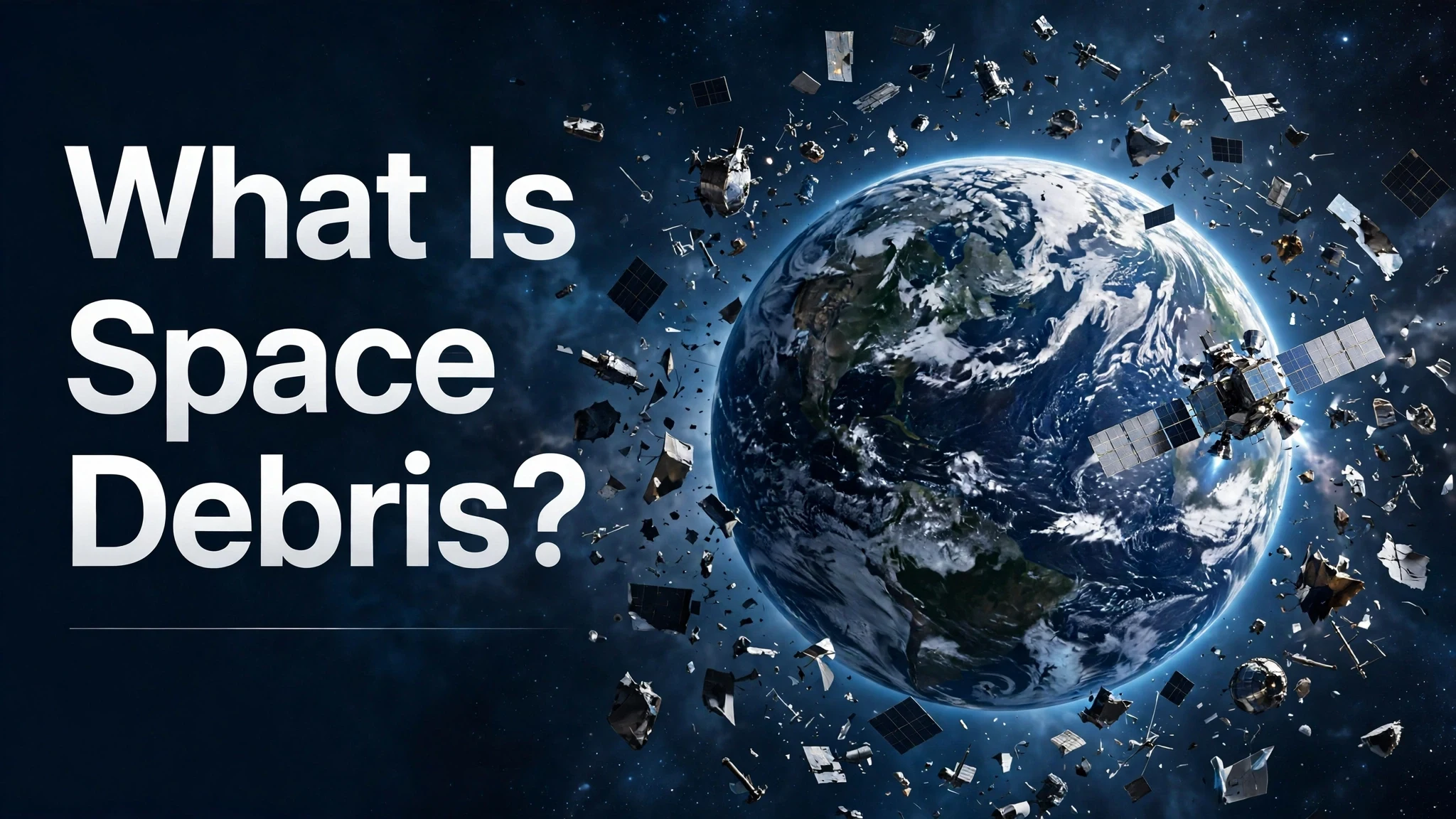
Above your head right now, travelling at twenty-eight thousand kilometres an hour, are millions of pieces of rubbish: dead satellites, spent rocket stages, fragments from collisions, and flecks of paint, each one moving fast enough to punch a hole through a spacecraft. This is space debris, also called space junk, and it is one of the fastest-growing problems in space. It is also one of the least visible. You cannot see it from the ground, it makes no sound, and it does not appear in the news unless something goes wrong. But it is there, it is increasing, and in 2027 it is beginning to affect what we can do in orbit.
The problem has grown because space has become busier. There are now thousands of active satellites, and tens of thousands more have been launched in recent years, many of them part of large constellations that provide internet and communications. Each launch leaves something behind — a rocket stage, a deployment mechanism, a piece of hardware — and each satellite, when it dies, becomes debris itself. Collisions between debris create more debris, and that debris can cause further collisions, in a chain reaction that could, in the worst case, make parts of orbit unusable.
This article explains what space debris is, where it comes from, why it is dangerous, what is being done about it, and what the future holds. It covers the famous Kessler syndrome, the rules that are supposed to prevent the problem from getting worse, and the new technologies being developed to clean up orbit. You do not need to know anything about spaceflight to follow it — only to have looked up at the night sky and wondered what else is up there, besides the stars.
What Counts as Space Debris?
Space debris is any human-made object in orbit around the Earth that is no longer useful. That includes whole dead satellites, the upper stages of rockets, and the fragments created when objects collide or explode. It also includes smaller items: bolts, springs, lens covers, and even a glove lost by an astronaut on a spacewalk, which is still in orbit. The smallest debris — flecks of paint and tiny fragments — are the most numerous, and they are also the hardest to track.
The numbers are sobering. Space agencies track tens of thousands of objects larger than about ten centimetres, and they estimate there are hundreds of thousands of objects larger than a centimetre, and millions larger than a millimetre. A piece of debris only a centimetre across, travelling at orbital speed, carries the energy of a hand grenade. A fleck of paint, moving at that speed, once cracked the window of a space shuttle. Size is not the measure of danger in orbit. Speed is, and everything in orbit is moving very fast.
Most debris is in low Earth orbit, the region a few hundred to a couple of thousand kilometres above the Earth, where the International Space Station and most satellites operate. That is also the region where new satellites are being launched fastest, which is why the problem is getting worse there first. Higher orbits, including the geostationary orbit where communications satellites sit, also have debris, but the density is lower and the objects move more slowly relative to each other. The problem is worst where we use space most, which is a pattern that should be familiar from problems on Earth.
Where It Comes From: Launches, Explosions and Collisions
Debris comes from three main sources. The first is launches: every rocket that puts a satellite into orbit leaves something behind, usually the upper stage that carried the satellite to its final orbit. In the early days of spaceflight, those stages were simply abandoned. Today, many are designed to fall back to Earth and burn up, or to be moved to a safe orbit, but the legacy of decades of launches is still up there.
The second source is explosions. Old satellites and rocket stages that still contain fuel or pressurised tanks can explode, sometimes years after they were abandoned, creating thousands of fragments in a single event. A single explosion can double the number of tracked objects in an orbit. Space agencies now design satellites to vent their remaining fuel at the end of their lives, to prevent this, but the older objects are still a risk.
The third source, and the most worrying, is collisions. In 2009, an active communications satellite collided with a dead Russian satellite, creating thousands of pieces of debris. In 2007, a deliberate destruction of a satellite by a missile created a similar cloud. Each collision creates debris that can cause further collisions, and that is the mechanism behind the most feared outcome of all, which is described in the next section. Collisions are rare, but each one makes the next one more likely, and that is the heart of the problem.
The Kessler Syndrome: When Collisions Breed Collisions
In 1978, a NASA scientist named Donald Kessler described a scenario that now bears his name: a chain reaction in which collisions between debris create more debris, which causes more collisions, until a region of orbit becomes so crowded with fragments that it is unusable. The Kessler syndrome is not a single event but a process, and it does not have a clear beginning. It is a tipping point, after which the debris population grows on its own, even if no new satellites are launched.
Whether we have already passed that tipping point in some orbits is debated. Some scientists think that in the most crowded orbits, the process has already begun, and that the debris will keep increasing even if launches stop. Others think we are close to the tipping point but not past it, and that action now can still prevent it. Either way, the direction is clear: the more objects in orbit, the higher the risk, and the risk is rising as more satellites are launched.
The consequences of a full Kessler syndrome would be serious. The orbits affected would become too dangerous for satellites or for crewed spacecraft, which would mean losing weather forecasting, navigation, communications and Earth observation — the services that modern life depends on. It would also make it much harder to launch new satellites, because they would have to pass through a cloud of debris to reach orbit. The Kessler syndrome is therefore not only a problem for space agencies. It is a problem for everyone who uses a phone, a weather forecast, or a map.
Why It Matters: Satellites, Astronauts and Everyday Life
Space debris matters because it threatens the satellites that modern life depends on. A single collision can destroy a satellite worth hundreds of millions of dollars and the service it provides. A weather satellite lost to debris means worse forecasts. A communications satellite lost means an outage. A navigation satellite lost means less accurate positioning for aircraft, ships and phones. The services are invisible when they work, and their absence would be felt immediately.
It also matters for astronauts. The International Space Station has shielding that can stop small debris, and its orbit is adjusted when a larger object is predicted to come close — a manoeuvre that happens several times a year. But shielding cannot stop everything, and a collision with a larger object would be catastrophic. Astronauts on spacewalks are especially vulnerable, because a suit offers no protection against a fragment moving at orbital speed. The risk is managed, but it is real, and it grows as the debris population grows.
There is also a less obvious cost: the effort and money spent on tracking, avoiding and shielding against debris. Space agencies and companies spend significant resources monitoring tens of thousands of objects, predicting close approaches, and moving satellites out of the way. That is money and time that could be spent on science or on new missions. Debris is, in that sense, a tax on everything we do in space, and the tax is rising.
Tracking the Junk: How We Watch Millions of Objects
Tracking space debris is a major undertaking. Ground-based radar and telescopes monitor objects larger than about ten centimetres in low orbit, and larger objects in higher orbits, and the data is shared by space agencies and, increasingly, by commercial companies. When a tracked object is predicted to come close to a satellite or the space station, a warning is issued, and the satellite’s operators can decide whether to move it. The station performs avoidance manoeuvres several times a year, and satellite operators do the same.
The problem is the objects that cannot be tracked. Fragments smaller than ten centimetres are too small for most radars, yet they are large enough to damage or destroy a satellite. There are hundreds of thousands of them, and they are effectively invisible. Newer radars and telescopes are improving the tracking of smaller objects, and there are proposals for space-based sensors that could watch debris from orbit, but the gap remains. The most dangerous debris is, in many cases, the debris we cannot see.
Tracking is also a shared responsibility. No single country or company can track everything, and the data needs to be shared quickly and accurately for warnings to be useful. There are international efforts to improve sharing, but they are incomplete, and they depend on cooperation between countries that are also competitors in space. The debris problem is a reminder that orbit is a shared environment, and that it can only be managed if the countries and companies that use it work together.
Cleaning Up: Nets, Harpoons, Lasers and New Rules
Cleaning up space debris is harder than it sounds. The objects are moving at enormous speeds, they are often tumbling, and they are in different orbits. Several ideas are being tested. One is a net or a harpoon, fired from a small spacecraft, that captures a piece of debris and then drags it into the atmosphere to burn up. Another is a robotic arm that grabs a dead satellite and moves it. A third is a laser, fired from the ground or from orbit, that nudges a piece of debris just enough to change its orbit so it falls into the atmosphere. Each idea has been tested in small trials, but none has yet been used to clean up debris at scale.
The most effective cleanup, for now, is prevention: designing satellites so they do not become debris. That means building them to fall back to Earth and burn up within a certain time after their mission ends — currently, the guideline is within twenty-five years, though many argue that is too long — and designing them to vent fuel and to avoid explosions. It also means not creating new debris deliberately, such as by testing anti-satellite weapons, which has been condemned by most spacefaring nations and which creates thousands of fragments in a single event.
There are also new rules and incentives. Some countries now require satellite operators to have a plan for disposing of their satellites, and some propose fees or insurance requirements that make operators responsible for the debris they create. The rules are still voluntary in many cases, and enforcement is difficult, but the direction is towards a system where the people who use orbit are responsible for keeping it clean. That is the same principle that applies to the oceans and the atmosphere, and it is the only principle that has ever worked for a shared environment.
The Future: More Satellites, More Risk, More Hope
The future of space debris depends on what happens next. The number of satellites in orbit is growing rapidly, driven by large constellations that provide internet and communications. If those satellites are designed well, and if they are removed at the end of their lives, the risk can be managed. If they are not, or if a major collision occurs, the problem could get much worse, quickly. The next few years will be decisive, because the decisions made now — about design, about rules, about cleanup — will determine whether orbit remains usable for the next generation.
There is reason for hope. The technology to track debris is improving, the technology to remove it is being tested, and the awareness of the problem is growing. Companies that operate large constellations have a strong incentive to keep orbit safe, because their own satellites are at risk. Governments are beginning to take the rules seriously. And the public, which once knew nothing about space debris, is beginning to understand that the night sky is not empty, and that what we put up there stays up there.
The lesson of space debris is an old one: that a shared environment, used without rules, will be damaged by the very people who depend on it. We have learned that lesson with the oceans, with the atmosphere, and with the land, and we are learning it again in orbit. The difference is that in orbit, the damage is harder to see and harder to repair, and the stakes — the satellites that run the modern world — are higher. The time to act is now, while the problem is still manageable, because once the chain reaction begins in earnest, it may be too late to stop it.
My Take:
My view on space debris is that it is the most ordinary and the most depressing problem in space, because it is not caused by a lack of technology or by a mystery of physics. It is caused by carelessness, by the habit of using a shared place and leaving the rubbish behind, and by the assumption that because space is big, it does not matter what we leave in it. We have made the same mistake with the oceans, with the atmosphere, and with the land, and now we are making it again, higher up, where it is harder to see and harder to clean. That familiarity is what makes it depressing. We should have learned by now.
What worries me most is the invisibility of it. You cannot see space debris from the ground, you cannot hear it, and it does not affect your daily life until something goes wrong — a satellite fails, a forecast gets worse, a mission is delayed. That invisibility makes it easy to ignore, and easy for the companies and countries that create it to avoid responsibility. I think that is why the problem has been allowed to grow for so long: it is a problem that is easy to postpone, because the consequences are in the future and the costs of acting are now. That is the same logic that has delayed action on so many environmental problems, and it is a logic that has never ended well.
The Kessler syndrome is the part that stays with me, because it is a tipping point — a line after which the problem grows on its own, even if we stop making it worse. Tipping points are frightening because they remove the option of fixing the problem later. Once the chain reaction begins, you cannot undo it by being careful. You can only watch it happen. Whether we have crossed that line in some orbits is debated, but the fact that serious scientists think we might have is reason enough to act now, while action can still make a difference. Waiting for certainty is a luxury we may not have.
I am encouraged, though, by the cleanup ideas, not because any of them is a complete solution, but because they show that people are thinking about the problem seriously. A net, a harpoon, a laser, a robotic arm — these are the kinds of ideas that sound like science fiction and turn out to be engineering, and the fact that they are being tested at all is a sign that the attitude is changing. The most important cleanup, though, is not a net or a laser. It is the decision not to create new debris in the first place, and that decision is a matter of rules, of incentives, and of taking responsibility. Technology can help, but it cannot substitute for the decision to be careful.
For a reader who uses a phone, a map, or a weather forecast, the takeaway is simple: the services you rely on depend on satellites, and those satellites depend on an orbit that is getting more crowded and more dangerous. That is not a reason to panic, but it is a reason to care, and to support the rules and the cleanup efforts that will keep orbit usable. Space feels distant, but it is part of the infrastructure of modern life, and like any infrastructure, it needs maintenance. The debris problem is a maintenance problem, and maintenance is never glamorous, but it is what keeps things working.
Finally, I think space debris is a test of whether we can learn from our own history. We have damaged shared environments before, and we have sometimes repaired them — the ozone layer is a good example — when we acted early, together, and on the basis of evidence. Orbit is a chance to do that again, before the damage becomes irreversible. The tools exist, the knowledge exists, and the incentive exists, because the people who create the debris are also the people whose satellites are at risk. What is missing is the decision to act as if the future matters as much as the present. That decision is still open, and it belongs to all of us, not only to the people who launch rockets.
I also think about the tracking problem, because it is a reminder of how much we depend on things we cannot see. Hundreds of thousands of objects too small to track, each one capable of destroying a satellite, are orbiting above us right now, invisible and uncounted. That is an unsettling thought, and it is also a familiar one: the most dangerous problems are often the ones we cannot see, whether they are in orbit, in the atmosphere, or in the ocean. The answer is not to pretend they are not there, but to build better ways of seeing them, and to act on what we see. The new radars and space-based sensors are a step in that direction, and they deserve support.
The anti-satellite weapon tests are the part that angers me most, because they are a deliberate creation of debris, for no purpose except to demonstrate a capability. A single test can create thousands of fragments that will remain in orbit for years, endangering every satellite and every astronaut, including those of the country that conducted the test. It is a reckless act, and it is one that most spacefaring nations have now condemned. I think that condemnation should become a binding rule, because a shared environment cannot survive deliberate damage, and the countries that use orbit most have the most to lose from it.
One more thought: the debris problem is a chance to prove that we can manage a shared resource before it is ruined, rather than after. We have not always done that — the oceans and the atmosphere are evidence of that — but we have sometimes done it, and the ozone layer is the proof. Orbit is smaller, more visible, and more clearly shared than the atmosphere, and the people who use it are fewer and better organised. If we cannot manage orbit, what hope do we have for the larger commons? And if we can manage orbit, it will be a model for everything else. The stakes are high, and the time is now.
Frequently Asked Questions
What is space debris?
Space debris, or space junk, is any human-made object in orbit that is no longer useful: dead satellites, spent rocket stages, and fragments from collisions or explosions. There are tens of thousands of tracked objects larger than 10 centimetres, and millions of smaller ones.
Why is space debris dangerous?
Objects in orbit travel at about 28,000 kilometres per hour, so even a small fragment carries enormous energy. A piece only a centimetre across can damage or destroy a satellite, and a fleck of paint once cracked a space shuttle window. Debris threatens satellites, the space station and astronauts.
What is the Kessler syndrome?
Named after NASA scientist Donald Kessler, it is a chain reaction in which collisions between debris create more debris, which causes more collisions, until a region of orbit becomes too crowded to use safely. Some scientists think the process may already have begun in the most crowded orbits.
How do we track space debris?
Ground-based radar and telescopes track objects larger than about 10 centimetres in low orbit, and the data is shared so satellite operators can move their satellites out of the way. Smaller fragments cannot be tracked with current systems, which is a major gap.
Can space debris be cleaned up?
Several technologies are being tested, including nets, harpoons, robotic arms and lasers that nudge debris into the atmosphere to burn up. None has yet been used at scale. For now, prevention — designing satellites to burn up after their mission — is the most effective approach.
Will space debris affect everyday life?
Yes, potentially. Satellites provide weather forecasting, navigation, communications and Earth observation. If debris makes orbits unusable, those services would be degraded or lost. That is why debris is not only a problem for space agencies but for everyone who uses those services.