What Ponzi Schemes Really Are
In this post
- The Simple Mechanism: New Money Pays Old Money
- Why It Looks Real For So Long
- Social Proof: The Second Key
- The Moment It Must Collapse
- The Trigger That Starts The Collapse
- The Warning Signs, In Plain Language
- Why Victims Rarely Get Their Money Back
- Why Prevention Matters More Than Cure
- A Second Cruelty After The Collapse
- What To Do If You Are Offered A Suspicious Investment
- You may also like
The poster promises something wonderful: invest a small sum, earn extraordinary returns, in a short space of time, with almost no risk. Your neighbour tried it and got paid. Your cousin tried it and got paid, and told the family. The person running it is confident, well-dressed, and always available to take your money. Everything looks like success, until one morning the office is empty, the phone is dead, and the money is gone. That is a Ponzi scheme, and it is one of the oldest frauds in the world, because it runs on the most powerful advertising of all: people you trust, telling you they got paid.
A fraudster places an advertisement for a non-existent investment that offers extraordinary returns in a short space of time. That is how the United Kingdom’s national fraud reporting centre, Action Fraud, begins its description of Ponzi schemes, and every word matters. The investment does not exist. The returns are extraordinary, which is the warning sign. And the time is short, which is the pressure. This post explains, in simple words, how a Ponzi scheme works, why it looks so convincing, why it must always collapse, and how to spot one before your money joins the queue.
The Simple Mechanism: New Money Pays Old Money
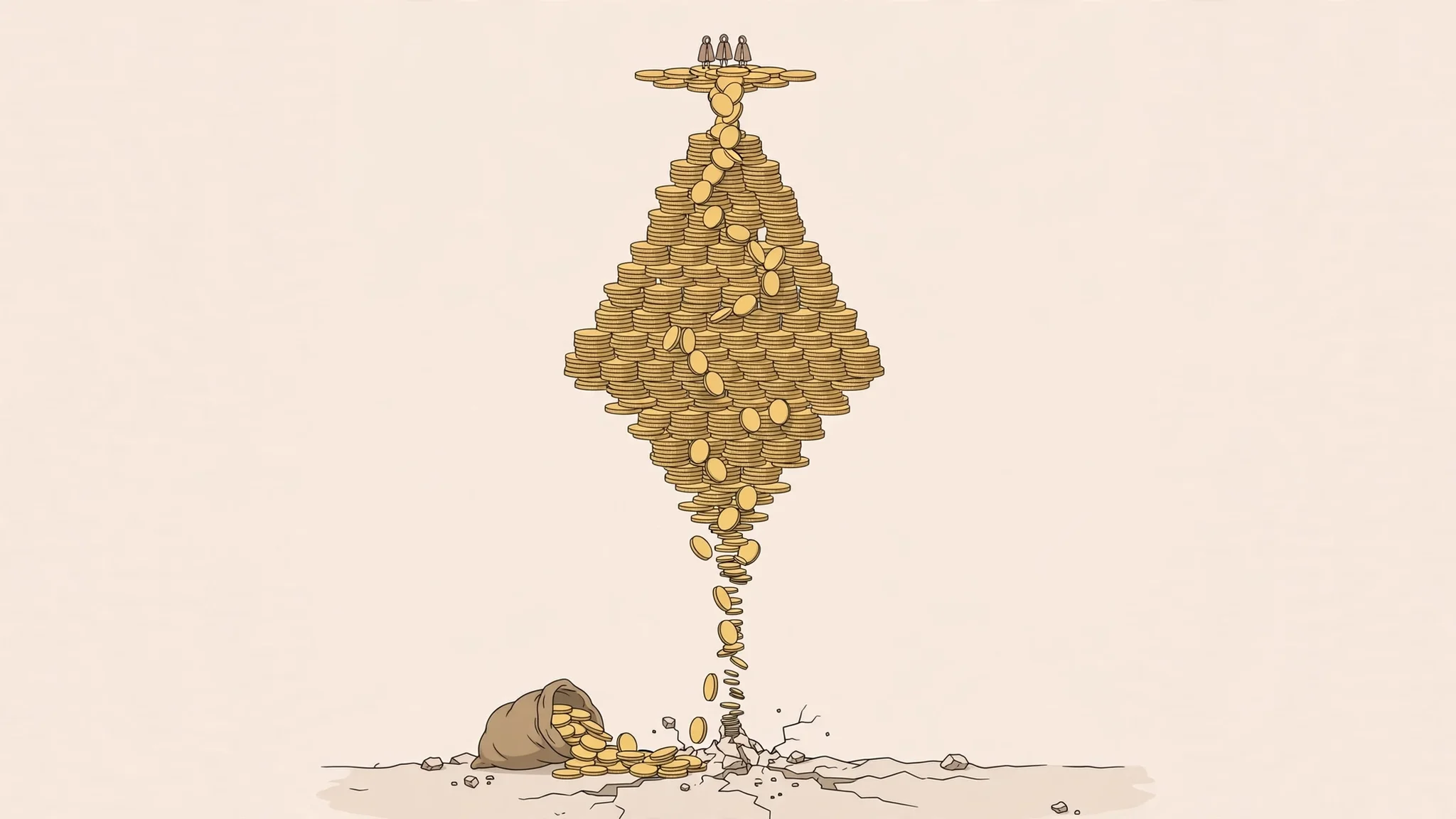
Here is the whole trick, in one sentence. Because the money is not invested in any kind of investment vehicle, there are no profits. Instead, the first investors are simply paid out from the money paid in by new investors. Read that again, because it is the entire fraud. There is no trading, no business, no product, and no profit. There is only a flow of money, from later people to earlier people, with the fraudster taking a share as it passes through.
Imagine a simple example, with round numbers, to see how the flow works. A fraudster promises 20 percent profit in one month. Ten people each give 1,000 rupees, so the fraudster holds 10,000 rupees. At the end of the month, the fraudster pays each of the ten people 200 rupees of “profit”, using 2,000 rupees of the money they themselves gave, and keeps the rest. The ten people are delighted. They tell their friends. Twenty new people arrive, each giving 1,000 rupees. The fraudster now has 20,000 rupees of new money, plus what is left of the old money, and uses it to pay the next round of “profits”, to the first ten and to some of the twenty. Everyone who is paid becomes an advertiser for the scheme, free of charge, telling everyone they know that it works.
The scheme gains credibility in exactly this way. After receiving the promised returns on their investment, the first investors start to spread the word to family and friends. In this way, the scheme gains credibility. It is not credible because it is real. It is credible because the fraudster is spending the victims’ own money to buy their trust, and their trust brings in more victims, whose money buys more trust. The circle only works while new money keeps arriving faster than old money is paid out. The moment new money slows, the circle breaks.
Why It Looks Real For So Long
A Ponzi scheme looks real because, from the victim’s point of view, it behaves like a real investment. You give money. You receive statements showing growth. You receive payments, on time, in the amounts promised. Your friends receive payments too. The office exists, the website works, and the person in charge answers the phone. What more proof could anyone want? The proof that is missing is invisible: the money is not invested anywhere, and the payments are not profits. But a victim cannot see that from outside, because the fraudster controls all the information the victim receives.
The statements are the key. A real investment produces statements that reflect real markets, with ups and downs, fees, and taxes. A Ponzi scheme produces statements that show smooth, steady growth, month after month, with no bad months and no losses. That smoothness should be suspicious, because real markets are never that smooth, but to a hopeful investor it looks like skill. The fraudster has removed the one thing that makes real investing uncertain, risk, and replaced it with a story. The story is consistent, the payments are real, and the victim has no reason to doubt either, until the day the payments stop.
Social Proof: The Second Key
The social proof is the second key. Ponzi schemes are created for all levels of income, and have taken in investors in the top bracket as well as those on middle and low levels. Wealthy, educated, careful people fall for them, because the recommendation comes from someone they trust: a friend, a relative, a colleague, a member of their community. Trust is borrowed from the recommender and spent by the fraudster. The victim thinks, “my friend would not lie to me,” and the friend is not lying. The friend was paid, and believes the scheme is real. Both are victims. Only the fraudster knows the difference.
The Moment It Must Collapse
Every Ponzi scheme collapses. It is not a matter of bad luck or poor management. It is arithmetic. To pay each round of investors their promised returns, the scheme needs more new money than the round before, because each round has more people expecting payment. The number of new investors needed grows faster and faster, like a chain letter, until it needs more people than exist, or more money than the community can supply. No population is infinite. No fraudster can recruit forever.
Typically, the fraudster will vanish with investors’ money, so the system eventually collapses with later investors receiving nothing, including their initial investment. The early investors may keep their “profits”, which were really other people’s money, and may even believe they were clever. The late investors lose everything: not only the promised profit, but the money they put in. That unfairness is built into the design. A Ponzi scheme is not a business that failed. It is a transfer of wealth from latecomers to earlycomers and to the fraudster, and the later you join, the more you lose.
The Trigger That Starts The Collapse
Collapse often comes suddenly, triggered by something small: a few large investors asking for their money back at once, a newspaper asking questions, a regulator starting an inquiry, or simply a month when not enough new people join. The fraudster has no investments to sell to meet withdrawals, because there never were any investments. The money that came in has been paid out as “profits” or taken by the fraudster. When the requests exceed the cash in hand, the scheme stops paying, the fraudster disappears, and the victims discover, all at once, that the statements were fiction.
The Warning Signs, In Plain Language
Action Fraud gives clear, practical warnings, and they are worth learning by heart. Do not be rushed into making an investment. Remember, legitimate organisations will never pressure you into investing on the spot. Pressure is the fraudster’s favourite tool, because a person who has time to think, check, and ask questions is a person who will spot the fraud. Time-limited offers, countdowns, and warnings that the opportunity will vanish tomorrow are designed to stop you thinking. A real investment will still be there tomorrow. A fraud needs you to decide today.
You should treat investment opportunities with extreme caution if there is pressure to invest, such as time-limited offers; downplayed risk of losing your money; or promised returns that sound too good to be true. Those three signs, together, are the fingerprint of a Ponzi scheme and of many other investment frauds. Extraordinary returns in a short space of time, with little or no risk, do not exist in real markets. Real returns come with real risk, real waiting, and real ups and downs. Anyone who promises otherwise is either lying or does not understand investing, and neither is a safe person to give money to.
Seek advice first. Before making significant financial decisions, speak with trusted friends or family members, or seek professional independent advice. The key word is independent: advice from someone who does not profit from your decision. A fraudster’s “adviser” is a salesperson. A real adviser has no stake in whether you invest in this scheme or not, and will happily tell you to walk away. Checking whether a firm is properly authorised matters too: Action Fraud advises using the Financial Conduct Authority’s register to check if a company is regulated, because if you deal with a firm that is not regulated, you may not be covered by the Financial Ombudsman Service if things go wrong and you lose your money.
Why Victims Rarely Get Their Money Back
Because Ponzi schemes are unauthorised and make no profits, you are very unlikely to recover any lost money. That sentence, from Action Fraud, is blunt, and it should be. There are no investments to sell, no profits to distribute, and no insurance to claim from, because the scheme was never a real business. The money has been spent: paid out as fake profits, taken by the fraudster, or vanished with them. Police and courts may recover some money, sometimes, from bank accounts or property the fraudster bought, but recovery is the exception, not the rule, and it is usually only a fraction of what was lost.
Why Prevention Matters More Than Cure
This is why prevention matters so much more than cure. Once money is handed to a fraudster, the chances of seeing it again are small. The time to stop a Ponzi scheme is before the first payment, when the warning signs are visible and the pressure is on. After the collapse, the work is different: report the fraud, tell your bank, and warn others, so the same scheme does not take more victims. But the money itself, in most cases, is gone, and honest advice says so plainly rather than offering false hope.
A Second Cruelty After The Collapse
There is a second cruelty to watch for after a collapse. Fraudsters sometimes re-establish contact with previous victims claiming that they can help them recover lost money. This is just a secondary scam. The “recovery” helper asks for a fee, or for access to accounts, and steals again from people who have already lost once. Hang up on any callers that claim they can get your money back for you, unless you have verified, independently, that they are a legitimate authority or adviser with no connection to the original fraud.
What To Do If You Are Offered A Suspicious Investment
If someone offers you an investment that promises extraordinary returns quickly, with little risk, stop. Do not decide on the spot. Take the offer away, in writing, and show it to someone independent: a trusted friend, a family member, or a professional adviser with no stake in the deal. Ask three questions. First, what exactly is the money invested in, and can I see independent proof that the investment exists? Second, who regulates this firm, and can I verify that on the official register myself? Third, why am I being pressured to decide now?
If you have made a payment, inform your bank as soon as possible, because the bank can help prevent any further losses. Monitor your bank statements regularly for any unusual activity. If you have shared personal or financial information and suspect your identity may have been stolen, check your credit file quickly and easily online, and do this every few months anyway, using a reputable service provider, following up on any unexpected or suspicious results. Speed matters: the sooner a bank knows, the more it can do to stop further money leaving your accounts.
Above all, remember the simple test at the heart of this post. Real investing makes profits by owning things that earn money: businesses, property, loans that are repaid. A Ponzi scheme makes “profits” by paying old investors with new investors’ money, and it can only survive while new money keeps arriving. When you understand that one mechanism, the posters, the promises, and the paid neighbours lose their power. The scheme is not complicated. It is a queue, and the people at the back of the queue pay for the people at the front. The only way to win is not to join it.
You may also like
Frequently Asked Questions
What is a Ponzi scheme in simple words? A Ponzi scheme is a fraud in which a fraudster advertises a non-existent investment offering extraordinary returns in a short space of time. Because the money is not invested in any kind of investment vehicle, there are no profits: the first investors are simply paid out from the money paid in by new investors. The scheme gains credibility when the first investors spread the word to family and friends, but it must eventually collapse, with later investors receiving nothing, including their initial investment.
How can I spot a Ponzi scheme? Treat an investment opportunity with extreme caution if there is pressure to invest, such as time-limited offers, downplayed risk of losing your money, or promised returns that sound too good to be true. Legitimate organisations will never pressure you into investing on the spot, and extraordinary returns in a short space of time, with little or no risk, do not exist in real markets. Seek advice first from trusted friends, family members, or a professional independent adviser, and use the Financial Conduct Authority’s register to check whether the company is regulated.
Why do Ponzi schemes always collapse? Because the arithmetic cannot work forever. To pay each round of investors their promised returns, the scheme needs more new money than the round before, since each round has more people expecting payment, and the number of new investors needed grows faster and faster. No population is infinite, so the scheme eventually runs out of new money, the fraudster typically vanishes with the investors’ money, and the system collapses with later investors receiving nothing, including their initial investment.
Can victims get their money back after a Ponzi scheme collapses? Very rarely, and usually only a fraction of it. Because Ponzi schemes are unauthorised and make no profits, you are very unlikely to recover any lost money: there are no investments to sell and no profits to distribute, because the scheme was never a real business. If you have made a payment, inform your bank as soon as possible, because the bank can help prevent further losses, and monitor your bank statements regularly for unusual activity. Be careful of secondary scams in which fraudsters contact previous victims claiming they can recover lost money for a fee.
Are rich and educated people fooled by Ponzi schemes? Yes. Ponzi schemes are created for all levels of income, and have taken in investors in the top bracket as well as those on middle and low levels. They succeed because the recommendation comes from someone the victim trusts, a friend, relative, colleague, or community member, who was paid and believes the scheme is real. Trust is borrowed from the recommender and spent by the fraudster, so the victim’s judgement is not foolish: it is the mechanism of the fraud, which uses real payments to real people to buy credibility.
Sources
- Action Fraud (UK), “Ponzi schemes”: https://www.actionfraud.police.uk/a-z-of-fraud/ponzi-schemes