Why Do Flamingos Stand on One Leg? Explained Simply
In this post
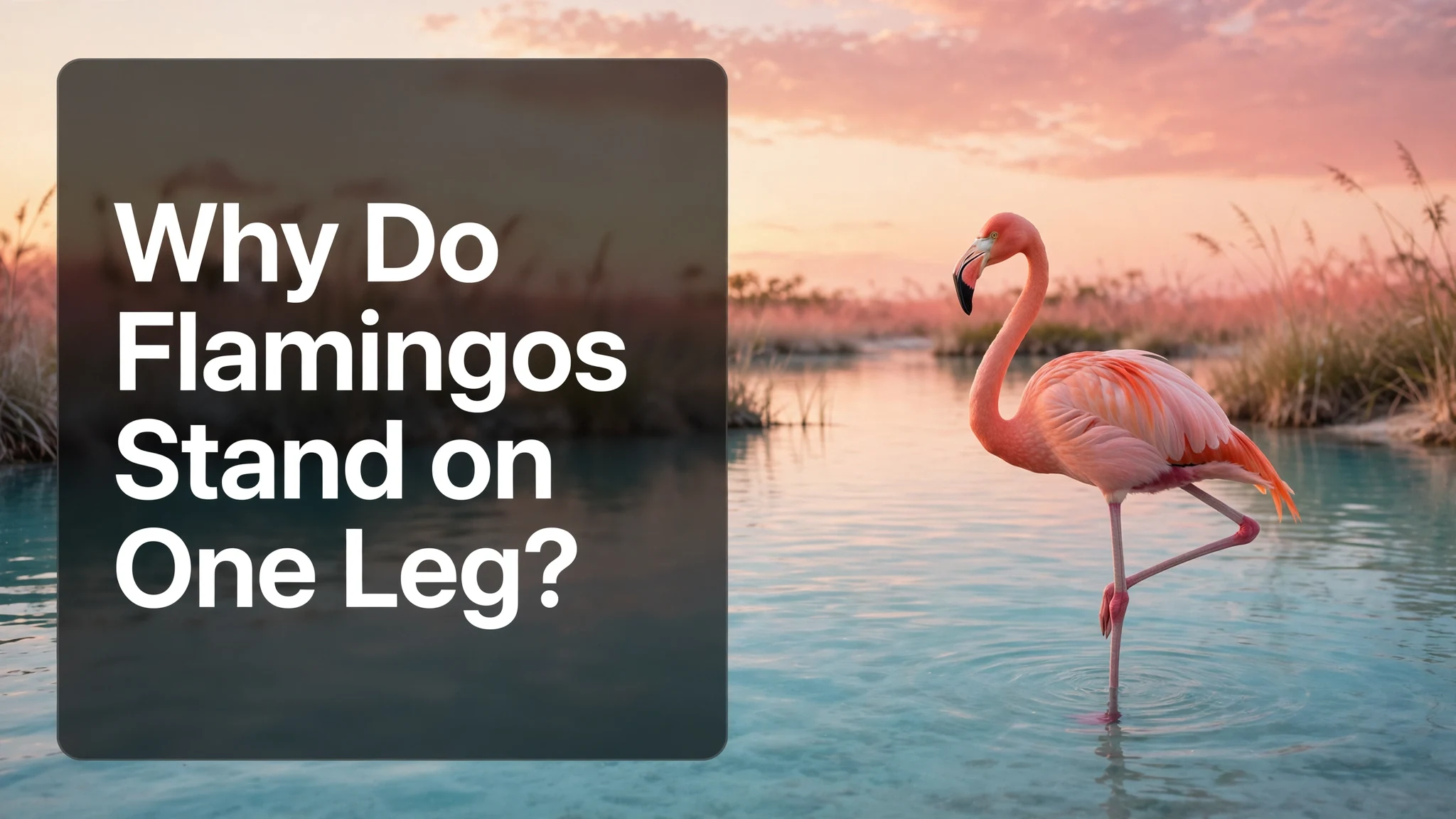
A flamingo standing on one leg looks like a trick, or a joke. The bird is tall, pink, and balanced on a single thin leg in cold water, often with its head tucked away as if it were asleep. It looks uncomfortable, yet the flamingo can stay like that for hours. The truth is simpler and cleverer than the trick suggests. Standing on one leg saves heat, saves effort, and helps the bird rest.
Flamingos spend much of their life in shallow, salty water, where heat loss and tired legs are real problems. This guide explains the heat-saving idea, the locking joint that lets the leg hold without effort, the role of sleep, and why flamingos sometimes stand on two legs instead.
The Heat-Saving Answer
The most widely supported reason is heat. One leg in cold water loses less heat than two.
In practice, Flamingos stand in shallow water for hours while they feed and rest, and that water is often cold. Heat escapes from the body through the legs, which have little feather insulation. By lifting one leg into the warm feathers of the body, the flamingo halves the surface losing heat to the water. So one leg up is a way of keeping warm without spending extra energy on shivering or moving. Tucking one leg into the belly feathers is the flamingo’s answer to cold water, and once that clicked for me, the one-legged pose stopped looking like a show and started looking like a thermostat.
Look closer and Scientists have tested this by watching flamingos in different temperatures. In colder water, flamingos spend more time on one leg than in warmer water. That pattern fits the heat idea: the colder the water, the more the bird protects its heat. So the behaviour changes with the weather, which is what you would expect if heat were the main reason. A flamingo’s stance is a small system, not a pose: the locked joint holds the weight, the hidden leg stays warm, and the bird can sleep without falling over.
The key point is that The leg that is tucked away is held close to the body, under the feathers. There it is warmed by the bird’s own body heat, like a hand in a pocket. When the flamingo needs to move, it simply lowers the leg again. So the tucked leg is not resting in the usual sense; it is being kept warm, ready for use. At close range the one-legged stand looks less like a circus act and more like a sensible way to keep warm while standing in a chilly, salty lake.
A Leg That Locks Into Place
Standing on one leg looks tiring, but the flamingo’s leg can lock, so it needs almost no muscle effort.
What makes this work is that A flamingo’s leg has a joint that can lock into a stable position, a little like a folding chair clicking open. Once it is locked, the leg can support the bird’s weight with very little muscle work. That is why a flamingo can stand on one leg for hours without getting tired. So the balance is not a feat of strength; it is a feat of design, built into the joint itself. Most visitors laugh at the single leg and miss the point, yet that tucked leg explains why the bird can rest for hours in water that would chill us in minutes.
Step back for a moment and The same locking idea helps the bird sleep while standing. A sleeping flamingo does not need to think about balance, because the locked leg holds it up. Its body stays upright, and its head is tucked back into its feathers for warmth. So sleep and standing go together, and the lock makes both possible at once. Standing on one leg packs heat-saving, balance, and rest into a single posture, and the flamingo pays almost nothing in effort to hold it.
The surprising part is that Young flamingos are less steady than adults, and they practise standing on one leg. At first they wobble, then they learn to find the balance point. That learning is part of growing up, like a child learning to ride a bicycle. So the famous pose is not born perfect; it is learned, and it improves with practice. Link the locked joint to the warm belly and the cold lake, and the whole flamingo story, pink feathers included, begins to hang together.
Sleeping on One Leg
Flamingos often sleep standing up, on one leg, with their head turned back and their beak tucked into their feathers.
In practice, Sleeping on one leg keeps the bird ready to move if a predator comes. It does not need to stand up first, because it is already standing. That readiness matters in open water, where there is nowhere to hide. So sleep is not a deep, helpless state here; it is a light rest with one foot ready to go. Tucking one leg into the belly feathers is the flamingo’s answer to cold water, and once that clicked for me, the one-legged pose stopped looking like a show and started looking like a thermostat.
Look closer and The tucked head also saves heat, because the beak and face lose heat quickly. By burying the beak in the feathers of the back, the flamingo protects a sensitive part of its body. The whole pose is a compact, warm shape, with as little surface exposed as possible. So the sleeping flamingo is really a bird folded up for warmth, with one leg doing the work of two. A flamingo’s stance is a small system, not a pose: the locked joint holds the weight, the hidden leg stays warm, and the bird can sleep without falling over.
The key point is that Flamingos can also sleep on two legs, or lying down, when they feel safe. In a zoo or a sheltered lagoon, you may see them resting in different poses. The one-leg pose is a choice, not a rule, and the bird changes it as conditions change. So the pose tells you something about how the bird feels: one leg often means it is resting, but still alert. At close range the one-legged stand looks less like a circus act and more like a sensible way to keep warm while standing in a chilly, salty lake.
Balance, Wind, and Water
Standing in water is harder than standing on land, and the flamingo has to cope with wind and moving water.
What makes this work is that The flamingo’s body is light for its size, and its centre of gravity sits over the standing leg. That balance is helped by the long neck, which the bird can move to adjust its weight. If the wind pushes the bird, it shifts its neck and body to stay upright. So balance is a whole-body job, not just a leg job, and the neck is part of the balancing system. Most visitors laugh at the single leg and miss the point, yet that tucked leg explains why the bird can rest for hours in water that would chill us in minutes.
Step back for a moment and The standing leg is usually the one that is slightly stronger or more comfortable at that moment. Flamingos switch legs from time to time, so neither leg gets too cold or too tired. That switching is a small detail, but it shows the bird is managing its body, not just standing still. So the pose is active, even though it looks passive, and the bird is making small adjustments all the time. Standing on one leg packs heat-saving, balance, and rest into a single posture, and the flamingo pays almost nothing in effort to hold it.
The surprising part is that In strong wind, a flamingo may stand on two legs for extra stability. Two legs give a wider base, which is safer when the water is moving. That choice shows the bird is weighing heat saving against stability, and choosing what matters most. So the flamingo is not following a fixed rule; it is making a trade-off, moment by moment. Link the locked joint to the warm belly and the cold lake, and the whole flamingo story, pink feathers included, begins to hang together.
Why Flamingos Are Pink, and What That Has to Do With Standing
The pink colour and the one-leg pose both come from the flamingo’s life in shallow, salty water.
In practice, Flamingos are not born pink. They are born grey, and they turn pink from the food they eat. Their food contains pigments called carotenoids, found in algae and small crustaceans. Those pigments build up in the feathers and skin, turning the bird pink over time. So the pink is a sign of a healthy diet, and a pale flamingo may be a hungry or unwell one. Tucking one leg into the belly feathers is the flamingo’s answer to cold water, and once that clicked for me, the one-legged pose stopped looking like a show and started looking like a thermostat.
Look closer and Flamingos feed with their heads upside down, sweeping their beaks through the water to filter out small food. That feeding style keeps them in shallow water for long periods, which is why heat loss matters so much. The one-leg pose is part of the same life: long hours in cold water, standing and feeding. So the colour and the pose are linked by the same habitat, even though they look unrelated. A flamingo’s stance is a small system, not a pose: the locked joint holds the weight, the hidden leg stays warm, and the bird can sleep without falling over.
The key point is that The legs themselves are also pink, or red, because of the same pigments. The long, thin legs look fragile, but they are strong enough to support the bird and to wade through mud. Their length lets the flamingo stand in deeper water than other wading birds. So the legs are tools for a water life, and their colour is a side effect of the food that life provides. At close range the one-legged stand looks less like a circus act and more like a sensible way to keep warm while standing in a chilly, salty lake.
Do Other Birds Stand on One Leg Too?
Flamingos are the most famous one-leg standers, but they are not the only birds that do it.
What makes this work is that Many wading birds, such as herons, storks, and ducks, also stand on one leg to rest. They do it for the same reasons: to save heat and to rest a leg. Ducks often tuck one leg into their feathers while they float or stand. So the behaviour is common among water birds, and flamingos are simply the most visible example. Most visitors laugh at the single leg and miss the point, yet that tucked leg explains why the bird can rest for hours in water that would chill us in minutes.
Step back for a moment and Birds that live on land, such as pigeons, also tuck one leg up when they rest. They do it to keep the foot warm and to reduce the effort of standing. The difference is that flamingos do it in water, where heat loss is faster. So the same trick is used by many birds, in different places, for the same basic reason. Standing on one leg packs heat-saving, balance, and rest into a single posture, and the flamingo pays almost nothing in effort to hold it.
The surprising part is that What makes flamingos special is how long and how often they do it. They can stand on one leg for hours, even while asleep, which is longer than most birds. That endurance comes from the locking joint and the bird’s light body. So flamingos are not unique in the idea, but they are the best at it, and that is why we notice them. Link the locked joint to the warm belly and the cold lake, and the whole flamingo story, pink feathers included, begins to hang together.
What to Look For When You Watch Flamingos
Next time you see flamingos, watch the legs, not just the colour.
In practice, Notice which leg is up, and how long it stays up before the bird switches. You may see the bird switch legs, shake the cold one, and tuck the other away. That switching is a small, ordinary moment, but it tells you the bird is managing heat. So watching the legs gives you a window into the bird’s body, not just its beauty. Tucking one leg into the belly feathers is the flamingo’s answer to cold water, and once that clicked for me, the one-legged pose stopped looking like a show and started looking like a thermostat.
Look closer and Notice whether the bird is on one leg or two, and what the weather is like. On a cold, windy day, you will see more one-leg poses than on a warm, calm day. That pattern is a simple test of the heat idea, and you can check it yourself. So a visit to a flamingo lagoon can be a small science experiment, if you know what to look for. A flamingo’s stance is a small system, not a pose: the locked joint holds the weight, the hidden leg stays warm, and the bird can sleep without falling over.
The key point is that Notice the head position too. A head tucked back usually means the bird is resting. A head held up and moving usually means it is feeding or watching. Together, the legs and the head tell you what the bird is doing, even from a distance. So the whole bird is a set of signals, and learning to read them makes watching much richer. At close range the one-legged stand looks less like a circus act and more like a sensible way to keep warm while standing in a chilly, salty lake.
My Take:
I used to think the one-leg pose was a party trick, something flamingos did to look interesting. Now I think it is a quiet piece of common sense. If you have to stand in cold water for hours, you lift one leg out of it. That is not clever in a complicated way. It is clever in the way a person puts their hands in their pockets on a cold day. The best ideas often look like that: simple, obvious once you see them, and easy to miss until someone points them out.
I think the heat answer is the most convincing, because it changes with the weather. Flamingos stand on one leg more when the water is cold, which is exactly what you would expect if heat were the reason. That kind of pattern, where the behaviour follows the conditions, is what makes me trust an explanation. What keeps drawing me back to flamingos is the way the answer changes with the weather: colder water, more one-legged standing, as if the bird were turning a dial. A flamingo on one leg is no longer a picture in my head; it is a reminder I use whenever I see an animal solving a problem with its body instead of its brain.
The locking joint is the part that surprised me most. I assumed standing on one leg would be tiring, yet the bird can do it for hours without effort. It reminded me that the body is full of small mechanisms we never notice, until we ask how something that looks hard can be easy. For me, the honest test for a flamingo standing on one leg is simple. A smart-sounding flamingo theory that predicts nothing gets discarded, and I watch the bird instead. An explanation earns my trust when it lets me forecast the birds, for instance that they will switch legs after a while, and this one did that repeatedly. That is the kind of flamingo detail I would tell a child at a zoo, so the pink bird on one leg becomes a lesson in keeping warm, not just a pretty sight.
I also like that flamingos switch legs. It is a small, practical habit, and it shows the bird is not just standing still. It is managing its body, taking turns, and keeping both legs in working order, which is a sensible way to live. It took me a while to accept that standing still could be an active skill, because I had always equated stillness with doing nothing. For me, learning about a flamingo standing on one leg was not one dramatic moment. One bird switching legs, another sleeping upright, a third feeding head-down, and gradually the separate sights formed a single, sensible picture. I no longer brush off simple questions about flamingos, because asking why they do not fall over led me straight to the locking joint.
Watching flamingos has changed how I look at other birds too. Now, when I see a duck tuck one leg away, I recognise the same idea. That is the pleasure of learning one fact properly: it suddenly explains a dozen other things you had ignored. If a friend asked about flamingos, I would tell them to look past the pink and ask what the leg is doing, because that is where the story lives. Ask what happens on a warm day, who gains from the pink colour, and what standing costs the bird, and the pose turns into a set of trade-offs. My earlier view of flamingos was a joke about a party trick, and the quieter view that replaced it has needed no defending since.
If I could tell a child one thing about flamingos, it would be this: the pink is food, and the one leg is warmth. Two simple facts explain the two most famous things about the bird. That is a good way to teach, because it gives a child two handles to hold onto, and both are true. Studying flamingos has humbled me a little, because a bird I thought was showing off turns out to be quietly managing heat and balance. The more I learn about flamingos, the less I trust my first impressions of animals, and that caution feels like progress, not doubt. A flamingo rewards a second glance, because the first sees pink and the second sees a bird keeping warm. I would rather keep one vivid picture, a flamingo asleep on one leg in cold water, than collect ten flamingo facts that fade by next weekend.
The lesson I take away is about trade-offs. A flamingo chooses between heat and stability, between rest and readiness, and it changes its mind as conditions change. I think good decisions in our own lives work the same way: there is rarely one right answer, only the answer that fits the moment. If I had to keep just one flamingo idea, it would be the heat-saving leg, because it changes how I watch every wading bird I meet now. Writing about flamingos in my own words exposed the gaps in my understanding, especially where I had confused the pink diet with the standing habit.
Looking again at the heat-saving section, I saw how a single degree of water temperature can decide whether a flamingo stands on one leg or two. The famous pink is not the most instructive part; the unnoticed joint that locks the leg in place teaches far more about how the bird lives. That unnoticed joint reassures me, because it shows that the most useful parts of nature are often the ones nobody photographs.
The locking-joint section changed my conversations about birds, because now I have a mechanism to describe instead of just a colour to admire. These days I open with a question about cold water, point to the tucked leg, and only then offer my own reading of what it means. That sequence feels more honest to me, because the listener sees the bird’s problem first and my answer second, in the right order. It also lets the listener argue back, and a flamingo discussion that welcomes argument is worth far more than one that demands agreement.
Sleeping on one leg, considered at the end, revealed a pattern across the whole piece that I had completely missed at the start. Heat, balance, and a willingness to revise my first guess kept reappearing, in the lake, in the joint, and in the bird’s sleep. Those ideas help with more than flamingos, which is why I intend to revisit this piece instead of reading it once and moving on. Next time I see flamingos, I will watch the legs first, and I expect that second look to teach me something the first one missed.
Frequently Asked Questions
Do flamingos stand on one leg to sleep?
Yes, flamingos often sleep standing on one leg, with their head tucked back. The leg can lock into place, so the bird can rest without falling over.
Do flamingos get tired standing on one leg?
Not much. Their leg joint can lock, which supports their weight with very little muscle effort. They also switch legs regularly, so neither leg gets too cold or tired.
Why are flamingos pink?
Flamingos get their pink colour from pigments called carotenoids in their food, such as algae and small crustaceans. They are born grey and turn pink as they eat that food.
Do baby flamingos stand on one leg?
Young flamingos practise standing on one leg, but they are less steady than adults at first. They improve with practice as their legs and balance develop.
Do other birds stand on one leg?
Yes, other wading birds do it too. Many wading birds, ducks, herons, and storks also stand on one leg to save heat and rest a leg. Flamingos are simply the most famous and the most skilled at it.
Do flamingos ever stand on two legs?
Yes, flamingos use two legs whenever they need to. Flamingos stand on two legs when they are walking, feeding, or when the wind is strong and they need extra stability. One leg is a resting pose, not a permanent rule.