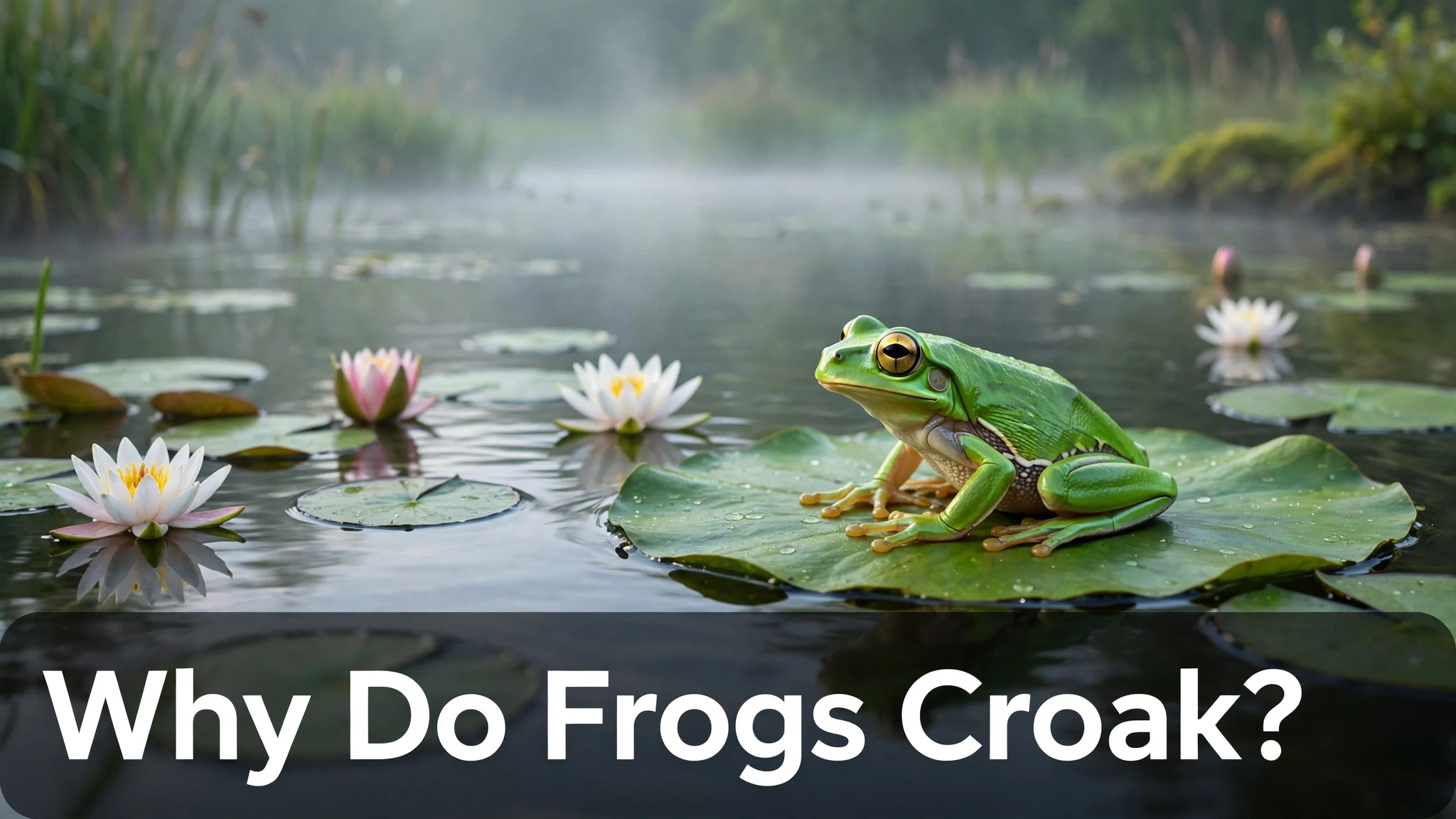
Why Do Frogs Croak? Explained Simply
In this post
On a warm night near a pond, the air can be full of sound. Frogs croak, trill, and chirp, sometimes so loudly that it is hard to talk over them. That chorus is not random noise. It is a conversation, and most of it is about finding a mate. A frog’s croak is its voice, its advertisement, and its claim to a place by the water.
Frogs croak for several reasons, and the main one is mating. Males call to attract females, to warn other males away, and to show that they are healthy and strong. This guide explains how frogs make their calls, why each species sounds different, why they croak most at night, and what the chorus tells us about the health of a pond.
The Main Reason: Finding a Mate
Most frog croaking is done by males, and most of it is about attracting a female.
In practice, A male frog calls to tell females where he is and that he is ready to mate. The call is a kind of advertisement, and females listen and choose the male whose call sounds strongest or most attractive. A loud, steady call often means a large, healthy male, which is what females prefer. So the chorus is a competition, and the best singer often wins the mate. The vocal sac is the frog’s loudspeaker, and once I saw it inflate, a tiny animal suddenly made sense as a musician with a built-in amplifier.
Look closer and Each species has its own call, so a female can tell her own species apart from others. That matters because ponds often hold several species at once, and a female needs to find a male of her own kind. The call’s pitch, rhythm, and length are all part of that species signature. So the croak is not just loud; it is specific, and that specificity prevents wasted mating between species. A frog’s call is not just noise; the sac, the throat, and the timing work together, and the way a small frog can be heard across a pond proves the system is built for distance.
The key point is that Males also call to claim a small territory around their calling spot. That spot may be a lily pad, a bank, or a patch of reeds, and the male defends it from other males. If another male comes too close, the call may change to a warning or a fight call. So the chorus is also a map of territories, with each male marking his own small piece of the pond. Up close, croaking looks less like showing off and more like a practical announcement, a male frog telling rivals and mates exactly where he is in the dark.
How a Frog Makes Its Call
A frog does not have vocal cords like a human. It makes sound with air, a voice box, and a throat pouch.
What makes this work is that A frog pushes air from its lungs over a voice box, which makes the air vibrate and produce sound. The sound is then amplified by a throat pouch, called a vocal sac, which inflates like a balloon. That pouch makes the call much louder than the frog’s small body could manage alone. So the throat pouch is a loudspeaker, and it is what makes a tiny frog sound so big. People hear a chorus and think it is random noise, yet each species’ call is distinct, and that distinction is what lets mates find each other without confusion.
Step back for a moment and Some frogs have one vocal sac, while others have two, one on each side of the throat. The size and shape of the sac affect the sound, and they are part of what makes each species sound different. When the frog is not calling, the sac deflates and is hard to see. So the puffed throat you see in a photo is the frog in full voice, and it is a sign the frog is calling. One evening of croaking packs advertising, warning, and courtship into a single sound, and the frog spends its breath so efficiently that the chorus can last all night.
The surprising part is that Frogs can call without breathing in fresh air each time, by moving air back and forth between the lungs and the sac. That recycling lets them call for a long time without pausing to breathe. It is an efficient system, and it is why a chorus can go on for hours. So the frog’s call is built for endurance, and it can keep going long after a human singer would need a rest. Connect the sac to the night air to the listening females, and the separate facts about frogs, sound, and seasons join into a single, sensible story.
Why Frogs Croak at Night
Frogs croak most at night, and there are good reasons for that timing.
In practice, Night is cooler and more humid than day, which is better for a frog’s skin. Frogs lose water through their skin, and the damp night air helps them stay moist. Calling at night also means fewer predators that hunt by sight, such as birds. So the night is safer and more comfortable for a frog, and it is the best time to be loud. The vocal sac is the frog’s loudspeaker, and once I saw it inflate, a tiny animal suddenly made sense as a musician with a built-in amplifier.
Look closer and Sound also travels well at night, when the air is still and cool. A call can carry further in the quiet night than in the busy day. That matters because a male needs his call to reach females that may be some distance away. So the night is not just a habit; it is a good acoustic choice, and it helps the call travel. A frog’s call is not just noise; the sac, the throat, and the timing work together, and the way a small frog can be heard across a pond proves the system is built for distance.
The key point is that Rain and warm weather can make frogs croak more, even during the day. After rain, the pond is full, the air is damp, and the conditions are good for breeding. That is why a rainy evening often brings a louder chorus than a dry one. So the weather is a trigger, and the frogs are responding to conditions, not just to the clock. Up close, croaking looks less like showing off and more like a practical announcement, a male frog telling rivals and mates exactly where he is in the dark.
Different Calls for Different Jobs
Frogs do not have one call. They have several, for mating, warning, and distress.
What makes this work is that The mating call is the loud, repeated call that most people recognise. It is the call a male uses to attract a female, and it can go on for hours. Each species has its own version, and experienced listeners can tell species apart by sound alone. So the mating call is the frog’s main voice, and it is the one you hear most often. People hear a chorus and think it is random noise, yet each species’ call is distinct, and that distinction is what lets mates find each other without confusion.
Step back for a moment and The territorial call is shorter and sharper, and it is used when another male comes too close. It says, in effect, this spot is taken, and it may lead to a fight if the other male does not leave. Those fights are usually short, with males pushing each other, rather than serious injury. So the territorial call is a warning, and it helps frogs sort out space without fighting all the time. One evening of croaking packs advertising, warning, and courtship into a single sound, and the frog spends its breath so efficiently that the chorus can last all night.
The surprising part is that The distress call is a high, sudden sound made when a frog is grabbed by a predator. It may startle the predator, giving the frog a chance to escape. Some frogs also make a release call when they are grabbed by another frog by mistake. So the frog’s voice is a toolkit, with a different sound for each situation, not just one noise. Connect the sac to the night air to the listening females, and the separate facts about frogs, sound, and seasons join into a single, sensible story.
The Chorus: Many Frogs, One Sound
When many frogs call together, they form a chorus, and that chorus has its own pattern.
In practice, In a chorus, males space themselves out around the pond, each calling from his own spot. They may take turns, or they may call together, depending on the species. That spacing helps females hear each male clearly, instead of hearing a jumble. So the chorus is organised, not chaotic, and the frogs are listening to each other as well as calling. The vocal sac is the frog’s loudspeaker, and once I saw it inflate, a tiny animal suddenly made sense as a musician with a built-in amplifier.
Look closer and A large chorus can be heard from far away, and it tells other frogs that this pond is a good place to breed. That can attract more frogs, which makes the chorus even larger. A pond with a loud chorus is often a healthy pond, with clean water and plenty of food. So the chorus is a sign of a living pond, and its absence can be a warning that something is wrong. A frog’s call is not just noise; the sac, the throat, and the timing work together, and the way a small frog can be heard across a pond proves the system is built for distance.
The key point is that Frogs in a chorus may also synchronise their calls, calling in waves. That synchrony may help them avoid predators, because a predator cannot pick out one frog from a wall of sound. It may also help females compare males, by hearing them side by side. So the chorus is both a competition and a protection, and it works because the frogs act together. Up close, croaking looks less like showing off and more like a practical announcement, a male frog telling rivals and mates exactly where he is in the dark.
Frogs, Seasons, and Breeding
Croaking is tied to the breeding season, which is tied to temperature and rain.
What makes this work is that Most frogs breed in spring or in the warm, wet season, when the pond is full and the weather is warm. That is when you hear the loudest choruses, because the males are calling most actively. Outside the breeding season, frogs are quieter, and they may not call at all. So the croak is seasonal, and its return each year is a sign that spring has arrived. People hear a chorus and think it is random noise, yet each species’ call is distinct, and that distinction is what lets mates find each other without confusion.
Step back for a moment and Temperature affects how fast a frog calls and how high its pitch is. A warm frog calls faster than a cold one, and its call may sound higher. That is why the same species can sound different on a warm night and a cool night. So the call is not fixed; it changes with the frog’s body temperature, which changes with the weather. One evening of croaking packs advertising, warning, and courtship into a single sound, and the frog spends its breath so efficiently that the chorus can last all night.
The surprising part is that After mating, the female lays eggs in the water, and the male may stay nearby and keep calling. The eggs hatch into tadpoles, which grow into frogs over weeks or months. That cycle depends on clean water, because tadpoles cannot survive in polluted ponds. So the croak is the start of a cycle, and the whole cycle depends on the pond staying healthy. Connect the sac to the night air to the listening females, and the separate facts about frogs, sound, and seasons join into a single, sensible story.
What Frog Calls Tell Us About Nature
Listening to frogs can tell us about the health of a place, and about changes in the climate.
In practice, Frogs are sensitive to pollution, because their skin absorbs chemicals from the water and air. If frogs disappear from a pond, it may mean the water is polluted or the habitat has changed. Scientists use frog calls to monitor ponds, by recording the chorus and counting the species. So frogs are indicators, and their silence can be a warning that something is wrong. The vocal sac is the frog’s loudspeaker, and once I saw it inflate, a tiny animal suddenly made sense as a musician with a built-in amplifier.
Look closer and Climate change is also affecting frog calls, because warmer springs make frogs breed earlier. That shift can affect the timing of the whole pond, including the insects that tadpoles eat. If frogs breed too early, their tadpoles may hatch before their food is ready. So a change in the chorus can be a sign of a larger change in the seasons, and it is worth listening to. A frog’s call is not just noise; the sac, the throat, and the timing work together, and the way a small frog can be heard across a pond proves the system is built for distance.
The key point is that You can help frogs by keeping a pond clean, leaving some wild plants near water, and avoiding chemicals. A small pond in a garden can be a home for frogs, and it can bring a chorus to your own backyard. Listening to that chorus is a simple pleasure, and it is also a way of checking that nature is still working. So the frog’s call is not just a sound; it is a report on the health of the place where it lives. Up close, croaking looks less like showing off and more like a practical announcement, a male frog telling rivals and mates exactly where he is in the dark.
My Take:
I like frog choruses, even when they are loud. There is something honest about a sound that has a clear purpose. A frog is not croaking to show off. It is calling for a mate, claiming a spot, and warning a rival, all with the same small body and the same puffed throat. That is efficient. It is also a reminder that nature is full of voices we ignore, until we stop and listen to what they are actually saying.
I think the throat pouch is the cleverest part. A tiny frog can sound huge because it has a built-in loudspeaker, and that is a good design. It reminds me that size is not the same as impact, and that a small thing with the right tool can be heard from far away. The throat pouch is the detail I keep coming back to, because a frog no bigger than my thumb can fill a whole pond with sound, and that mismatch between size and volume still surprises me. Frog calls are no longer background noise to me; they are a language I am learning to hear, and I catch myself listening for the different voices in a chorus now.
The idea that each species has its own call stayed with me. It means a pond can hold several species, and each one can find its own mate without confusion. That is a neat solution to a crowded problem, and it shows how much information can be packed into a sound. For me, the honest test for a frog croaking is simple. A frog theory that only sounds clever is useless to me, so I put it down and listen to the pond. I trust a frog explanation when it lets me predict the pond, like knowing the chorus will rise after rain, and this piece kept getting those predictions right. That is the kind of frog detail I would tell a friend on a summer walk, so the next loud chorus feels like a conversation rather than a nuisance.
I also like that frogs croak most at night for practical reasons. The night is cooler, damper, and safer, and sound travels further in still air. It is a reminder that behaviour which looks like a habit is often a careful choice, made for reasons we can understand if we ask. Understanding frog calls took me longer than I expected, because each call has a job, and I had lumped them all together as simply croaking. For me, learning about a frog croaking was not one dramatic moment. A mating call here, a warning call there, a chorus building at dusk, and the separate sounds gradually sorted themselves into a system I could follow. I am gentler now with simple questions about frogs, because asking why they croak at night led me to cooler air, damper skin, and sound that travels further.
The chorus as a health report is the part I would tell a friend. If frogs disappear from a pond, something is wrong, and their silence is a warning. That makes listening a useful skill, not just a pleasant one, and it gives us a reason to pay attention to small animals. If a friend asked about frogs, I would tell them to listen at night first, and not to stop at the first croak they hear. Ask what rain does to the chorus, who gains when many frogs call together, and what silence costs a pond, and the croaking gains a whole set of reasons. My old idea of frogs was a cartoon croak, and the layered chorus that replaced it is quieter in my head and far more interesting to listen to.
If I had a garden pond, I would want frogs in it. I would leave some wild plants, keep the water clean, and let the chorus come. That is a small, practical way to help, and it brings a sound into the garden that no speaker can replace. Learning about frogs has made me slower to dismiss loud animals, because a sound I once found annoying turns out to be a careful, honest signal. The more I learn about frog calls, the less sure I feel about judging a sound before I know its purpose, and that feels like a useful caution. Frogs repay listening twice, because the first chorus sounds like noise and the second sounds like separate voices. I would rather keep one frog picture clearly, a small throat pouch swelling like a balloon, than memorise a list of call types I will forget by autumn.
The lesson I take from frogs is about speaking clearly. A frog’s call is specific, repeated, and honest about what it wants. I think our own communication could learn from that: say what you mean, say it in a way your own kind can recognise, and do not be afraid to be heard. If I could keep one frog idea, it would be the species-specific call, because it shows how animals can share a pond without talking over each other. When I explained frog calls without the guide beside me, the blur became obvious, above all between a mating call and a distress call.
Going back to the mating section, I noticed how much of the frog story depends on being heard by the right listener, and how much is wasted on the wrong one. The croak everyone knows is less revealing than the sac behind it, inflating and deflating all night, which is where the frog’s real effort goes. That quiet sac work reassures me, because it shows that even a loud animal succeeds through small, repeated efforts rather than one big shout.
The section on how a frog makes its call changed how I talk about frogs, because it gave me a physical part to point to instead of a vague sound. Now I start by asking how the sac works, then I describe the night chorus, and only then do I offer my own view of what the calls mean. The mechanism first, my opinion second: that sequence lets the listener test what I claim instead of simply taking my word for it. It also leaves space for a different view, and a frog conversation that welcomes disagreement is much better than one that simply repeats a croak.
Thinking about night croaking at the end, I saw a thread running through the whole piece that I had not spotted while reading the earlier sections. Listening, signalling, and adjusting to the season kept appearing together, in the calls, in the chorus, and in the frogs that fall silent when something is wrong. Those ideas reach beyond ponds into how I listen generally, so I will keep this piece for a second reading on another evening. I will stop by a pond on the next warm evening, listen for the separate voices, and expect that second listening to teach me something new.
Frequently Asked Questions
Why do frogs croak at night?
Frogs croak most at night because the air is cooler and more humid, which suits their skin, and sound travels well in still night air. Night is also safer from predators that hunt by sight.
Do female frogs croak?
Female frogs usually croak much less than males, and some species’ females rarely call at all. Most loud croaking is done by males to attract a mate and defend a territory.
How do frogs make their croaking sound?
A frog pushes air over its voice box, then amplifies the sound with a throat pouch called a vocal sac, which inflates like a balloon. That pouch makes a small frog sound much louder.
Why do all frogs in a pond croak together?
Males gather at a breeding pond and call to attract females, forming a chorus. The chorus also helps females find the pond, and it can protect individual frogs by making it hard for predators to pick one out.
Do frogs croak in the rain?
Yes, frogs often croak more after rain, because the air is damp, the pond is full, and conditions are good for breeding. Warm, wet weather is a strong trigger for calling.
Can you tell frog species apart by their call?
Yes, every frog species has a call of its own. Each species has its own call, with a different pitch, rhythm, and length. Experienced listeners can identify species by sound alone, and scientists use recordings to monitor frog populations.