Why Do Koalas Sleep So Much? Explained Simply
In this post
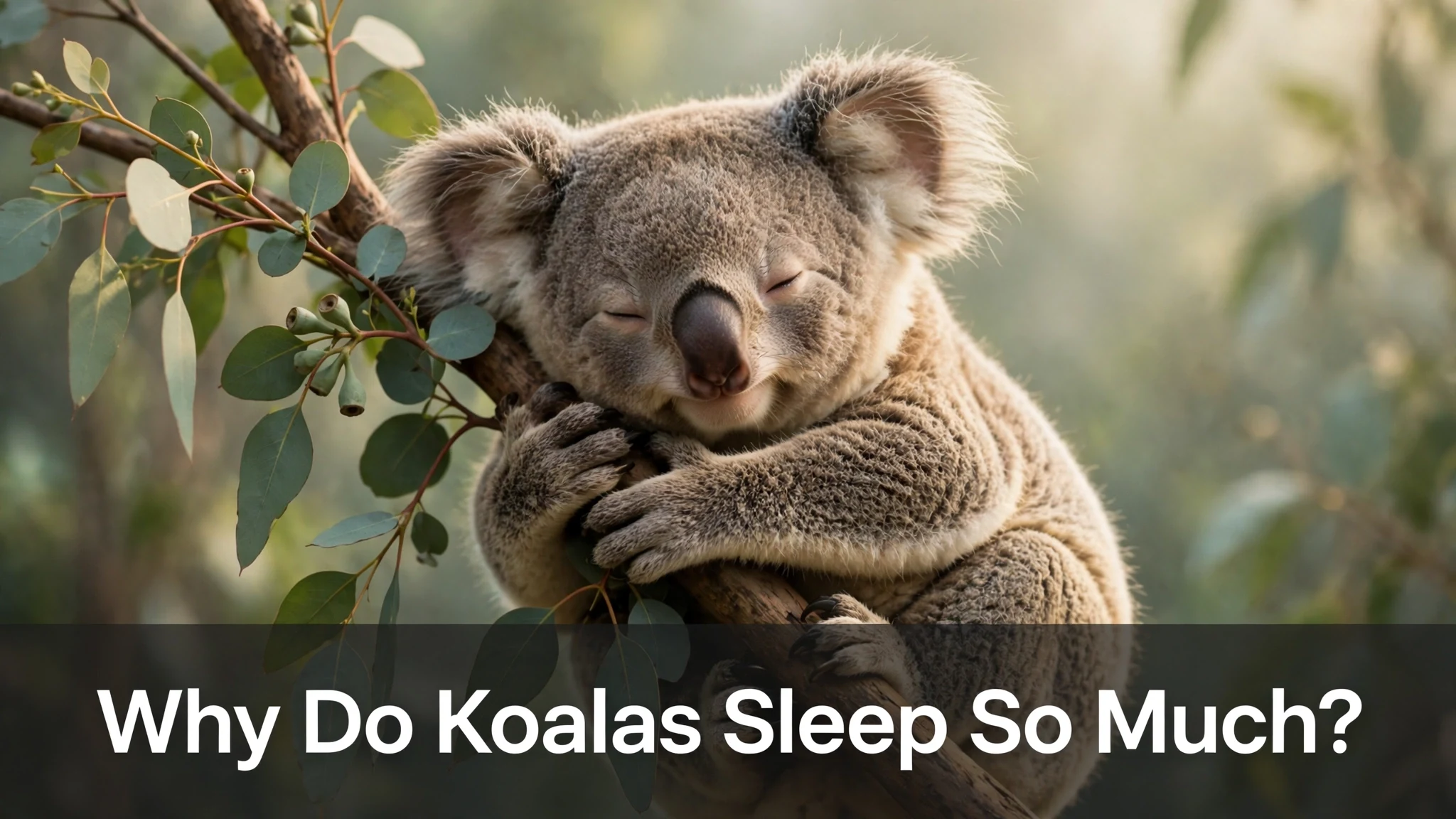
A koala spends most of its life asleep. It sleeps for up to 20 hours a day, curled up in a tree, hugging a branch, looking like a soft toy that has run out of batteries. It is easy to call the koala lazy, but that is unfair. The koala is not lazy. It is living on a diet that gives it almost no energy, and sleeping is how it survives on that diet. Its long sleep is not a choice to do nothing. It is a strategy.
This guide explains the eucalyptus diet, why it gives so little energy, how the koala’s body handles toxic leaves, and why sleeping saves energy. It also explains what koalas do when they are awake, and why their slow life is a successful one.
The Short Answer: A Diet With Almost No Energy
Koalas eat eucalyptus leaves, which are low in nutrients and hard to digest, so they have very little energy to spend.
In practice, Eucalyptus leaves are low in calories and protein, and high in fibre and toxins. A koala must eat a lot of leaves to get enough energy, yet even a full stomach gives it little fuel. That low-energy diet means the koala must save energy wherever it can. So sleeping is the koala’s main way of saving energy, and it sleeps because its food gives it so little to work with. The eucalyptus diet is the koala’s whole economy, and once I saw that, twenty hours of sleep stopped looking like laziness and started looking like a strict budget.
Look closer and A koala eats about 200 to 500 grams of leaves a day, which sounds like a lot. But those leaves are mostly water and fibre, and the usable energy is small. The koala’s body is slow, its movements are slow, and its sleep is long, all because its fuel is poor. So the koala’s whole life is shaped by its food, and its sleep is the most visible sign of that. A koala is not lazy; the toxic leaves, the slow gut, and the long sleep work as one system, and the way a joey learns to digest poison from its mother proves every part is doing a job.
The key point is that Other animals that eat leaves, such as sloths, also sleep a lot for the same reason. A low-energy diet and a slow life go together in nature. That pattern is a clue: if an animal sleeps a lot, ask what it eats, because the answer is often a poor diet. So the koala is not an exception; it is part of a pattern, and that pattern makes sense once you see it. Up close, sleeping all day looks less like idleness and more like a sensible way to live on food that gives almost no energy and takes a huge effort to digest.
Eucalyptus: Toxic, Tough, and Hard to Digest
Eucalyptus leaves are not just low in energy. They are also toxic, and the koala must work hard to digest them safely.
What makes this work is that Eucalyptus leaves contain oils and compounds that are poisonous to most animals. Koalas have a special liver that can break down those toxins, and a gut that can handle them. That detox work uses energy, which leaves even less energy for moving and playing. So the koala pays a price for its food, and that price is paid in energy, which it then saves by sleeping. People call koalas lazy and move on, yet that word hides a bold choice, eating leaves that poison most animals, and living slowly enough to survive on them.
Step back for a moment and The leaves are also tough and fibrous, which makes them hard to chew and digest. A koala has strong teeth and a large gut, where bacteria help break down the fibre. That digestion takes a long time, and the koala may spend hours digesting a meal it ate earlier. So the koala’s body is a slow factory, and sleeping gives that factory time to work without interruption. One koala day packs toxic food, slow digestion, and long sleep into a single animal, and the koala spends its energy so carefully that doing nothing is actually doing its job.
The surprising part is that Koalas are picky about which eucalyptus they eat, and they choose leaves with fewer toxins and more nutrients. They use their excellent sense of smell to pick the best leaves. That choosiness helps, but it does not change the basic fact: eucalyptus is a poor food. So the koala is a specialist, and its specialism is eating a food that almost no other animal can eat, at the cost of a slow, sleepy life. Follow the leaf from the tree to the gut to the long sleep, and the separate facts about koalas join into one story about making a poor food work.
Sleep as Energy Saving
Sleeping is the koala’s main energy-saving tool, and it does it well.
In practice, When a koala sleeps, its body uses less energy than when it is awake and moving. Its heart rate slows, its breathing slows, and its muscles relax. That saving adds up over 20 hours, and it is the difference between surviving and starving on a poor diet. So sleep is not wasted time for a koala; it is the time when its body saves the energy it needs to live. The eucalyptus diet is the koala’s whole economy, and once I saw that, twenty hours of sleep stopped looking like laziness and started looking like a strict budget.
Look closer and Koalas also sleep in a curled-up position, hugging a branch, which helps them stay warm. That position reduces heat loss, which also saves energy. In cold weather, a koala may curl up tighter, and in hot weather, it may stretch out to cool down. So the sleeping pose is also a thermostat, and it helps the koala manage its temperature without spending energy. A koala is not lazy; the toxic leaves, the slow gut, and the long sleep work as one system, and the way a joey learns to digest poison from its mother proves every part is doing a job.
The key point is that Koalas sleep during the day and are more active at night, when it is cooler. That timing helps them avoid the heat of the Australian sun. At night, they move, eat, and socialise, in short bursts of activity. So the koala’s day is upside down compared to ours, and its sleep is timed to the coolest, safest part of the day. Up close, sleeping all day looks less like idleness and more like a sensible way to live on food that gives almost no energy and takes a huge effort to digest.
What Koalas Do When They Are Awake
Koalas are not asleep all the time. When they wake, they eat, move, and communicate, in short, efficient bursts.
What makes this work is that A koala’s waking hours are mostly spent eating, because it needs a lot of leaves to get enough energy. It moves slowly from branch to branch, picking leaves and chewing them carefully. That eating is slow and steady, not fast and frantic. So the koala’s active time is not playtime; it is mealtime, and it is the work that fuels the next long sleep. People call koalas lazy and move on, yet that word hides a bold choice, eating leaves that poison most animals, and living slowly enough to survive on them.
Step back for a moment and Koalas also communicate with each other, especially males, who make a deep bellowing sound. That bellow is surprisingly loud for a small animal, and it carries far through the forest. It tells other males where the caller is, and it attracts females. So the koala’s voice is another surprise, like the frog’s throat pouch, and it shows that a quiet animal can be loud when it needs to be. One koala day packs toxic food, slow digestion, and long sleep into a single animal, and the koala spends its energy so carefully that doing nothing is actually doing its job.
The surprising part is that Koalas move between trees by climbing down and walking on the ground, which is risky. They are vulnerable to dogs, cars, and predators when they are on the ground. That is why they prefer to stay in trees, where they are safer. So the koala’s awake time is not only about food; it is also about risk, and the koala manages that risk by staying high and moving slowly. Follow the leaf from the tree to the gut to the long sleep, and the separate facts about koalas join into one story about making a poor food work.
Baby Koalas: Sleep, Milk, and Learning
Baby koalas, called joeys, sleep a lot too, and they depend on their mothers for food and safety.
In practice, A joey is born tiny, about the size of a jelly bean, and it climbs into its mother’s pouch. It stays there for about six months, drinking milk and growing. During that time, it sleeps a lot, as babies do, and its mother provides warmth and food. So the joey’s early life is a sleepy, safe time, inside the pouch, where it can grow without spending energy. The eucalyptus diet is the koala’s whole economy, and once I saw that, twenty hours of sleep stopped looking like laziness and started looking like a strict budget.
Look closer and After leaving the pouch, a joey rides on its mother’s back or belly for several more months. It starts to eat leaves, and it learns which ones to pick by watching its mother. It also eats a special substance from its mother, called pap, which gives it the gut bacteria it needs to digest eucalyptus. So the joey’s learning is gradual, and it depends on its mother for both food and the bacteria that make that food digestible. A koala is not lazy; the toxic leaves, the slow gut, and the long sleep work as one system, and the way a joey learns to digest poison from its mother proves every part is doing a job.
The key point is that Young koalas sleep less than adults as they grow, but they still sleep a lot. They need sleep to grow, and they need their mother’s protection while they sleep. That protection is important, because young koalas are vulnerable to predators. So the koala’s sleepy life starts early, and it is part of growing up, not just a habit of adults. Up close, sleeping all day looks less like idleness and more like a sensible way to live on food that gives almost no energy and takes a huge effort to digest.
Are Koalas Lazy? A Fairer View
Calling a koala lazy misses the point. A koala is efficient, not lazy, and its slow life is a success.
What makes this work is that A koala’s slow life is a successful adaptation to a difficult food. By eating a food that other animals cannot eat, koalas avoid competition. They have a whole forest of eucalyptus to themselves, with few rivals. So the koala’s diet is a trade: poor food, but plenty of it, and no competition, which is a good deal in the long run. People call koalas lazy and move on, yet that word hides a bold choice, eating leaves that poison most animals, and living slowly enough to survive on them.
Step back for a moment and Koalas have lived in Australia for millions of years, which shows their strategy works. They have survived droughts, fires, and changes in the forest, by being slow, careful, and energy-saving. That survival is a sign of success, not failure. So the koala is not a failed animal; it is a specialist, and specialists can be very successful in the right place. One koala day packs toxic food, slow digestion, and long sleep into a single animal, and the koala spends its energy so carefully that doing nothing is actually doing its job.
The surprising part is that The word lazy is a human judgment, not a scientific one. It assumes that being active is always better, which is not true in nature. For a koala, being active would waste energy and could lead to starvation. So the fairer word is efficient, and the koala is one of the most efficient animals in Australia, because it does a lot with very little. Follow the leaf from the tree to the gut to the long sleep, and the separate facts about koalas join into one story about making a poor food work.
Koalas, Trees, and a Changing Australia
Koalas depend on eucalyptus trees, and those trees are under threat from clearing, fire, and disease.
In practice, Koalas need large, healthy eucalyptus forests to live, because they need many trees to find enough food. When forests are cleared for farms or houses, koalas lose their home and their food. That loss is the main threat to koalas, and it is a human-caused threat. So protecting koalas means protecting trees, and that is a practical, clear goal. The eucalyptus diet is the koala’s whole economy, and once I saw that, twenty hours of sleep stopped looking like laziness and started looking like a strict budget.
Look closer and Bushfires are also a serious threat, because they can destroy whole forests and kill koalas that cannot escape. Koalas are slow, and they cannot outrun a fast fire. After a fire, the forest may take years to recover, and koalas may have nowhere to go. So fire is a natural part of Australia, but it is becoming more frequent and more severe, which makes it harder for koalas to recover. A koala is not lazy; the toxic leaves, the slow gut, and the long sleep work as one system, and the way a joey learns to digest poison from its mother proves every part is doing a job.
The key point is that Disease, especially chlamydia, also affects koalas, and it can cause blindness and infertility. That disease is a major problem for some koala populations. Scientists are working on vaccines and treatments, but the best help is still habitat protection. So the koala’s future depends on people, and on whether we protect the forests that koalas need to sleep, eat, and live. Up close, sleeping all day looks less like idleness and more like a sensible way to live on food that gives almost no energy and takes a huge effort to digest.
My Take:
I used to think koalas were lazy, because that is the easy word for an animal that sleeps 20 hours a day. Now I think that word is unfair. A koala is living on a diet that gives it almost nothing, and it has found a way to survive on it by sleeping, by moving slowly, and by eating a food no one else wants. That is not laziness. That is a clever, patient solution to a hard problem, and it has worked for millions of years.
I think the diet answer is the key, because it explains everything else. Low-energy food means low energy to spend, which means slow movement and long sleep. Once you see that chain, the koala’s life makes sense, and the word lazy stops fitting. The diet answer is what I keep thinking about, because low-energy food explains the sleep, the slowness, and the whole koala way of life in one stroke. Koalas have stopped being a joke about laziness for me; they are a study in needing less, and that study stays with me whenever I feel I need more.
The toxic leaves are the part that surprised me most. Eucalyptus is poisonous to most animals, yet koalas eat it every day. That is a bold choice, and it shows that a difficult food can be a good food if you are the only animal that can eat it. For me, the honest test for a koala sleeping so much is simple. Koala talk that only sounds clever is no use to me, so I set it aside and look at the leaves. An explanation about koalas earns my trust when it lets me guess the animal’s day, for instance that it will sleep through the heat, and this piece kept guessing right. That is the kind of koala detail I would pass on at a wildlife park, so the sleeping animal in the fork of a tree feels like a survivor, not a slacker.
I also like the idea of sleep as saving, not wasting. We think of sleep as time lost, but for a koala, sleep is time saved, because it is when the body uses least energy. That is a useful way to think about rest in our own lives too: rest is not always lost time, and sometimes it is the most productive thing you can do. It took me a while to see koala sleep as saving rather than wasting, because I had always treated sleep as lost time, not as a way to save energy. For me, learning about a koala sleeping so much was not one dramatic moment. A poisonous leaf here, a long sleep there, a joey learning from its mother, and the separate pieces gradually formed a picture I had not expected. Simple questions about koalas do not feel silly to me any more, because asking why they sleep so much led straight to the leaves, the gut, and the energy budget.
The baby koala story stayed with me, because it shows how much a mother gives. A joey needs milk, warmth, protection, and even gut bacteria from its mother, before it can eat leaves on its own. That is a long, careful start to life, and it reminds me that slow beginnings can lead to a long, successful life. If a friend asked about koalas, I would say look at the food first, because the food explains the sleep, and the sleep explains almost everything else. Ask what the leaves cost to digest, who gains from a food nobody else wants, and what waking costs a koala, and the long sleep turns into a careful calculation. My old word for koalas was lazy, and the slower, fairer view that replaced it has needed no argument since, which tells me it is probably right.
If I saw a koala in the wild, I would watch it sleep, not wake it. A sleeping koala is a koala doing its job, which is saving energy. Waking it would waste that energy, and it would be a selfish thing to do for a photo. Studying koalas has made me more careful with easy labels, because an animal I called lazy turns out to be doing a difficult job with very little fuel. The more I learn about koalas, the less I want to judge any animal by human working hours, and that shift feels like a small, useful correction. Looking again at a koala pays off, because the first look sees sleep and the second sees a strict energy budget. One image stays with me better than any list: a koala wedged in a fork, asleep in the heat, saving every scrap of energy it has.
The lesson I take from koalas is about efficiency. A koala does a lot with very little, by choosing a food no one else wants and by living slowly. I think we could learn from that: you do not always need more, and sometimes the best choice is to need less and to use it well. If I had to keep a single koala lesson, it would be the efficiency one, because doing a lot with very little is a skill I could use myself. Trying to retell the koala story without the guide in front of me showed me how much I still leaned on the word lazy, and how little that word explains.
Re-reading the opening section about a diet with almost no energy, I saw how a single shortage, energy, shapes the koala’s whole life. The famous twenty hours is not the most instructive part; the slow gut that makes those hours necessary is where the real koala story lives. That slow gut reassures me in a quiet way, because it proves a difficult life can be managed with patience rather than with speed.
The eucalyptus section changed my conversations about koalas, because now I can talk about a poison the animal eats daily instead of just its sleep. My koala conversations now begin with the leaves, move to the toxic diet, and finish by saying what the long sleep means to me. Putting the leaves before my conclusion lets the listener see the koala’s problem first, and that seems the fairest way to present it. It also gives the listener space to disagree, and a koala discussion that welcomes a different view is far more interesting than a lecture.
Reading about sleep as energy saving last gave me a new view of the whole piece, one I had missed in the earlier sections. Diet, sleep, and the joey’s long learning all pointed the same way: save energy, move slowly, and let what you learn change what you believed. Those habits matter beyond koalas, which is why I will come back to this piece instead of reading it once and moving on. Next time I see a koala, I will watch it sleep without waking it, and I expect that quiet watching to teach me something new.
Frequently Asked Questions
How many hours do koalas sleep a day?
Koalas sleep for up to 20 hours a day, usually 18 to 22 hours. They are most active at night, when it is cooler, and they spend their waking hours mainly eating.
Why do koalas sleep so much?
Koalas eat eucalyptus leaves, which are low in energy and hard to digest. Sleeping saves energy, which lets them survive on a diet that gives them very little fuel.
Are koalas lazy?
No, koalas are not lazy. Their slow, sleepy life is an adaptation to a low-energy diet. Sleeping and moving slowly save the energy they need to live, and their strategy has worked for millions of years.
What do koalas eat?
Koalas eat eucalyptus leaves, choosing species and leaves with fewer toxins and more nutrients. They eat about 200 to 500 grams of leaves a day, and they use their sense of smell to pick the best ones.
Do koalas drink water?
Koalas get most of their water from eucalyptus leaves, which are high in water. They rarely drink from streams, although they may drink during droughts or after fires. Their name is thought to mean no water in an Aboriginal language, although that meaning is debated.
Where do koalas sleep?
Koalas sleep in eucalyptus trees, curled up in a fork of branches, hugging the branch. That position helps them stay warm and safe, and it lets them rest without falling.