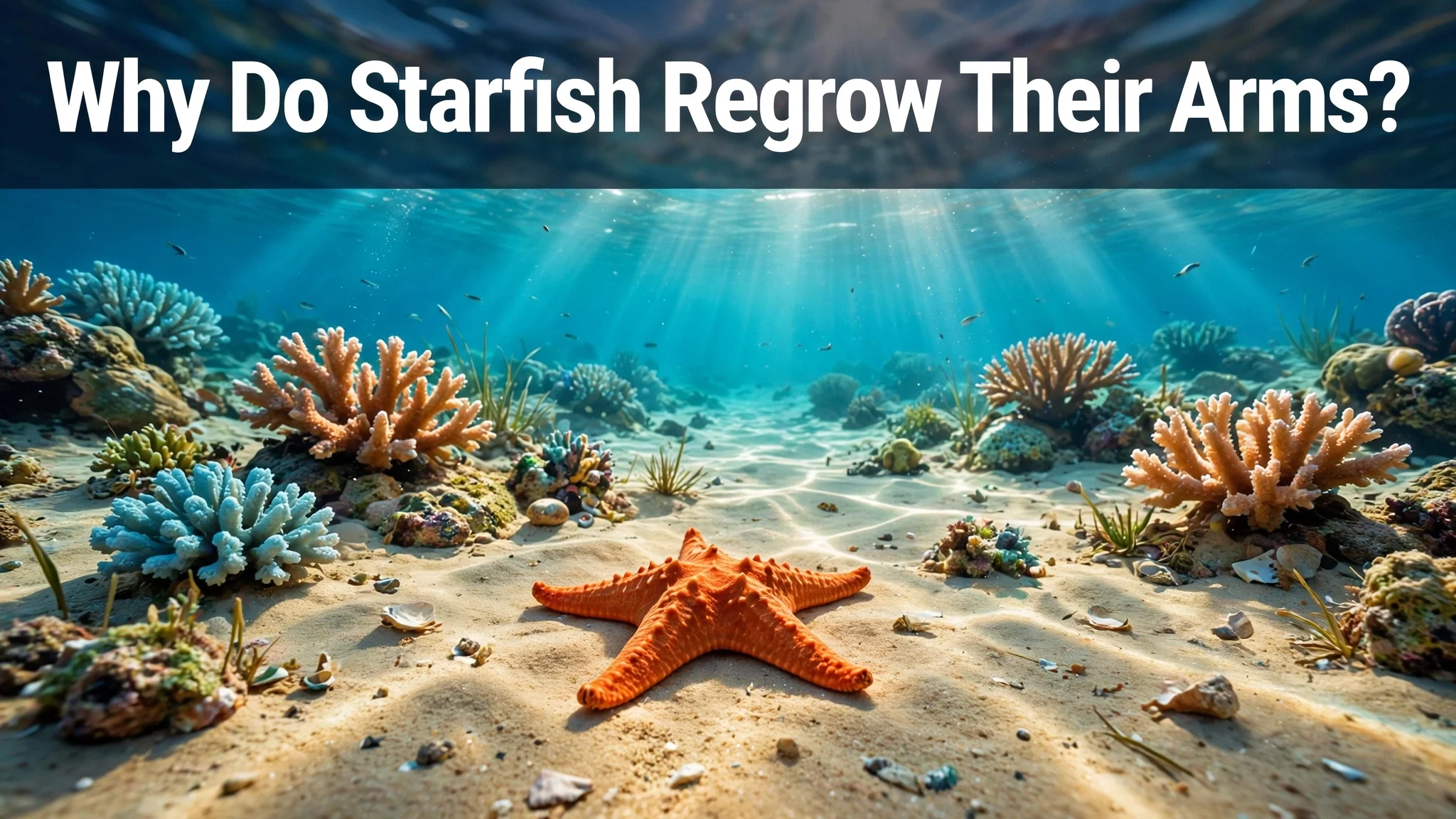
Why Do Starfish Regrow Their Arms? Explained Simply
In this post
A starfish loses an arm to a predator, or to a rock, and then, over weeks and months, it grows a new one. That sounds like science fiction, yet it is a normal part of starfish life. Some starfish can even grow a whole new body from a single arm, if that arm has part of the central disc. That ability, called regeneration, is one of the most remarkable in the animal kingdom, and it is a key reason starfish have survived for hundreds of millions of years.
This guide explains how starfish regrow arms, what happens inside the body during regrowth, why some starfish can regrow more than others, and what limits regeneration. It also explains why starfish lose arms in the first place, and what that tells us about their lives.
The Short Answer: A Body Built to Rebuild
Starfish can regrow arms because their bodies are simple, flexible, and full of cells that can become many different types.
In practice, A starfish’s body is not like a human body, with a brain, a heart, and a skeleton that must stay in one shape. It has a simple nervous system, a water-based system for moving, and no brain. Its cells are more flexible, and they can change into the cells needed to rebuild an arm. So the starfish’s simplicity is its strength, and it lets the body rebuild what it has lost. The regrowing arm bud is the starfish’s promise, and once I saw how a small bump becomes a whole arm, losing a limb stopped looking like a disaster and started looking like a plan.
Look closer and When an arm is lost, the wound closes quickly, and new cells grow to form a small bud. That bud grows into a new arm, with skin, muscles, and tube feet. The process takes weeks or months, depending on the species and the conditions. So regrowth is slow, but it is steady, and it is a normal part of the starfish’s life, not a miracle. A starfish’s body is not a single animal in the usual sense; the tube feet, the water system, and the stem cells work together, and the way one arm can become a whole starfish proves every part carries the instructions for the whole.
The key point is that Some starfish can regrow an arm in a few months, while others take a year or more. The speed depends on food, temperature, and the size of the arm lost. A well-fed starfish in warm water regrows faster than a hungry one in cold water. So regrowth is not fixed; it depends on the starfish’s health and its environment, like healing in any animal. Up close, regrowing an arm looks less like science fiction and more like a slow, practical repair, where stem cells become whatever the missing arm needs.
Why Starfish Lose Arms
Starfish lose arms to predators, to accidents, and sometimes on purpose, to escape.
What makes this work is that Predators such as fish, crabs, and birds can bite off a starfish’s arm. A starfish that loses an arm can escape, because the predator may be satisfied with the arm and leave the rest alone. That is a trade: lose an arm, save your life. So losing an arm is not always a disaster; it can be a successful escape, and regrowth makes that trade possible. People imagine regrowth as instant, yet the real process takes weeks or months, and that slowness is what makes it believable, a complex arm rebuilt cell by cell.
Step back for a moment and Starfish can also drop an arm on purpose, in a process called autotomy. If an arm is grabbed, the starfish can detach it at a weak point, like a lizard dropping its tail. That self-amputation lets the starfish escape, and the arm grows back later. So the starfish can choose to lose an arm, and that choice is a defence, not an accident. One starfish packs defence, repair, and a second chance into a single body, and the animal spends its energy so carefully that dropping an arm to escape a predator is a price worth paying.
The surprising part is that Arms can also be lost to rough waves, rocks, or injury. A starfish that is washed onto a shore or hit by a rock may lose an arm. In a healthy starfish, that arm will regrow, although it may take time. So the sea is a rough place, and regrowth is a way of coping with the damage that rough place causes. Follow the arm from the wound to the bud to the new limb, and the separate stages of regrowth join into one story about a body built to rebuild itself.
How Regrowth Works, Step by Step
Regrowth follows a series of steps, from wound closing to a new arm growing.
In practice, First, the wound closes, to stop the starfish losing fluid and to keep out infection. A thin layer of skin forms over the wound, which protects the inside of the body. That closing happens quickly, within hours or days. So the first step is protection, and it is the same as healing in any animal: close the wound first, then rebuild. The regrowing arm bud is the starfish’s promise, and once I saw how a small bump becomes a whole arm, losing a limb stopped looking like a disaster and started looking like a plan.
Look closer and Next, cells at the wound change and start to form a small bud, which will become the new arm. Those cells are stem cells, which can become many different types of cell. They divide and grow, forming the tissues of the new arm. So the bud is a fresh start, and it contains the potential to become a whole arm, with all its parts. A starfish’s body is not a single animal in the usual sense; the tube feet, the water system, and the stem cells work together, and the way one arm can become a whole starfish proves every part carries the instructions for the whole.
The key point is that The bud then grows longer, and it develops skin, muscles, tube feet, and other structures. The new arm is smaller at first, and it grows to full size over weeks or months. At first, the new arm may look pale or small, but it soon looks like the others. So regrowth is a gradual process, and the new arm is not finished in a day; it grows, like a plant growing a new shoot. Up close, regrowing an arm looks less like science fiction and more like a slow, practical repair, where stem cells become whatever the missing arm needs.
Can a Whole Starfish Grow From One Arm?
In some species, a single arm can grow into a whole new starfish, if it has part of the central disc.
What makes this work is that Most starfish need part of the central disc, the middle of the body, to regrow a whole animal. An arm without that central part can regrow the arm, but it cannot become a new starfish. That is because the central disc holds important organs, including part of the digestive system. So a single arm is not enough on its own; it needs a piece of the centre to make a whole new body. People imagine regrowth as instant, yet the real process takes weeks or months, and that slowness is what makes it believable, a complex arm rebuilt cell by cell.
Step back for a moment and Some species, however, can regrow a whole body from a single arm, even without the central disc. Those species have a more flexible body plan, and their arms contain enough of the right cells. That ability is rare, and it is a remarkable example of regeneration. So the answer depends on the species, and the most extreme regrowth is found in only a few starfish. One starfish packs defence, repair, and a second chance into a single body, and the animal spends its energy so carefully that dropping an arm to escape a predator is a price worth paying.
The surprising part is that That ability also means a starfish can reproduce by splitting, not just by laying eggs. A starfish that splits into pieces can become two starfish, each regrowing what it lost. That is a form of asexual reproduction, and it lets starfish spread without a mate. So regrowth is not only about healing; it is also about reproduction, and it gives starfish another way to make more starfish. Follow the arm from the wound to the bud to the new limb, and the separate stages of regrowth join into one story about a body built to rebuild itself.
Tube Feet, Water, and the Starfish Body
A starfish’s body is built around a water system, which helps it move, feed, and regrow.
In practice, Starfish move using tube feet, small, suction-cup feet on the underside of their arms. Those feet are filled with water, and they extend and retract to grip the ground. The water system, called the water vascular system, powers those feet. So the starfish’s movement is hydraulic, like a machine that uses water pressure, and that system must be rebuilt in a new arm too. The regrowing arm bud is the starfish’s promise, and once I saw how a small bump becomes a whole arm, losing a limb stopped looking like a disaster and started looking like a plan.
Look closer and Starfish also feed in a remarkable way, by pushing their stomach out of their body to digest food outside. They eat mussels, clams, and other shellfish, by opening the shell and digesting the animal inside. That feeding method needs a working stomach and tube feet, which is why a new arm must regrow all its parts. So the starfish’s body is a set of linked systems, and regrowth must rebuild all of them, not just the skin. A starfish’s body is not a single animal in the usual sense; the tube feet, the water system, and the stem cells work together, and the way one arm can become a whole starfish proves every part carries the instructions for the whole.
The key point is that Starfish have no brain, but they have a nervous system that runs through their arms. That system lets them sense light, touch, and chemicals in the water. A new arm must regrow its nerves too, so it can sense and move. So the starfish’s simplicity is deceptive, and its body is a complex, coordinated system, even without a brain. Up close, regrowing an arm looks less like science fiction and more like a slow, practical repair, where stem cells become whatever the missing arm needs.
What Limits Regeneration
Regeneration is powerful, but it has limits, and a starfish cannot regrow everything, every time.
What makes this work is that A starfish that loses its central disc, or that is badly injured, may not survive. Regrowth needs energy, food, and a healthy body, and a starfish that is starving or sick may not regrow well. That is why regrowth is faster in a well-fed starfish than in a hungry one. So regeneration is not magic; it is a biological process that needs resources, and it fails when those resources are missing. People imagine regrowth as instant, yet the real process takes weeks or months, and that slowness is what makes it believable, a complex arm rebuilt cell by cell.
Step back for a moment and Age also matters. Young starfish regrow faster than old ones. That is true in many animals: young bodies heal faster than old ones. A young starfish may regrow an arm in weeks, while an old one may take months. So regrowth slows with age, and that is a reminder that even a remarkable ability has its limits. One starfish packs defence, repair, and a second chance into a single body, and the animal spends its energy so carefully that dropping an arm to escape a predator is a price worth paying.
The surprising part is that Some species are better at regrowth than others, because their bodies are built differently. Species that live in rough places, where arms are often lost, tend to regrow better. Species that live in calm places may regrow more slowly. So the ability matches the life, and the starfish that needs regrowth most is the one that does it best. Follow the arm from the wound to the bud to the new limb, and the separate stages of regrowth join into one story about a body built to rebuild itself.
What Starfish Teach Scientists About Healing
Scientists study starfish regrowth to learn about healing, and that research may help humans one day.
In practice, Starfish stem cells are of interest to scientists, because they can become many different cell types. Understanding how those cells work may help us understand how human bodies heal, and why they cannot regrow limbs. That research is still early, but it is promising. So the starfish is not just a curiosity; it is a model, and it may teach us about our own bodies. The regrowing arm bud is the starfish’s promise, and once I saw how a small bump becomes a whole arm, losing a limb stopped looking like a disaster and started looking like a plan.
Look closer and Scientists also study how starfish close wounds without infection, even in dirty seawater. That wound healing is efficient, and it may hold lessons for medicine. A starfish can close a wound in hours, in water full of bacteria, without getting infected. So the starfish’s healing is a remarkable feat, and it is one that scientists want to understand better. A starfish’s body is not a single animal in the usual sense; the tube feet, the water system, and the stem cells work together, and the way one arm can become a whole starfish proves every part carries the instructions for the whole.
The key point is that Protecting starfish means protecting the sea, because starfish depend on clean water, healthy reefs, and plenty of food. Pollution, warming seas, and habitat loss all affect starfish. A starfish that cannot regrow because it is sick or starving is a sign that its environment is in trouble. So the starfish’s regrowth is also a health check, and its success or failure tells us about the sea. Up close, regrowing an arm looks less like science fiction and more like a slow, practical repair, where stem cells become whatever the missing arm needs.
My Take:
I find starfish regrowth both wonderful and humbling. A starfish loses an arm, and instead of being disabled for life, it grows a new one. It does not panic, it does not complain, and it does not need a hospital. It just closes the wound, grows a bud, and waits. That patience is impressive. It is also a reminder that our own bodies, which cannot regrow a limb, are not the only way to be alive, and that other animals have solved the problem of injury in a completely different way.
I think the trade of an arm for a life is the most honest part of the story. A starfish that drops an arm to escape a predator is making a clear choice: lose a part, save the whole. That is a brave, practical decision, and it is one I respect, because it puts survival above pride. The trade of an arm for a life is the part I keep thinking about, because a starfish that drops an arm to escape is making a clear choice, and that choice is brutally honest. Starfish are no longer just beach ornaments for me; they are a lesson in recovery, and I think about that lesson whenever I have to start again after a loss.
The idea that a single arm can become a whole starfish is the part that still feels like science fiction. It is true only for some species, and only if the arm has part of the centre, yet it is still remarkable. It reminds me that life is more flexible than we think, and that a body can be more than the sum of its parts. For me, the honest test for a starfish regrowing an arm is simple. Starfish explanations that only sound clever are put down, and I look at the tide pool instead. I trust a starfish explanation when it lets me predict the animal, like knowing regrowth will be slow, and this piece kept making that sort of prediction. That is the kind of starfish detail I would tell a friend on a beach, so the animal in the tide pool feels like a survivor, not just a pretty shape.
I also like that regrowth is slow. It takes weeks or months, not minutes, which is a realistic pace for rebuilding a complex arm. That slowness is a good correction to films where wounds heal instantly, and it shows that real healing takes time and energy. Understanding starfish regrowth took me longer than a glance, because the process is slow, the limits are real, and not every arm can become a whole animal. For me, learning about a starfish regrowing an arm was not one dramatic moment. A dropped arm here, a bud there, a new limb growing over months, and the separate stages gradually added up to a process I could finally follow. Simple questions about starfish feel less naive to me now, because asking whether one arm can become a whole starfish led me to species, stem cells, and limits all at once.
The stem cell detail is the one I would tell a scientist friend. Starfish stem cells can become many cell types, which is why they can rebuild an arm. Understanding those cells may help us understand human healing, and that is a practical reason to study a humble starfish. If a friend asked about starfish, I would tell them to put a live one back gently, because a starfish out of water is stressed, and a missing arm makes it more vulnerable. Ask what regrowth costs in time, who gains when a starfish drops an arm, and what the limits are, and the animal’s recovery turns into a set of trade-offs. My old view of starfish was a five-armed decoration, and the rebuilding animal that replaced it is far more interesting to think about.
If I found a starfish on a beach, I would put it back gently, if it was alive. A starfish out of water is stressed, and a starfish with a missing arm is already healing. Handling it roughly would make that healing harder, and it would be a thoughtless thing to do. Learning about starfish has made me slower to treat a loss as final, because an animal I thought was broken turns out to be in the middle of rebuilding. The more I learn about starfish, the less I trust the idea that damage is permanent, and that shift feels like a hopeful correction. A second look at a starfish pays off, because the first sees a decoration and the second sees an arm growing back. One image stays with me: a starfish with a tiny new arm bud, half the size of the others, and the patience that bud represents.
The lesson I take from starfish is about recovery. A starfish does not pretend it was never hurt. It closes the wound, grows a new arm, and carries on. I think we could learn from that: recovery is not about forgetting an injury, but about rebuilding, slowly, until the new part works as well as the old one. If I could keep one starfish lesson, it would be recovery, because the animal does not pretend it was never hurt, it closes the wound and grows again. When I tried to explain starfish without the guide, the uncertain part showed up fast: which species can regrow a whole body from one arm.
Going back to the opening section about a body built to rebuild, I noticed how much depends on stem cells, and how a single cell type can become many. Regrowth, the wonder everyone starts with, is less revealing than the tube feet, moving water through the body, which is where the starfish’s daily life actually runs. Watching water move through a starfish steadies me, because rebuilding turns out to depend on small processes, not on a single miracle.
The section on why starfish lose arms changed how I talk about them, because it gave me a reason, escape, to describe instead of just a wonder. I begin now by asking why a starfish would drop its own arm, then I describe the regrowth, and only then do I draw a wider lesson. Starting with the loss lets the listener feel the starfish’s choice first, and that seems a fairer way to present it than starting with my conclusion. It also leaves space for the listener to disagree, and a starfish conversation that welcomes a different view is far more interesting than a lecture.
How regrowth works, considered at the end, revealed a pattern I had missed: the starfish keeps solving the same problem, damage, in a different way at each stage. Losing, closing, and rebuilding kept appearing together, in the dropped arm, in the bud, and in the slow growth of a new limb. Those ideas help with more than starfish, which is why I intend to read this piece again rather than filing it away. I will look at the next starfish I find with fresh eyes, checking for a small new arm, and expecting that second look to show me more.
Frequently Asked Questions
Can starfish really regrow their arms?
Yes, a starfish can truly grow a lost arm back. Most starfish can regrow a lost arm over weeks or months. The wound closes first, then a small bud grows into a new arm with skin, muscles, and tube feet.
How long does it take a starfish to regrow an arm?
It depends on species, food, and temperature, but it usually takes several weeks to several months. A well-fed starfish in warm water regrows faster than a hungry one in cold water.
Can a whole starfish grow from one arm?
In some species, yes, if the arm has part of the central disc. An arm without that central part usually cannot become a whole new starfish, although it can regrow into a complete arm.
Why do starfish lose their arms?
Starfish lose arms to predators, accidents, and rough waves. They can also drop an arm on purpose to escape a predator, in a process called autotomy, and then regrow it later.
Do starfish feel pain when they lose an arm?
Starfish have a simple nervous system and no brain, so they do not feel pain in the way humans do. They can sense damage and respond to it, but their experience is very different from ours.
How many arms does a starfish have?
Most starfish have five arms, but some species have more. Some have 10, 20, or even 40 arms, and the number depends on the species.