Why Moon Changes Its Shape
In this post
- The Moon Always Has A Day Side And A Night Side
- Why We Always See The Same Face
- The Eight Phases In Order
- First Quarter And Waxing Gibbous
- Full Moon, Then The Long Waning
- The Waning Crescent: The Last Phase
- Why The Moon Does Not Eclipse Every Month
- Why The Moon Sometimes Appears In Daylight
- The Shape You See Depends On Where You Stand
- How To Watch The Phases Yourself
- You may also like
Go outside tonight and look at the Moon. Tomorrow night, look again. It will not look the same. One night it is a thin silver sliver, low in the evening sky. A week later it is half lit, bold and bright. A week after that it is a full, round face, rising as the Sun sets. Then it shrinks again, night by night, until it seems to vanish altogether, before the sliver returns and the whole show begins again. The Moon is not changing shape at all. What changes is how much of its sunlit half we can see from Earth, and that simple fact, repeated every month, explains every shape the Moon ever wears.
Night after night, and sometimes day after day, you will see the Moon take a slightly different shape in the sky. These different shapes are called the phases of the Moon, and they change with a regular pattern over a period of about 30 days. The phases are caused by the changing positions of the Moon, Earth, and the Sun. As the Moon goes around the Earth, different parts of it are illuminated by the Sun. This post follows that monthly journey, phase by phase, and clears up the misunderstandings that make the Moon seem stranger than it is.
The Moon Always Has A Day Side And A Night Side
Start with the most important idea, because everything else follows from it. The Moon is a round ball of rock, and the Sun shines on it from one direction, just as a lamp shines on one side of a ball in a dark room. The half facing the Sun is in daytime. The half facing away is in night. That never changes. Half the Moon is always lit, and half is always dark, no matter what shape we see from Earth.
What changes is our viewpoint. The Moon travels around Earth, and as it moves, we see different amounts of its lit half and its dark half. When the lit half faces mostly away from us, we see almost nothing: the dark side is turned toward Earth, and the Moon seems to vanish. When the lit half faces mostly toward us, we see a full, bright disc. In between, we see mixtures: slivers, halves, and bulging shapes, depending on how much of the daytime half has swung into view. The Moon is not growing and shrinking. We are watching the same ball from a moving seat.
A simple way to picture it is to hold a ball at arm’s length in a dark room with one lamp. Turn slowly in a circle. When your back is to the lamp and the ball is in front of you, the lamp lights the far side of the ball, and you see a dark disc. When you have turned halfway round, the lamp is behind you, lighting the side of the ball that faces you, and you see a bright disc. In between, you see half-lit balls, crescents, and bulges, exactly like the Moon’s phases. You are Earth, turning in the room. The ball is the Moon. The lamp is the Sun.
Why We Always See The Same Face
Here is a second puzzle. If the Moon travels all the way around Earth, why do we never see its far side? The same side of the Moon always points toward Earth, and that fact shapes everything about the phases. The Moon does spin on its own axis, but it spins at exactly the rate needed to keep the same face toward us as it orbits. It is like walking around a friend while always facing them: you turn as you circle, but your face never turns away.
Because the same side always points toward Earth, most of the time some of the illuminated part, daytime on the Moon, faces away from us, and some of the non-illuminated part, nighttime on the Moon, faces toward us. That mixture is what creates the phases. If the Moon did not keep the same face toward us, the pattern of phases would be different and harder to follow. As it is, the near side is our familiar Moon, with its dark patches and bright plains, and the phases are simply the changing pattern of sunlight falling across that familiar face.
The far side, the side we never see from Earth, is not dark. It gets just as much sunlight as the near side, over the course of a month. Calling it the “dark side of the Moon” is a misunderstanding. It is the far side, hidden from our view by the Moon’s motion, not by any lack of light. When the Moon is new and invisible to us, its far side is fully lit. When the Moon is full and bright to us, its far side is in darkness. Light and visibility are two different things, and the phases are about visibility, not about how much light the Moon receives.
The Eight Phases In Order
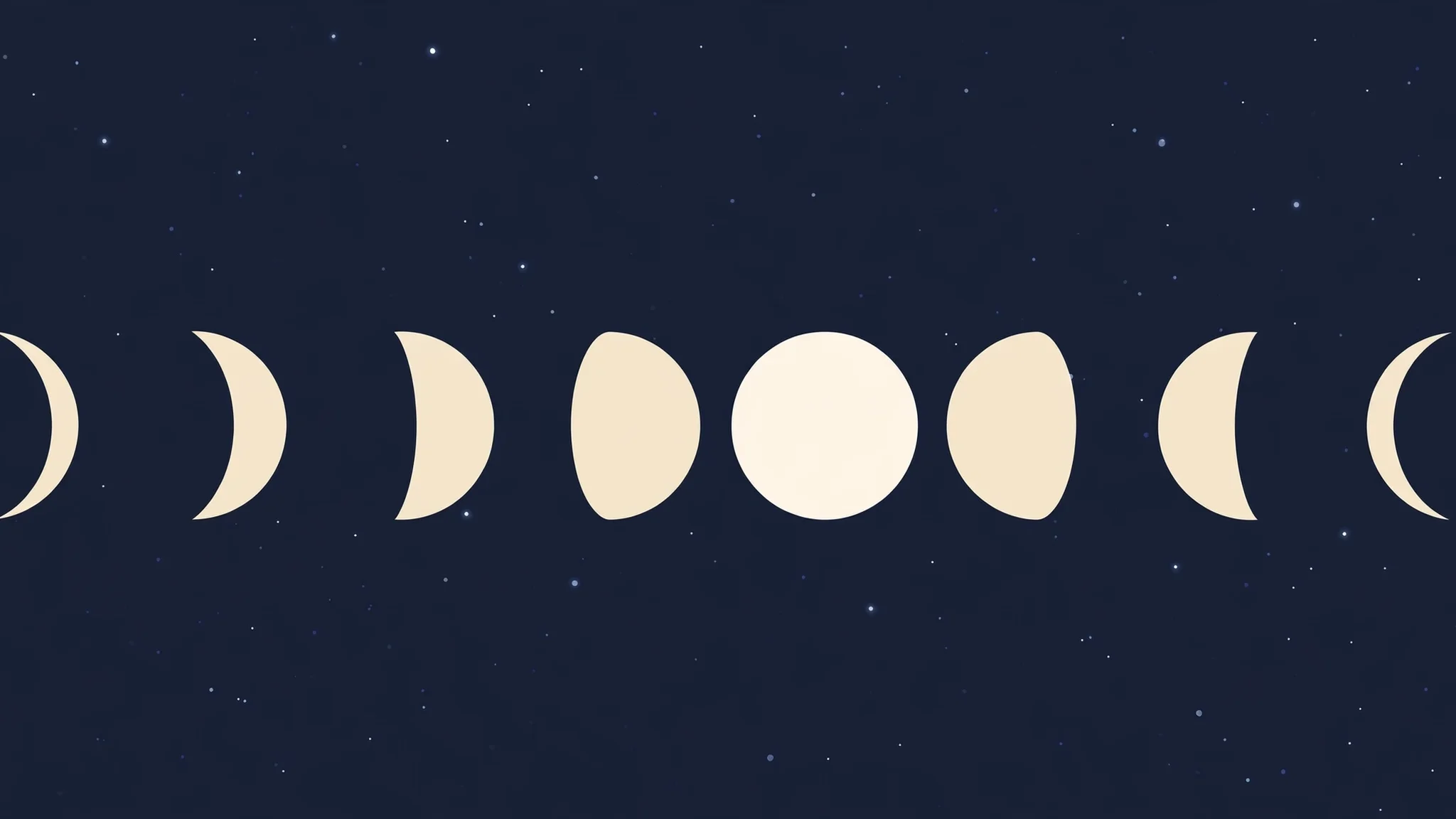
There are eight main Moon phases, and they always follow in the same order, like the hours on a clock. Learning them in order is the fastest way to read the night sky.
The cycle begins with the new Moon. This is when you cannot see the Moon easily at all, because the part that is illuminated by the Sun is on the side of the Moon pointing away from Earth. This phase happens when the Moon is between the Sun and Earth. Because the Moon’s orbit around the Earth is tilted by about five degrees, it is usually either above or below the Sun, so it does not block the Sun’s light every month. But sometimes it lines up directly with the Sun, and this creates a solar eclipse. On average, a solar eclipse happens between two and five times each year.
Next comes the waxing crescent. As the Moon moves in its orbit, a small sliver becomes visible. It takes a crescent shape because of the Moon’s roundness: we only see the edge of the part that is illuminated by the Sun, and that edge is on a round object, so it appears curved. “Waxing” means growing: from now until the full Moon, the lit part grows larger each night.
First Quarter And Waxing Gibbous
Then comes the first quarter. This is when half of the Moon’s illuminated surface is visible from Earth. The name is confusing, because we are seeing one-quarter of the total Moon’s surface illuminated, which is why it is called a quarter even though it looks like a half. The lit half is the right-hand side, as seen from the northern hemisphere, and the Moon is high in the sky in the evening.
After that comes the waxing gibbous. When more than half of the Moon’s surface visible from Earth is illuminated, we call it a gibbous Moon. “Gibbous” means bulging: more than half lit, but not yet full. Each night, the bulge grows, and the dark part shrinks to a shrinking sliver on the left.
Full Moon, Then The Long Waning
The fifth phase is the full Moon. When the Moon is on the opposite side of the Earth from the Sun, we see the entire near side of the Moon illuminated. The full Moon rises as the Sun sets, shines all night, and sets as the Sun rises, which is why full Moon nights feel so bright and why the full Moon has gathered so many stories, festivals, and names across cultures. For the same reason we do not have solar eclipses with every new Moon, we do not get lunar eclipses with every full Moon. The Moon’s orbit around the Earth is tilted by about five degrees, meaning sometimes it is below our shadow and sometimes it is above it. But every once in a while things line up so that it does go through the Earth’s shadow, and we get a lunar eclipse, when Earth’s shadow falls across the Moon and turns it a deep, coppery red.
After the full Moon, the illuminated portion visible from Earth begins to wane, or decrease in size. The waning gibbous phase follows: the Moon’s surface visible from Earth is still mostly illuminated, but a dark edge is now eating into the right-hand side, and the lit part shrinks a little each night. “Waning” means shrinking, and from here to the new Moon, the light only decreases.
Then comes the third quarter, also called the last quarter. This is when half of the Moon’s illuminated surface is visible from Earth, but now the illuminated part is the half of the near side that was not illuminated at first quarter: the left-hand half, as seen from the northern hemisphere. The Moon now rises late at night and is high in the morning sky.
The Waning Crescent: The Last Phase
The final phase is the waning crescent. This happens when only a small sliver of the Moon is visible, on the far side of the Moon’s visible surface compared with the waxing crescent, before it disappears into the new Moon phase once again. The sliver is thin, low in the early morning sky, and easily missed. A few days later, a new sliver appears in the evening, and the cycle begins again. The whole journey takes about 30 days, which is why months and Moons have been linked in calendars for thousands of years.
Why The Moon Does Not Eclipse Every Month
If the Moon passes between Earth and the Sun at every new Moon, why is there not a solar eclipse every month? And if the Moon passes behind Earth at every full Moon, why is there not a lunar eclipse every month? The answer is the tilt. The Moon’s orbit around the Earth is tilted by about five degrees, so at most new Moons it passes above or below the Sun, and at most full Moons it passes above or below Earth’s shadow. Only when the alignment is exact, which happens a few times a year, does an eclipse occur.
This tilt is a small detail with large consequences. Without it, eclipses would be monthly events, routine and unremarkable. With it, they are rare enough to be news, and predictable enough to be forecast years in advance. The same tilt also explains why the new Moon is invisible rather than black: at new Moon, the Moon is near the Sun in the sky, lost in its glare, and its dark side faces us, so there is nothing bright for our eyes to catch.
Why The Moon Sometimes Appears In Daylight
Many people are surprised to see the Moon in the daytime, as if it has broken a rule. It has not. The Moon is up in the daytime for roughly half of every month, because its phases put it in different parts of the sky at different times of day. The full Moon is a night creature, rising at sunset. The first-quarter Moon is high in the afternoon and evening. The last-quarter Moon is up in the morning. The crescent Moons hug the Sun, appearing briefly near sunrise or sunset.
Daytime Moons are often overlooked because the blue sky is bright and the Moon is pale by comparison, but on a clear day, especially around first and last quarter, the Moon is easy to spot if you know where to look. Its presence in daylight is a useful reminder that the phases are about geometry, not about night and day. The Moon does not sleep during the day. It is always there, circling us, lit by the same Sun that lights our afternoons, showing us more or less of its daytime half as it goes.
The Shape You See Depends On Where You Stand
One more detail completes the picture. The phases look mirrored depending on which hemisphere you stand in. In the northern hemisphere, the waxing Moon’s lit sliver grows on the right, and the waning Moon’s light retreats to the left. In the southern hemisphere, the pattern is reversed: the growing Moon lights up on the left, and the shrinking Moon fades on the right. Neither view is wrong. Both are the same geometry, seen from opposite sides of the planet, like looking at a clock from the front and from behind.
The shapes also look different near the equator, where the crescent Moon can appear like a boat, with its points facing upward, rather than like the letter C or D familiar in temperate skies. These differences are not different Moons. They are the same Moon, the same phases, and the same 30-day pattern, viewed from different places on a round Earth. Wherever you stand, the rule holds: the lit part grows from new to full, and shrinks from full to new, in the same order, every month.
How To Watch The Phases Yourself
You do not need a telescope to learn the phases. You need a clear sky, a few minutes each evening, and a little patience. Start on the evening after a new Moon, when the first thin crescent appears low in the west just after sunset. Note which side is lit. Come back the next evening, at the same time, and the sliver will be a little fatter, a little higher, and a little easier to find. Keep coming back, and within two weeks you will watch it grow to full. Then watch it shrink, rising later each night, until it is a morning sliver and then gone.
After one full cycle, you will never need to memorise the phases again, because you will have seen them happen. You will know, without thinking, that a half Moon in the evening is growing toward full, and a half Moon in the morning is shrinking toward new. You will know why the Moon sometimes vanishes, why it sometimes blazes all night, and why its shape is never a mystery, only a viewpoint. The Moon does not change its shape. We do, by moving around it, night after night, under the same Sun.
You may also like
Frequently Asked Questions
Why does the Moon change shape? The Moon does not change shape at all: it is a round ball of rock, and half of it is always lit by the Sun while the other half is dark. The phases are caused by the changing positions of the Moon, Earth, and the Sun. As the Moon goes around the Earth, different parts of it are illuminated by the Sun as seen from Earth, so we see different amounts of its lit half, from a thin crescent to a full disc and back again, over a period of about 30 days.
What are the eight phases of the Moon? The eight main phases, in order, are new Moon, waxing crescent, first quarter, waxing gibbous, full Moon, waning gibbous, third quarter, and waning crescent. At new Moon the lit part faces away from Earth and the Moon is almost invisible. At first quarter half the illuminated surface is visible, at full Moon the entire near side is illuminated, and at third quarter the other half is lit, before the light shrinks back to a thin waning crescent and the cycle begins again.
Why do we always see the same side of the Moon? Because the same side of the Moon always points toward Earth. The Moon spins at exactly the rate needed to keep the same face toward us as it orbits, like walking around a friend while always facing them. That is why the far side is never seen from Earth, even though it gets just as much sunlight as the near side over the course of a month, and why the phases are the changing pattern of sunlight across one familiar face.
Why is there not an eclipse every month? Because the Moon’s orbit around the Earth is tilted by about five degrees. At most new Moons the Moon passes above or below the Sun, and at most full Moons it passes above or below Earth’s shadow, so no eclipse happens. Only when the Sun, Earth, and Moon line up directly does a solar eclipse occur at new Moon or a lunar eclipse at full Moon, and on average a solar eclipse happens between two and five times each year.
Can the Moon be seen during the day? Yes. The Moon is up in the daytime for roughly half of every month, because its phases put it in different parts of the sky at different times of day. The full Moon rises at sunset and shines all night, the first-quarter Moon is high in the afternoon and evening, and the last-quarter Moon is up in the morning. Daytime Moons are often overlooked because the blue sky is bright and the Moon looks pale by comparison, but on a clear day, especially around first and last quarter, the Moon is easy to spot.
Sources
- The Planetary Society, “The phases of the Moon explained”: https://www.planetary.org/articles/the-phases-of-the-moon-explained