Why New Coke Failed Fast
In this post
It may be the most confident sentence ever spoken by a businessman just before disaster. On 23 April 1985, the chairman of The Coca-Cola Company stood before the press in New York and announced that his company was changing the taste of Coca-Cola — the most popular soft drink on Earth — for the first time in 99 years. He called it “the surest move ever made.”
He was wrong. Within weeks, the company was drowning in angry phone calls. Protest groups were forming. Customers were filling their basements with the old drink like families preparing for a siege. And just 79 days after the launch, Coca-Cola stood before the cameras again — this time to apologise and bring the old formula back. This is the story of New Coke, the most famous business mistake of the twentieth century, and of the one question that 200,000 taste tests forgot to ask.
A King Slowly Losing His Crown
To understand why Coca-Cola did something so risky, you have to understand how frightened it was.
Coca-Cola was still the world’s best-selling soft drink, but its great rival, Pepsi, had been eating into its lead for years. The Coca-Cola Company’s own history admits that its share lead over its chief competitor, in its biggest market with its biggest product, had been slowly slipping for 15 consecutive years. The whole cola business felt tired, and shoppers’ awareness of Coke was fading.
Pepsi’s weapon was embarrassingly simple. Its “Pepsi Challenge” campaign invited ordinary people to take blind taste tests — two unmarked cups, one sip each — and filmed their surprise when they picked Pepsi over Coke. Worse still for Coca-Cola, as HISTORY recounts, the company’s own secret taste tests produced the same result. People kept choosing the sweeter drink. Slowly, the executives in Atlanta reached a frightening conclusion: perhaps the problem was not Pepsi’s advertising at all. Perhaps the problem was the taste of Coca-Cola itself.
The Sweeter Formula That Won Every Test
The company did not rush. While developing the formula for Diet Coke in the early 1980s, its researchers had stumbled on something interesting: in top-secret taste tests, a sweeter version of the cola beat not only Pepsi but the classic Coke as well. So the company tested and tested. Coca-Cola’s own history says the new formula was preferred in taste tests of nearly 200,000 consumers. HISTORY puts the programme at some 190,000 blind taste tests across the United States and Canada. By the numbers, the decision looked unshakeable: give people the drink they themselves had chosen.
So the company made the boldest choice available. It did not launch the new taste alongside the old one. It replaced it. The 99-year-old formula was discontinued entirely, and, as HISTORY tells it, the classic recipe was locked away in an Atlanta bank vault, intended never to see the light of day again.
At the Lincoln Center launch, chairman and CEO Roberto Goizueta described the new drink as “smoother, rounder, yet bolder — a more harmonious flavor,” and president Donald Keough added: “I’ve never been as confident about a decision as I am about the one we’re announcing today.” The data was on their side. The tests were on their side. What could possibly go wrong?
Everything the tests had not measured.
America Says No
The backlash began almost at once, and it was not really about taste.
On the stock exchange, Coca-Cola’s shares fell while Pepsi’s rose, and Pepsi — smelling blood — gave its employees the day off and ran newspaper advertisements declaring victory: after 87 years of going at it eyeball to eyeball, the other guy had just blinked. But the real storm came from ordinary drinkers. Coca-Cola’s own history records that by June 1985 its consumer hotline was receiving 1,500 calls a day, compared with 400 a day before the change, and that calls flooded not just the hotline but Coke offices across the United States. Other accounts put the total calls across the company far higher still. People wrote furious letters; one reached Goizueta addressed simply to “Chief Dodo, The Coca-Cola Company.”
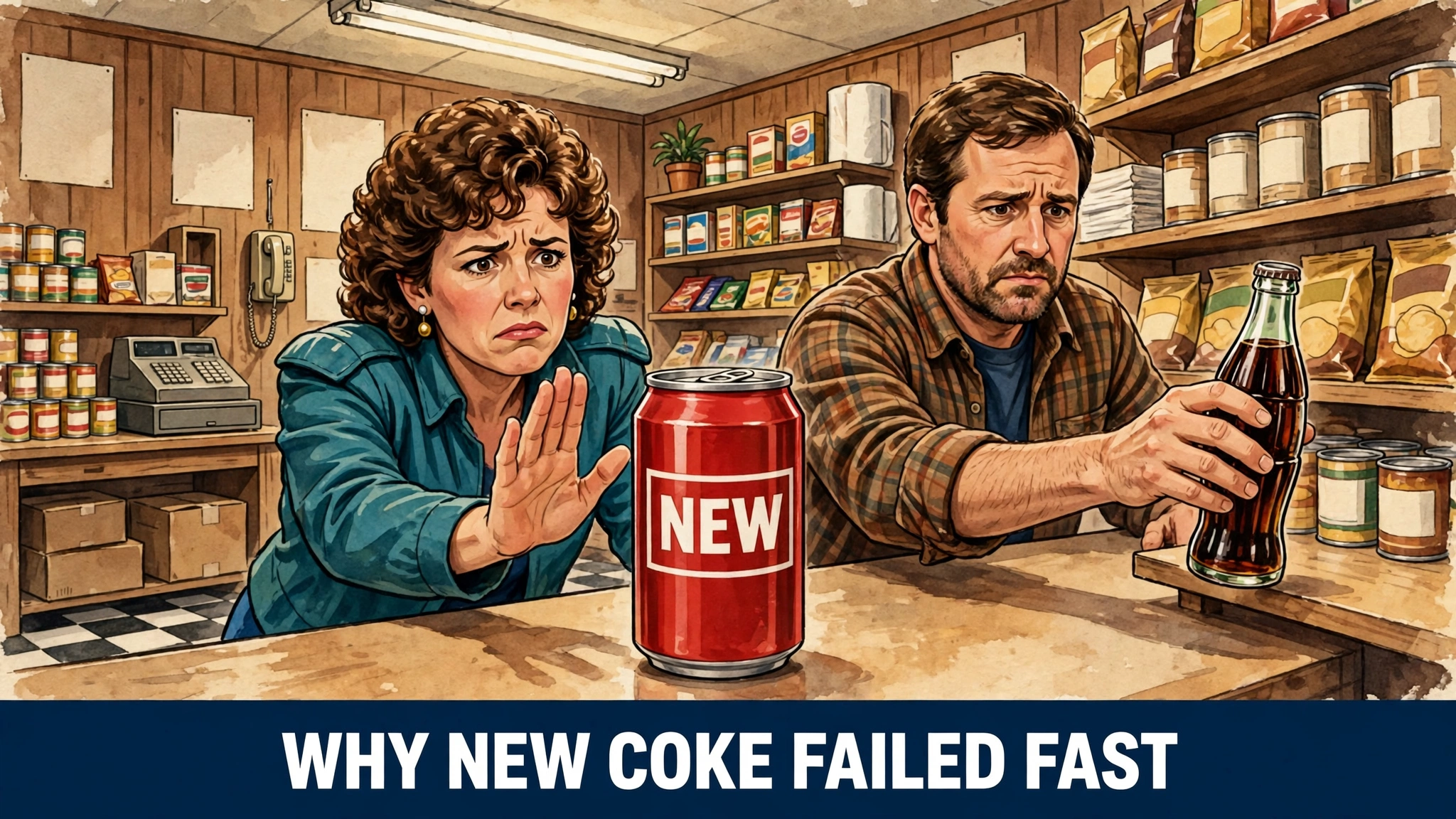
Customers began hoarding. The company’s history describes drinkers filling their basements with cases of the old Coke; one man in San Antonio, Texas, drove to a local bottler and bought $1,000 worth; when the old formula finally returned, some hoarders had as many as 900 bottles stored away. Protest groups sprang up around the country — the Old Cola Drinkers of America, which claimed to have recruited 100,000 members in its drive to bring back the old Coke, and the Society for the Preservation of the Real Thing. At protests, HISTORY recounts, people poured bottles of New Coke into sewer drains, and one Seattle customer even went to court to try to force the company to supply the old drink.
Read those scenes again and notice something. Nobody was saying, “this new drink tastes bad in a blind test.” They were saying something much deeper: you had no right to take it away. The tests had measured flavour. They had never measured love.
79 Days Later: “Our Boss Is The Consumer”
The company listened — because it had no choice. On 11 July 1985, just 79 days after the launch, Coca-Cola’s executives held another press conference. This time there was no talk of surest moves. The original formula was coming back, under a new name: Coca-Cola Classic. President Donald Keough faced the cameras and, as HISTORY records, said: “Our boss is the consumer. We want them to know we’re really sorry.”
The news was so big that television networks interrupted their regular programmes with special bulletins. And the public’s joy was as loud as its anger had been: Coca-Cola’s own history says the company received 31,600 telephone calls on its hotline in just the two days after the announcement. The protest leader who had fought hardest against the change was given the first case of Coca-Cola Classic.
Then came the twist nobody in Atlanta had dared to predict. Coca-Cola Classic quickly outsold New Coke, and within a few months it was once again the top-selling sugar cola, ahead of Pepsi. The failed new formula limped on beside it, was renamed Coke II in 1990, and was finally abandoned in 2002. The disaster had somehow left the company stronger than before: the whole episode had reminded millions of people how much the old drink meant to them. As the company’s own history concludes, the summer of 1985 ended with consumer affection replacing consumer outcry — and the Coca-Cola brand soaring to new heights.
Was It All A Secret Plan?
The ending was so perfect that many people refused to believe it was an accident. The theory spread: Coca-Cola had planned the whole thing. Remove the beloved drink, let the nation panic, then bring it back to a hero’s welcome and a mountain of free publicity. Surely no company could be that lucky by accident?
The company has always denied it — and its president denied it in a way that is hard to argue with. As HISTORY quotes Keough: “Some cynics say that we planned the whole thing. The truth is we’re not that dumb and we’re not that smart.” Ten years later, Goizueta himself looked back on the episode in front of employees and described it as an example of “taking intelligent risks,” saying: “We set out to change the dynamics of sugar colas in the United States, and we did exactly that — albeit not in the way we had planned.” Those are not the words of a company confessing to genius. They are the words of one admitting it got rescued by its own customers.
The Lesson Every Business Should Learn
New Coke is now taught in business schools everywhere, and its lesson is simple enough for anyone to use.
A taste test is a sip. A product is a lifetime. In a blind test, people compared two small cups and picked the sweeter one — a perfectly honest answer to a very small question. But nobody had asked the big question: how will you feel if the drink you grew up with disappears forever? Feelings, habit and identity were the real product. The red can stood for childhood summers, family meals and a hundred years of shared memories, and none of that fits inside a paper cup.
That is why the story matters far beyond soft drinks. Any business — a giant company or a small shop — can measure the features of what it sells and still miss the reason people truly buy it. Customers do not only purchase a thing. They purchase the place that thing holds in their lives. Coca-Cola learned in 79 days what some companies never learn at all: take away the thing people love, and no spreadsheet in the world can tell you what happens next.
Frequently Asked Questions
When was New Coke launched, and how long did it last? It was announced on 23 April 1985. The original formula returned as Coca-Cola Classic on 11 July 1985 — just 79 days later, according to The Coca-Cola Company’s own history.
Why did Coca-Cola change its formula at all? Its lead over Pepsi had been shrinking for years, and in blind taste tests — nearly 200,000 of them — people kept preferring a sweeter drink, including Pepsi. Executives concluded that the taste itself was the problem.
Why did customers hate New Coke so much? Mainly because the old drink was taken away. The tests measured flavour, but drinkers were attached to Coca-Cola emotionally — as a habit, a memory and a piece of identity — and they reacted as if something of theirs had been stolen.
Was New Coke a secret marketing plan to boost the original? No, according to the company, which has always denied it. President Donald Keough said of the theory: “The truth is we’re not that dumb and we’re not that smart.”
What happened to New Coke in the end? It was sold alongside Coca-Cola Classic, renamed Coke II in 1990, and finally abandoned in 2002. Coca-Cola Classic became the top-selling sugar cola again within a few months of its return.
Sources
- The Coca-Cola Company, “New Coke: The Most Memorable Marketing Blunder Ever?”: https://www.coca-colacompany.com/about-us/history/new-coke-the-most-memorable-marketing-blunder-ever
- HISTORY, “Why Coca-Cola’s ‘New Coke’ Flopped”: https://www.history.com/articles/why-coca-cola-new-coke-flopped
- The picture on this page is an original illustration made for Talha M Blog.