Aston Martin Vantage Technical Diagram
In this post
What makes a car beautiful? Is it the shape alone, or is it the way the shape makes you feel when you see it parked on a quiet street? The Aston Martin Vantage has been answering that question for years, and its answer has stayed remarkably steady. While other sports cars grow sharper wings and louder colours with every new version, the Vantage keeps a calmer kind of confidence. It does not shout. It simply looks right, from every angle, in any light.
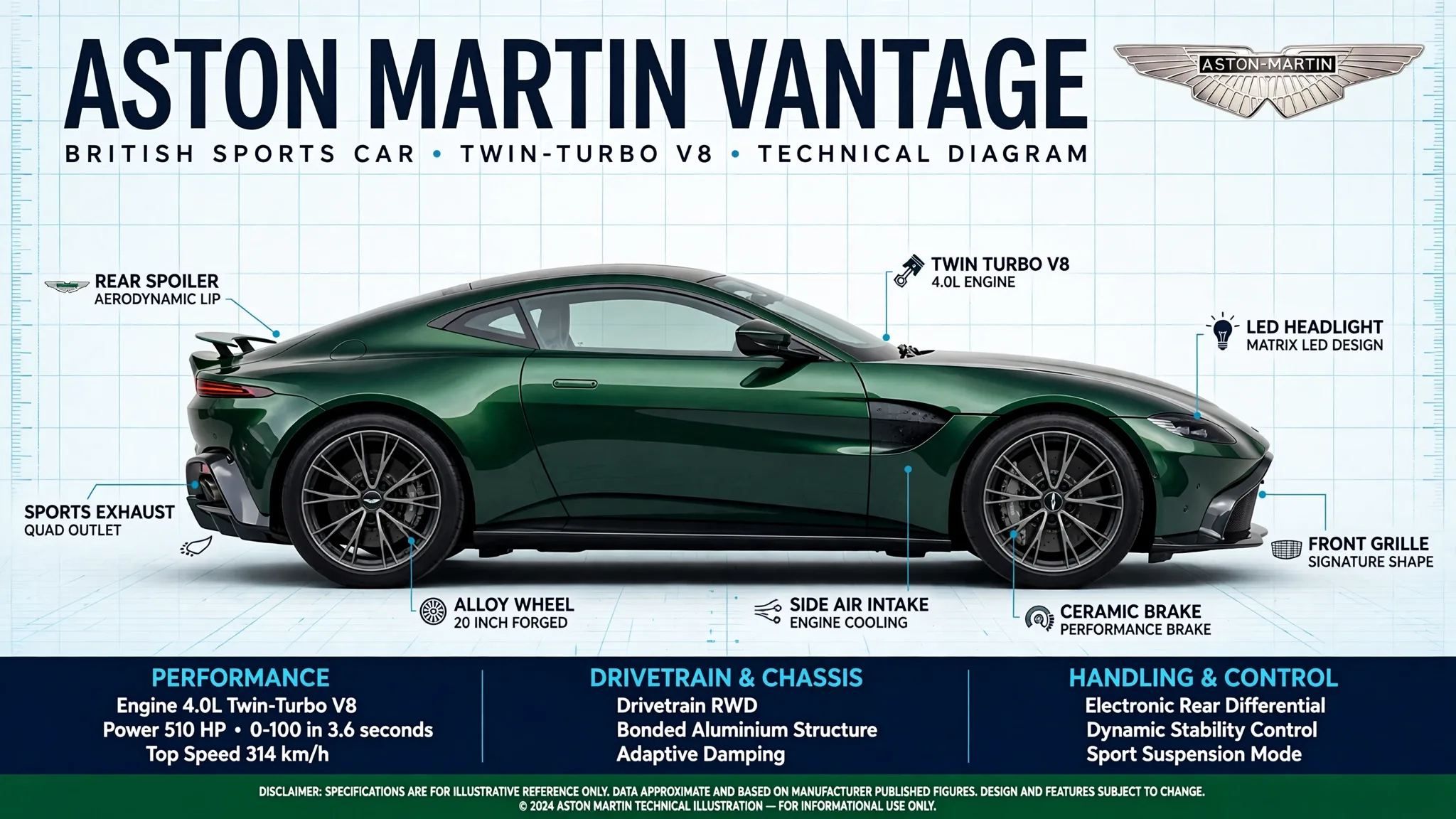
The current Vantage, the one that arrived in 2018, carries that tradition forward with a sharper edge than before. Its grille is wide and low. Its headlights sweep back like eyes narrowing against the wind. Its rear end is short and muscular, with a full-width light bar that glows at night. The diagram shows the proportions clearly: a long bonnet, a cabin pushed toward the back, and short overhangs at both ends. Those proportions are the classic recipe for a front-engined sports car, and Aston Martin has followed it with rare discipline.
Beauty with a purpose
It is easy to call the Vantage pretty and stop there, but the shape works as hard as it looks. The long bonnet covers a powerful engine, and its sculpted lines guide air over the body instead of letting it pile up against the windscreen. The side vents behind the front wheels let hot air escape from the engine bay, which keeps temperatures down on a fast drive. The small rear spoiler is shaped to press the back of the car onto the road at speed, so the car stays stable when the numbers on the speedometer climb.
Inside, the cabin follows the same idea. The seats sit low, close to the centre of the car, so the driver feels connected to the road rather than perched above it. The dashboard wraps around the driver like the cockpit of a small aircraft, with the important controls close to hand. Leather and metal dominate the materials, and the finish feels hand-made rather than mass-produced. It is a cabin that rewards you for looking closely, with stitching and trim that stay elegant rather than flashy.
The voice of the V8
Under that long bonnet sits a 4.0-litre twin-turbocharged V8 engine, making 510 HP. Power goes to the rear wheels only, and the car reaches 100 km/h from rest in 3.6 seconds. Its top speed is 314 km/h. Those figures are strong, but the Vantage has never been a car that lives by figures alone. Its real signature is the sound.
Press the start button and the V8 wakes with a deep, rolling growl that settles into a steady idle. It is not the highest-pitched sound in the sports car world, nor the loudest. It is rich and warm, like a low note held on a cello, and it gives the car a character that drivers remember long after the drive ends. On a tunnel road, with the windows down, that sound turns an ordinary trip into something worth planning your day around.
The twin-turbo setup means the engine pulls strongly from low speeds, so you do not need to rev it hard to feel the push. On a motorway, overtaking is calm and effortless. On a winding road, the engine responds to small pedal movements with a smooth surge, which makes the car feel friendly rather than frightening. That friendliness matters. Some supercars demand total concentration at all times. The Vantage asks for attention, but it also forgives small mistakes, and that makes it a car you can enjoy without being a racing driver.
How it drives
The Vantage is built around a bonded aluminium structure, a frame glued and riveted together from aluminium parts. Aluminium is lighter than steel, and a lighter car changes direction more eagerly and stops more quickly. Engineers also placed the engine as far back in the body as possible, close to the cabin, which balances the weight between the front and rear wheels. A balanced car turns more naturally, without the nose pushing wide or the tail stepping out unexpectedly.
An electronic rear differential helps put the power down. In simple words, a differential lets the two rear wheels spin at different speeds when the car turns, and the electronic version can lock the wheels together when extra grip is needed. On a wet road or a tight corner, that system quietly keeps the car stable while the driver simply enjoys the drive. Adaptive dampers, which adjust the suspension stiffness many times per second, let the car ride softly over rough roads and firm up when the road turns smooth and fast.
Steering feel is another area where the Vantage earns praise. The wheel is precise, and it tells the driver what the front tyres are doing without shaking or feeling nervous. On a long journey, that precision means less tiredness, because the car goes where you point it without constant correction. On a fun road, it means you can place the car exactly where you want it, corner after corner.
Who should look at one
To me, this is the car you buy with your heart first and your head second, and that is meant as praise. On paper, there are faster cars and cheaper cars, and a careful spreadsheet would point you elsewhere. But cars are not spreadsheets. The Vantage offers something its rivals struggle to match: a sense of occasion every single time you open the door. The shape, the sound, the smell of the leather and the weight of the door closing all add up to an experience that feels special before the engine even starts.
That makes it a natural choice for someone who drives for pleasure rather than for lap times. It suits weekend roads, evening drives and long tours across the country. It is less suited to carrying a family or hauling luggage, since space behind the seats is tight and the cabin is built for two people. Prices vary by market, year and options, so buyers should check current figures in their own country rather than trusting a single number from another market.
There is also a quieter reason the Vantage deserves attention. Aston Martin is a small company compared with the giants of the car world, and every car it builds carries a sense of craftsmanship that mass production rarely achieves. Buying one is, in a small way, supporting a tradition of British sports car building that stretches back more than a century. For many owners, that history is part of the pleasure, and it shows in the way they talk about their cars years after buying them.
The Vantage will not be the right car for everyone, and it does not try to be. It is a car for people who value beauty, sound and feeling as much as speed, and who believe a sports car should stir something in you before it ever moves. In a world where cars are becoming quieter, heavier and more alike, that is a rare and welcome thing.
Common questions
How fast is the Aston Martin Vantage?
It reaches 100 km/h from rest in 3.6 seconds and has a top speed of 314 km/h, thanks to its 510 HP twin-turbo V8 engine and rear-wheel drive.
Is the Vantage a daily-use car?
It can be used daily, with a comfortable ride and a usable boot for two people, but it is happiest as a pleasure car. Space is tight, and running costs sit at sports car levels.
What makes its engine special?
The 4.0-litre twin-turbo V8 delivers strong pulling power from low speeds and a deep, rich exhaust sound that many drivers consider the car’s defining feature.
Does it handle well on wet roads?
Yes. The balanced weight, electronic rear differential and adaptive suspension help the car stay stable on wet or uneven surfaces, though careful driving is still essential in a rear-wheel drive sports car.