Bentley Continental GT Technical Diagram
In this post
There is a particular kind of silence that only a truly expensive car can make. It is not the silence of something missing. It is the silence of everything working so well that nothing needs to shout. Close the door of a Bentley Continental GT and the world outside seems to step back politely. The engine starts with a soft murmur, not a bark. The car moves away like a large ship leaving harbour: smooth, calm, and completely sure of itself.
First, the Quiet
The Continental GT arrived in 2003, and it changed Bentley forever. Before this car, Bentleys were grand but old-fashioned, loved by a small circle of loyal owners. The Continental GT kept the grandeur and added modern speed, modern design, and a much wider appeal. It became the car that saved the company and introduced Bentley to a new generation.
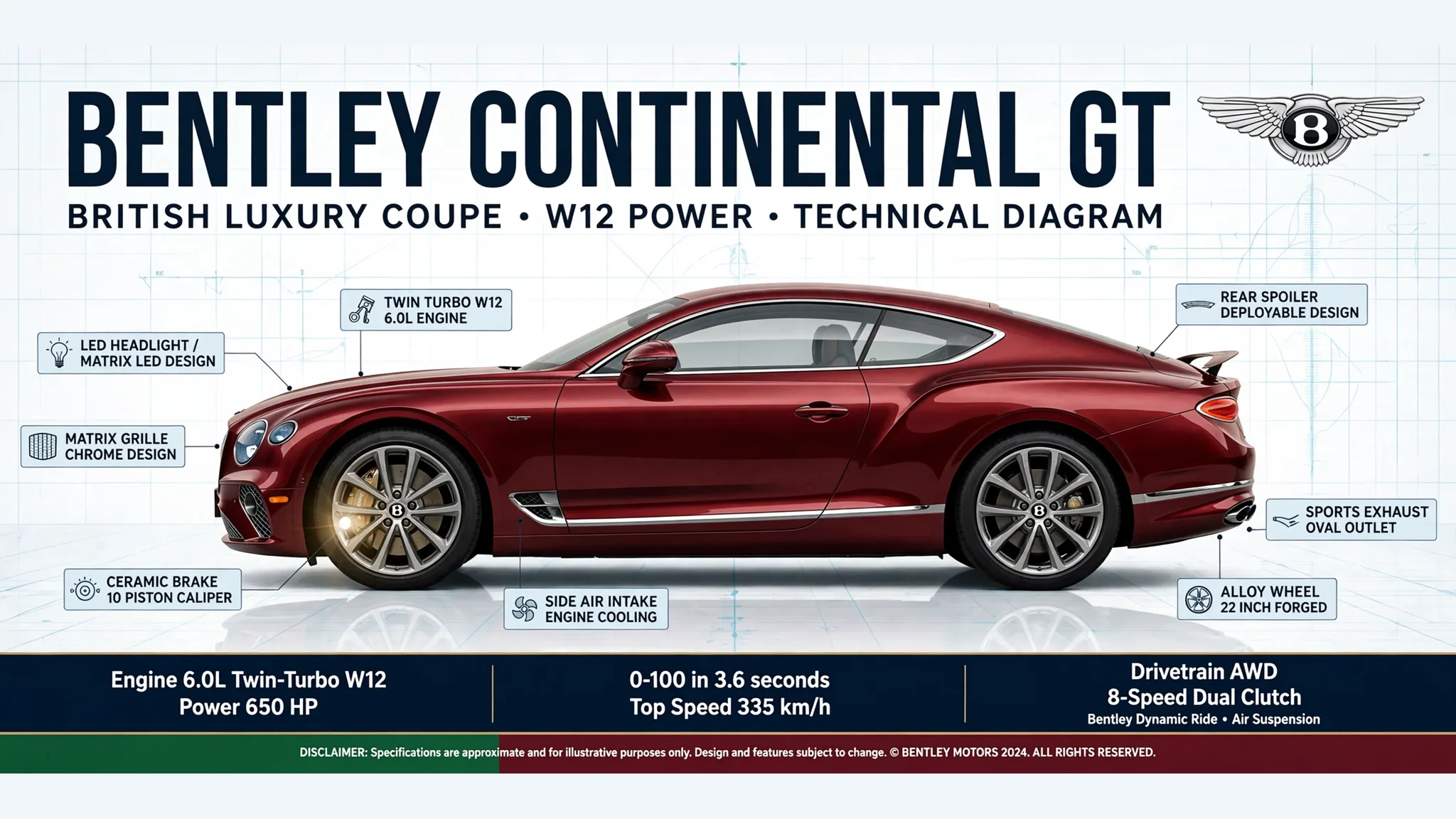
Look at the diagram and the first thing you notice is proportion. The car is long and low, with a bonnet that stretches gracefully forward and a roofline that flows down to a short, tidy tail. Nothing about it is loud. The famous matrix grille sits at the front like a piece of jewellery, and the round headlights give the car a gentle, watchful face. It is the kind of design that looks expensive without trying to prove anything.
Each car is built in Crewe, in England, where Bentley has worked for over a century. Craftspeople still stitch the leather by hand and polish the wood until it shines like glass. Machines do the heavy work, but the finishing touches belong to human hands. You can feel that care the moment you touch anything inside the car.
A Cabin Made Like a Living Room
Step inside and the Continental GT stops feeling like a car at all. It feels like a beautiful room that happens to move. Soft leather covers nearly every surface. Real wood, cut from a single tree so the grain matches across the dashboard, runs in smooth lines around the cabin. The metal details are cool to the touch and machined with the kind of precision you usually find in a fine watch.
I sat in one once at a car show, and the thing I remember most is not the leather or the wood. It is the smell. It smelled like a library mixed with a leather workshop, warm and calm all at once. I closed the door, the noise of the hall vanished, and for a moment I understood why people pay so much for silence.
The seats deserve a mention of their own. They are wide, deeply padded, and adjustable in more ways than you will ever use. After hours on the road, you climb out feeling fresh, which is exactly the point. This car was built for long journeys across countries, not short sprints between traffic lights. It is called a Grand Tourer for a reason: it turns a thousand-kilometre drive into something you actually look forward to.
Power Without the Noise
Under that long bonnet sits a 6.0-litre twin-turbo W12 engine. A W12 is a rare and clever design, almost like two V6 engines joined together into one compact block. It makes 650 HP, which is an enormous amount of power, yet the car delivers it with remarkable manners. There is no drama, no wheelspin, no fuss. You press the accelerator and the car simply gathers speed, the way a wave gathers height before it reaches the shore.
The figures tell their own quiet story. The Continental GT runs from 0 to 100 km/h in 3.6 seconds. Its top speed is 335 km/h. Power goes to all four wheels, which helps the car stay planted and calm even on wet roads or fast corners. For a car this large and this comfortable, those numbers are genuinely impressive.
What surprises people most is how easy it all feels. You do not need racing skill to drive this car quickly. The suspension reads the road ahead and softens the bumps before you reach them. The steering is light at parking speeds and steady at high speeds. The car does the hard work, and leaves you free to enjoy the journey.
Where It Belongs
The Continental GT belongs on long, open roads. Picture a coastal highway in the early morning, mist over the water, and the Bentley moving through it in near silence. Or a mountain pass at dusk, headlights on, the W12 humming softly as the road unwinds. These are the moments this car was designed for.
It also belongs outside a fine hotel or a quiet restaurant, where its presence speaks without a word. Valets treat it with extra care. Passers-by slow down for a second look. Yet the car never looks flashy or desperate for attention. It has the confidence of something that knows its own worth.
Prices vary by market, year, and options, so anyone dreaming of one should check local listings first. But the dream itself is easy to understand. The Continental GT is proof that speed and comfort do not have to fight each other. Done properly, they can share the same car, and the result is something truly special.
A Name With a Long History
To understand the Continental GT, it helps to know where Bentley comes from. The company was founded in 1919 by Walter Owen Bentley, a man who loved engines and believed a car should be both fast and refined. His early cars won the famous Le Mans 24-hour race five times in the 1920s, and that racing success gave Bentley a name that still carries weight today.
The word Continental has its own story. In 1952 Bentley built the R-Type Continental, a fast, elegant coupe for wealthy owners who wanted to cross Europe in style. It was one of the fastest four-seat cars of its day, and it set the template: luxury, speed, and long-distance comfort in one graceful shape.
When the modern Continental GT arrived in 2003, it picked up that thread after a gap of many decades. The new car was not a copy of the old one, but it shared the same idea. It was built for people who wanted to travel far, travel fast, and arrive feeling rested. That idea has kept the Continental GT at the heart of Bentley’s range ever since, through several generations and many updates.
Knowing this history changes how you look at the car. The grille, the round lights, and the long bonnet are not random styling choices. They are echoes of a century of Bentley design, kept alive by people who care deeply about the badge on the bonnet. When you buy a Continental GT, you are not just buying speed and leather. You are buying into a story that began over a hundred years ago, and that story is part of what makes the car feel special.
Common questions
What engine does the Bentley Continental GT have? This version uses a 6.0-litre twin-turbo W12 engine that makes 650 HP. A W12 packs twelve cylinders into a compact block, giving huge power with smooth manners.
How fast is the Continental GT? It reaches 100 km/h in 3.6 seconds and has a top speed of 335 km/h. Power goes to all four wheels, which helps it stay calm at high speed.
Where is the Continental GT built? It is built in Crewe, England, where Bentley has made cars for over a century. Much of the interior work, like leather stitching and wood polishing, is still done by hand.
Is the Continental GT a sports car or a luxury car? It is both, and that is the point. It is a Grand Tourer: a car built to cross countries quickly and in great comfort, mixing sports car speed with luxury car calm.