Pagani Huayra Roadster Technical Diagram
In this post
In a small workshop in Modena, Italy, a group of craftspeople build cars the way jewellers make watches: slowly, by hand, and with an obsession over details most people will never notice. Their boss is Horacio Pagani, a man from Argentina who moved to Italy as a young man with a dream of building the most beautiful cars on earth. The Huayra Roadster is what that dream looks like with the roof taken off.
A Car Built Like a Piece of Art
Walk around a Huayra Roadster and the first thing that strikes you is that nothing looks accidental. The body curves flow into each other like water over stone. The mirrors are shaped like leaves. Even the bolts are polished and arranged in patterns, because Horacio Pagani believes a car should be beautiful underneath too, not just on the outside.
This way of working comes from Pagani’s own life. As a boy he built small models and dreamed of working with the great Italian car makers. He studied design, moved to Italy, and spent years learning how carbon fibre works before starting his own company in 1992. His first car, the Zonda, shocked the car world in 1999. The Huayra followed in 2011 as its successor, and the Roadster version arrived in 2017, letting drivers hear the engine with nothing between them and the sky.
Every Huayra is built in small numbers, and every owner can choose their own colours, leathers, and finishes. No two are quite alike. Buying one is less like buying a car and more like commissioning a painting: you talk to the artist, you wait, and one day your car is ready.
Named After the Wind
The name Huayra comes from Huayra-tata, the god of wind in the old Andean stories of South America. It is a fitting name, because this car is shaped by the wind as much as it fights it. Four small flaps on the body move on their own as you drive, rising and falling to keep the car steady. At high speed they work like invisible hands, pressing the car down and balancing it through corners.
That attention to air is not decoration. It is the reason the Roadster can go so fast without a roof. Most open-top cars shake and flex at speed, because removing the roof removes strength. Pagani solved this by building the car’s core from a material called Carbo-Titanium, a weave of carbon fibre and titanium that is both light and incredibly stiff. The Roadster is actually lighter than the coupe version, which is almost unheard of in the car world.
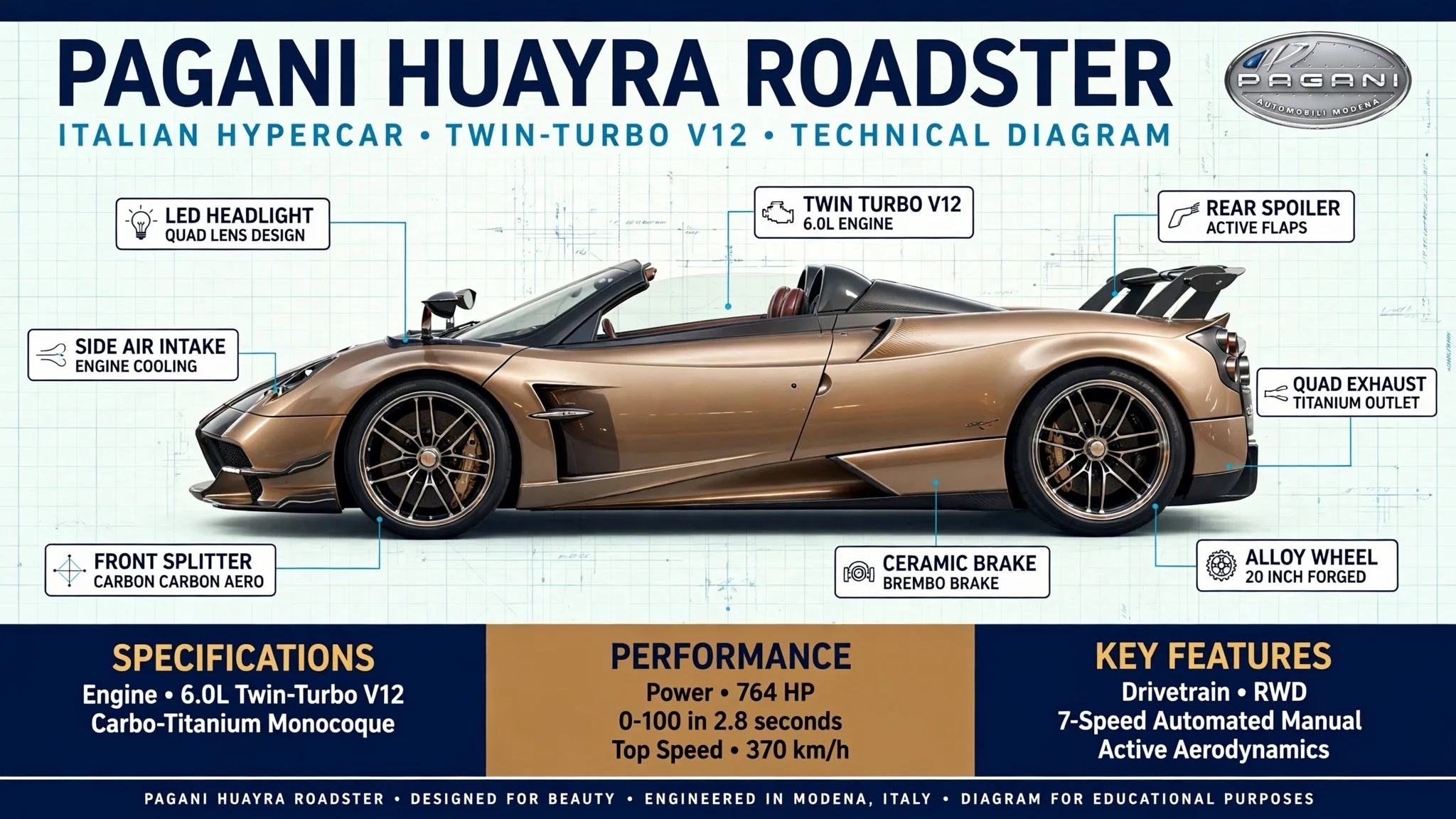
Look at the diagram and you can see the result: a long, flowing body with no awkward lines, a low nose, and a cabin that sits like a jewel in the middle. It is a shape that looks fast even standing still, which is the highest compliment you can pay a car designer.
The Engine in the Middle
Behind the seats sits the heart of the car: a 6.0-litre twin-turbo V12 engine, built specially for Pagani by Mercedes-AMG in Germany. Twelve cylinders, two turbochargers, and 764 HP. It is the kind of engine that car lovers talk about in hushed tones, because big V12 engines are slowly disappearing from the world.
The power goes to the rear wheels only, through a seven-speed automated gearbox. On paper the numbers are stunning: 0 to 100 km/h in 2.8 seconds, and a top speed of 370 km/h. On the road, owners say the real joy is the sound. A V12 does not scream like a smaller engine. It sings, deep and smooth, rising in pitch as the revs climb. With the roof off, that song has nowhere to hide, and that is exactly the point of a roadster.
Pagani also tunes the car for feel rather than raw violence. The steering is precise, the brakes are strong, and the suspension is firm but not harsh. It is a car that wants a good road and a careful driver, and it rewards both with an experience few machines can match.
Why a Roadster Feels Different
There is a simple reason people love open-top cars, and it has nothing to do with speed. With the roof gone, you smell the trees, you hear the birds between gear changes, and the world feels closer. A fast drive becomes a full-body experience instead of something watched through glass.
The Huayra Roadster takes that feeling and adds supercar speed to it. Imagine crossing a mountain pass at dawn, the V12 humming behind you, cool air on your face, and golden light on the road ahead. That image is the car’s whole reason for existing. It is not the most practical car in the world. It has little luggage space, it needs careful handling, and it costs a fortune to maintain. None of that matters to its owners, because no practical car can make them feel the way this one does.
For me, the Huayra Roadster is proof that cars can still be art. In a world where most new cars look alike and drive themselves, Pagani still builds machines by hand, names them after ancient gods, and polishes bolts nobody will ever see. That stubborn love for beauty is something worth protecting, and it is why this car will be remembered long after faster, cheaper cars are forgotten.
Prices vary by market, year, and options, so the numbers belong to private conversations between Pagani and its customers. The rest of us can enjoy the pictures, the diagrams, and the story of a man who crossed an ocean to build his dream.
Small Details That Take Hours
The most remarkable thing about a Pagani is not its speed. It is the time spent on things you might never notice. Take the gear lever. In many cars it is a plastic stick hidden in a boot of leather. In the Huayra, the gear mechanism is exposed, a sculpture of polished metal rods and joints that moves like a tiny machine every time you change gear. Drivers say they catch themselves staring at it at traffic lights.
Then there is the exhaust. Four titanium pipes sit in the centre of the rear, arranged in a square, each one shaped and finished by hand. Titanium is light and strong, but it is difficult to work with, and shaping four perfect pipes takes patience. The result is worth it: a sound that is deep, clean, and unlike any other car on the road.
Inside, the leather is stitched by hand, and the carbon fibre weave is left visible in places instead of being painted over. Pagani wants you to see the material, because the material is part of the beauty. Even the air vents are milled from solid metal, cool to the touch and precise in their movement.
These details explain why a Huayra takes so long to build. A normal factory measures production in cars per hour. Pagani measures it in weeks per car, with craftspeople checking each other’s work as they go. It is a slow, old-fashioned way to build a car, and it is exactly why the finished machine feels less like a product and more like something made by people who care.
Common questions
What does Huayra mean? Huayra comes from Huayra-tata, the god of wind in ancient Andean stories. Pagani chose the name because the car’s design is shaped by airflow.
Who builds the Pagani Huayra? Pagani Automobili builds it by hand in Modena, Italy. The company was founded by Horacio Pagani, who came from Argentina to Italy to build his dream cars.
How fast is the Huayra Roadster? It reaches 100 km/h in 2.8 seconds and has a top speed of 370 km/h, powered by a 764 HP twin-turbo V12 engine driving the rear wheels.
Why is the Roadster lighter than the coupe? Pagani built the Roadster’s core from Carbo-Titanium, a weave of carbon fibre and titanium. It is so stiff and light that the open-top version weighs less than the closed coupe, which is very unusual.