Koenigsegg Jesko Absolut Technical Diagram
In this post
How fast can a car honestly go? It sounds like a question for a pub quiz, but one small company in Sweden decided to answer it for real. The answer they built is called the Koenigsegg Jesko Absolut, and its claimed top speed is 531 km/h. That number is so high that most people read it twice, sure they have misread a digit. They have not.
To put it in plain words: at full speed, this car would cover a football field in less than a second. It would outrun a small airplane at take-off. And unlike a rocket, it has seats, a steering wheel, and a number plate. How did something like this come out of a workshop with a handful of people? The story is as remarkable as the car.
The Man Behind the Name
Every Koenigsegg carries the name of its founder, Christian von Koenigsegg, a Swedish entrepreneur who started the company in 1994 with a simple dream: build the perfect sports car. But the Jesko is named after someone else. It is named after Jesko von Koenigsegg, Christian’s father, who believed in his son’s dream from the very beginning and helped fund those early, difficult years.
That detail matters, because it tells you what kind of company this is. Koenigsegg is not a giant corporation with endless departments. It is a family-driven team in Ängelholm, a small town in southern Sweden, where engineers sit close to the cars they build and the founder still walks the factory floor. When a company is that small, every car has to be extraordinary. There is no room for an ordinary one.
The Jesko was first shown to the world at the Geneva Motor Show in 2019. Car journalists, who had seen everything, stopped and stared. Here was a car with a new nine-speed gearbox that could jump straight to any gear, a steering system that felt alive, and an engine that promised power figures most manufacturers would not dare to print.
A Wing That Is Not There
Here is the strangest thing about the Absolut version: it is fast partly because of something it does not have. Most hypercars wear a giant rear wing to press them onto the road at high speed. The Jesko Absolut skips the giant wing. Instead, its body is shaped so smoothly that air flows over it with very little resistance, while two small fins at the back keep it stable. Less drag means more speed, and the Absolut was designed with one job in mind: go as fast as physics allows.
Its sister version, the Jesko Attack, takes the opposite path. It wears a huge wing and chases lap times on race tracks, where grip matters more than top speed. The Absolut chases the horizon instead. Same engine, same family, two very different answers to the question of what fast means.
The body itself is made mostly from carbon fibre, a material that is lighter than steel and stronger too. The whole car weighs about as much as a normal family hatchback, yet it carries an engine with four times the power. That balance of light weight and huge power is the oldest trick in fast cars, and Koenigsegg has pushed it further than almost anyone.
Numbers That Sound Made Up
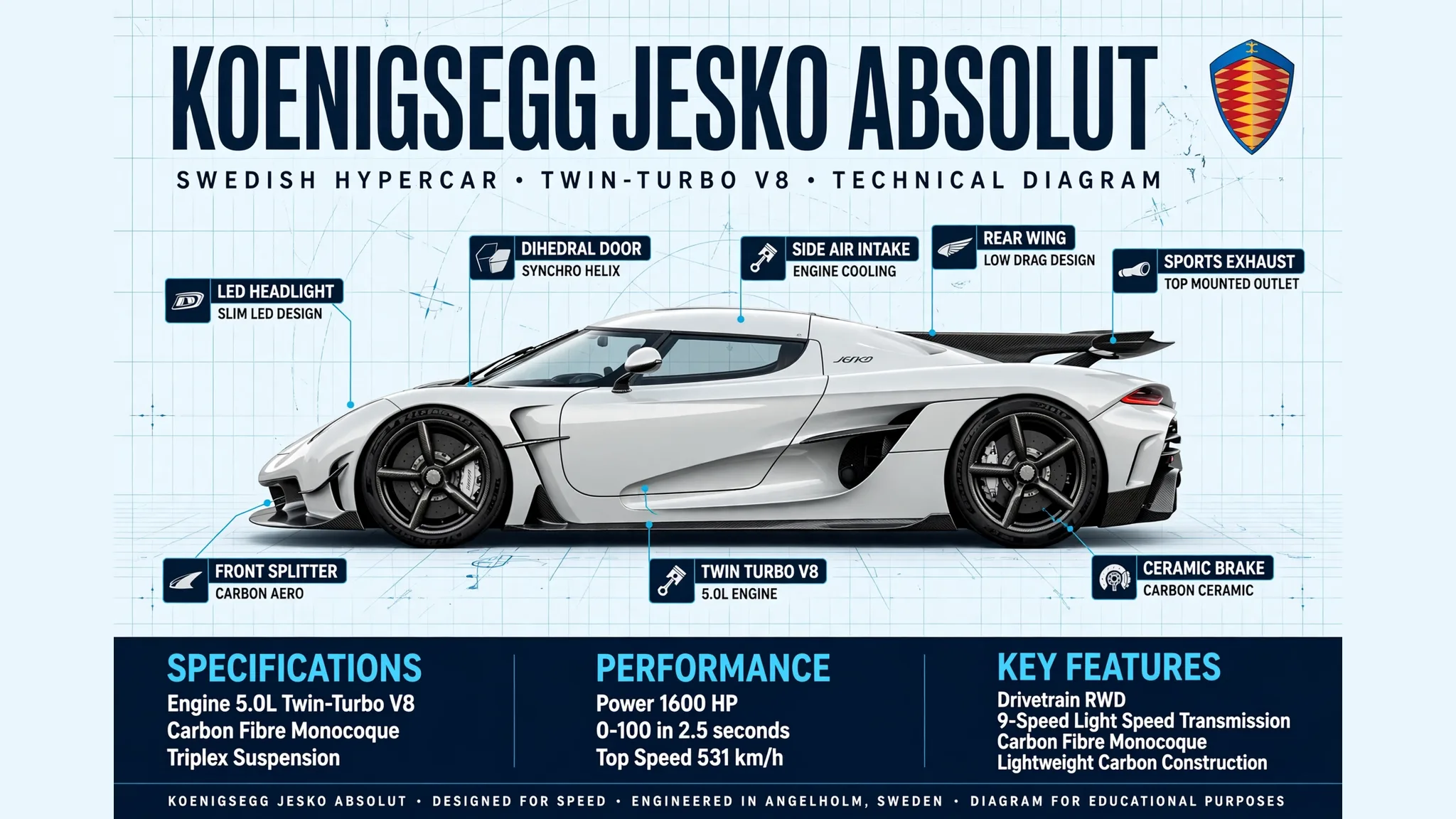
Let us walk through the figures slowly, because they deserve it. The engine is a 5.0-litre twin-turbo V8, built in-house by Koenigsegg, and it makes 1600 HP. That is roughly the power of ten family cars added together, all in one engine. The car runs from 0 to 100 km/h in 2.5 seconds. By the time you finish saying the word “supercar,” it is already at highway speed.
The top speed is the headline: a claimed 531 km/h. It is important to be honest here. That figure is the company’s calculated aim for the Absolut, not a speed that has been proven in a public record run. Even so, the engineering behind it is real: a drag coefficient lower than most family cars, a gearbox that shifts almost instantly, and an engine that keeps pulling hard at speeds where most cars would give up.
I find myself admiring the honesty of the whole project more than the numbers. Koenigsegg never pretended this car was for everyone. It is for a tiny number of collectors, built in tiny numbers, by people who love cars the way artists love paint. That kind of focus is rare in a world of mass production, and it is worth celebrating even if you will never drive one.
Why It Matters to the Rest of Us
You might wonder why a car almost nobody can buy matters at all. The answer is that ideas from cars like the Jesko drift down into ordinary cars over time. Lightweight materials get cheaper. Gearbox tricks get copied. Aerodynamic lessons show up in family cars that use less fuel. The extreme edge of engineering pulls the whole industry forward, one wild idea at a time.
Prices vary by market, year, and options, and for the Jesko that conversation belongs to a very small world of collectors. The rest of us can simply enjoy the story: a father believed in his son, a small Swedish team refused to think small, and the result is a car that asks the fastest question in the world — and tries to answer it.
A Gearbox Like No Other
Most fast cars have gearboxes that climb up and down one gear at a time, like walking up stairs. The Jesko does something stranger and smarter. Its nine-speed gearbox, which Koenigsegg calls the Light Speed Transmission, can jump straight from any gear to any other gear in almost no time at all. Floor the accelerator in seventh gear and the car can drop straight to fourth, instantly, without working its way down step by step. It feels like teleporting to the right gear.
The gearbox uses several clutches working together, and it is lighter and smaller than a normal dual-clutch gearbox. That matters in a car where every kilogram counts. Koenigsegg builds the gearbox in-house, just as it builds the engine itself. Very few car companies do that. Most buy engines and gearboxes from suppliers. Koenigsegg designs its own, because no supplier sells exactly what its cars need.
The doors are another piece of in-house cleverness. They swing up and out at the same time, in a motion Koenigsegg calls dihedral synchro-helix. The trick is practical, not just showy: the doors open in tight spaces where normal doors would hit the car next door, and they make climbing into a very low car much easier.
Small details like these are why engineers admire Koenigsegg so much. The company does not just buy fast parts and bolt them together. It invents its own answers, tests them, and puts them into cars that regular collectors can actually drive. That spirit of invention runs through the whole Jesko, from its gearbox to its bodywork.
Common questions
Who is the Jesko named after? It is named after Jesko von Koenigsegg, the father of company founder Christian von Koenigsegg. He supported his son’s dream in the company’s early years.
How fast is the Jesko Absolut? The company claims a top speed of 531 km/h. It reaches 100 km/h in 2.5 seconds, powered by a 1600 HP twin-turbo V8 engine.
What is the difference between the Jesko Absolut and the Jesko Attack? The Absolut is built for maximum top speed with a smooth, low-drag body and no giant wing. The Attack is built for race tracks, with a large wing for extra grip in corners.
Where is Koenigsegg based? Koenigsegg is based in Ängelholm, a small town in southern Sweden. It is a small, independent company, not part of a giant car group.