Lamborghini Aventador SVJ Technical Diagram
In this post
Some cars arrive quietly. The Lamborghini Aventador SVJ does not. You hear it first, a deep, angry roar that rolls down the street before the car even appears. Then you see it: low, wide, sharp as a blade, painted in colours that seem to glow. Doors that open upward like wings. A rear wing that looks ready for a racetrack. This is not a car that blends in. It was never meant to.
The Aventador takes its name from a fighting bull, following a Lamborghini tradition that goes back decades. Every Lamborghini flagship is named after a famous bull, and the name is a promise. Bulls are strong, stubborn, and impossible to ignore. So is this car. The letters SVJ add to the story. SV stands for Super Veloce, Italian for super fast. The J comes from Jota, a name Lamborghini once gave to a legendary test car. Put them together, and you get a simple message: this is the fastest, sharpest Aventador ever built.
The Last of a Breed
The Aventador SVJ matters for a reason that goes beyond speed. It is one of the last great cars powered by a large engine with no turbochargers at all. Its 6.5-litre V12 breathes on its own, the way engines did for most of car history. No turbos push air in. No electric motors help out. Just twelve cylinders, fuel, air, and fire, working together at incredible speed.
Why does that matter? Because a naturally aspirated engine feels different. Turbos give a sudden push, like a wave hitting you. A big V12 without turbos builds its power smoothly, rising higher and higher as the revs climb, until it screams near the top of its range. Drivers describe it as a living thing, pulling harder the more you ask of it. It is loud. It is raw. It is emotional in a way that quieter, more efficient engines simply are not.
The car world is changing fast. Smaller engines, hybrid systems, and electric motors are taking over, and for good reasons: they use less fuel and pollute less. But they cannot copy the sound and feeling of a big V12 at full cry. That is why the SVJ feels special today. It is a farewell to an era, a reminder of what cars sounded like when power came from size and revs alone.
Lamborghini built the Aventador family for over a decade, and the SVJ was its wildest child. When people look back at this period of car history, the SVJ will be one of the cars they point to and say: that was the peak. That was as dramatic as it ever got.
A Wing That Thinks
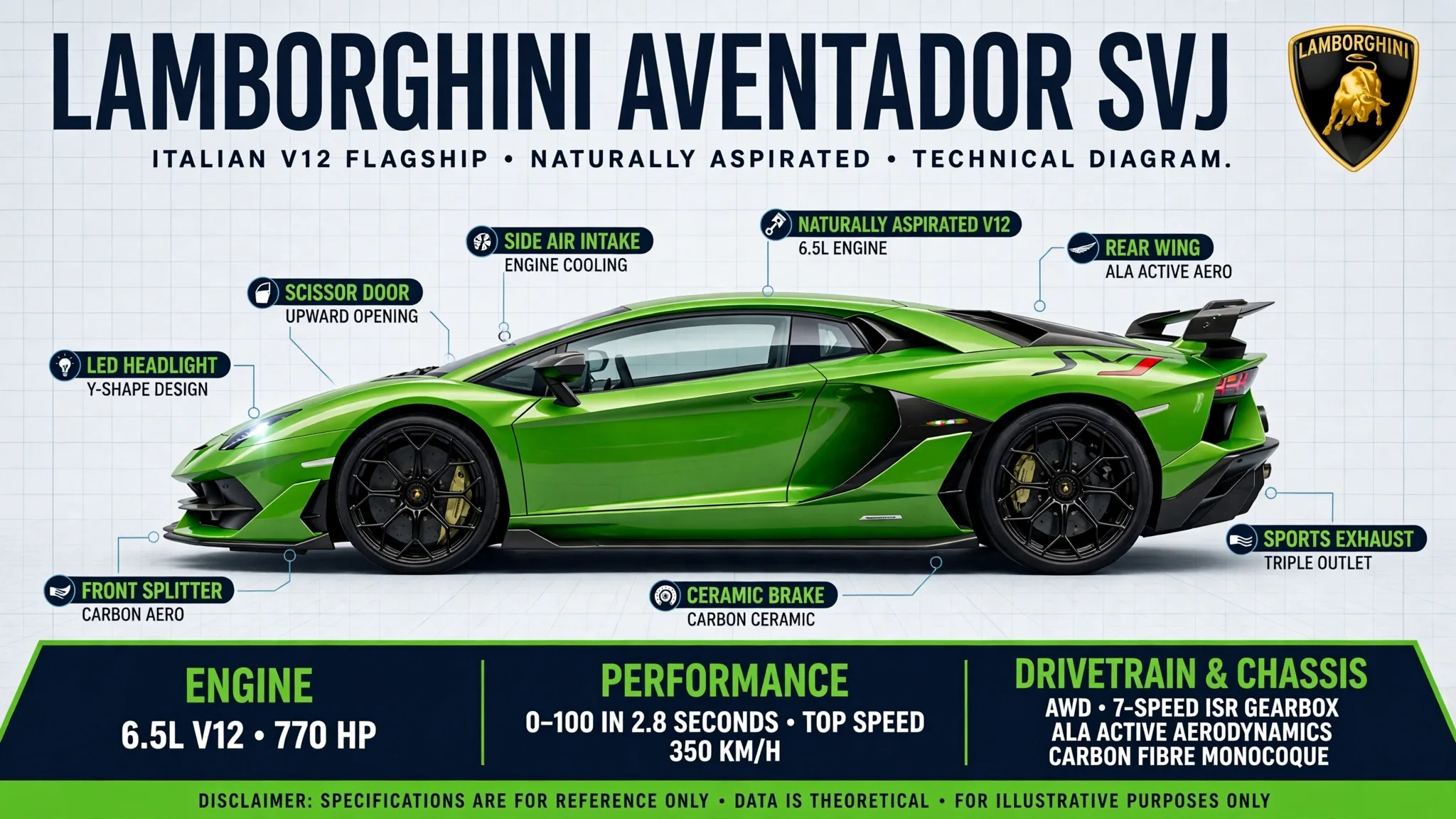
Look at the back of the SVJ in our diagram and you will see its most clever trick. The rear wing is not just a fixed board. It is part of a system Lamborghini calls ALA, short for Aerodinamica Lamborghini Attiva, which means active aerodynamics. In simple words, the wing thinks.
Here is the idea. When a car goes fast, air pushes down on it, which helps the tyres grip. That push is called downforce, and more of it means better grip in corners. But downforce also creates drag, which slows the car on straight roads. A normal wing forces you to choose: grip in corners, or speed on straights. The SVJ refuses to choose.
Its wing has flaps that open and close in less than a second. In a corner, the flaps shut on one side to press that side of the car down, giving extra grip exactly where it is needed. On a straight road, the flaps open to let air pass through, cutting drag so the car can reach higher speeds. The system works automatically, reading what the car is doing and adjusting constantly. The driver does not press any button. The wing simply knows.
The rest of the body works the same way. Air enters through the nose, flows over and under the car, and exits through carefully shaped vents. The underbody is flat, like the bottom of a racing car, so air moves smoothly beneath it. Every sharp edge and angle on the SVJ has a job. Nothing is there only to look wild, even though looking wild is something it does very well.
Numbers That Sound Unreal
Let us put the numbers on the table, because they are worth staring at. The V12 makes 770 horsepower. The car reaches 100 kilometres per hour in 2.8 seconds. Its top speed is 350 kilometres per hour. Power goes to all four wheels, which helps put that wild power onto the road without the car spinning its tyres uselessly.
To feel what 2.8 seconds means, try this. Say the words “Lamborghini Aventador” at normal speed. By the time you finish, the SVJ is already at 100 kilometres per hour. That is not a car accelerating. That is a car launching, like a plane leaving a runway, except the runway is a normal road and the roar comes from right behind your shoulders.
The SVJ once set a famous lap record at Germany’s Nürburgring circuit, one of the hardest racetracks in the world. A lap record there is not about straight-line speed. It is about corners, brakes, balance, and courage, all working together for many kilometres without a mistake. The record proved that the SVJ was not just a show car. It was a genuine racing weapon that happened to be legal on the road.
Inside, the car is as dramatic as the outside. The doors open upward, scissor-style, so getting in feels like entering a jet fighter. The seats are firm and shaped for fast driving. The dashboard is angular and futuristic. There is very little softness here, and that is the point. This cabin is not trying to be a living room. It is trying to be a cockpit.
Not a Car for Everyone
Let us be honest. The Aventador SVJ is not a practical car. It is very wide, which makes narrow streets stressful. It sits very low, so speed bumps are enemies. The view out the back is small, and parking takes patience. The engine drinks fuel the way a thirsty animal drinks water. Nobody buys an SVJ because it makes sense.
People buy it because it makes them feel something. Because of the sound. Because of the doors. Because of the way children point at it on the street and adults stop to take photos. Because driving it turns an ordinary road into an event. That feeling is hard to measure, but it is real, and it is why cars like this matter even to people who will never own one.
Prices vary by market, year, and options, and an SVJ is a rare and costly machine, so real figures should come from Lamborghini or a trusted specialist dealer. What costs nothing is the lesson in the diagram. Follow the labels from the V12 engine to the active wing, from the carbon fibre body to the brakes, and you will see how a car becomes more than transport. It becomes theatre.
If I ever stood beside one of these with the engine running, I think I would just stand there for a minute and listen. Not to judge it. Not to compare it. Just to hear what twelve cylinders sound like when they are allowed to sing without holding back. Some sounds you remember for the rest of your life, and I suspect this is one of them.
Common questions
What does SVJ mean? SV stands for Super Veloce, Italian for super fast. J comes from Jota, a name from Lamborghini history. Together, SVJ marks the fastest and sharpest version of the Aventador.
Why does the SVJ have no turbochargers? Its V12 is naturally aspirated, meaning it breathes on its own without turbos. This gives a smooth, rising power delivery and a loud, emotional engine sound that fans love.
Is the Aventador SVJ hard to drive every day? Yes, it can be. It is very wide and very low, with limited rear visibility. Most owners use it for special drives rather than daily trips.
What replaced the Aventador? Lamborghini replaced the Aventador with the Revuelto, a new flagship that keeps a V12 engine but adds hybrid electric power for the modern era.