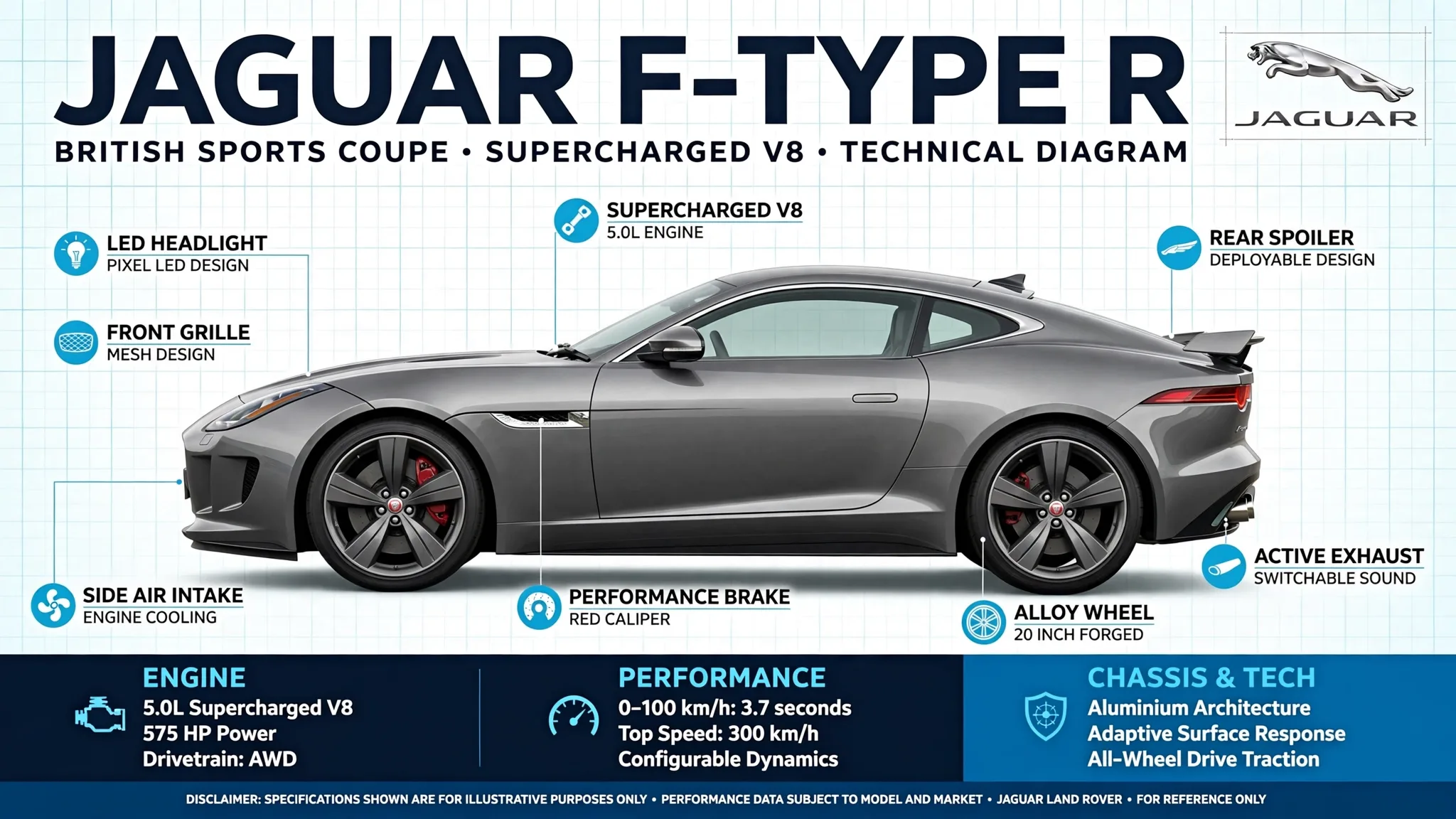
Jaguar F-Type R Technical Diagram
In this post
Some cars are fast. A few cars are loud. Very few cars are both and still manage to look elegant while doing it. The Jaguar F-Type R belongs to that rare third group, and it may be one of the last of its kind. The car world is moving toward electric power, and big supercharged V8 engines are disappearing from showrooms year by year. The F-Type R is a reminder of what that old recipe could do at its best, and it does it with a British accent.
Look at the car first, before any numbers. The F-Type is a coupe with a long bonnet, a short tail and haunches over the rear wheels that make it look ready to pounce even when parked. The R version adds wider intakes, a deeper front bumper and quad exhaust pipes at the back, but it never looks overdone. The diagram shows the classic sports car shape: engine in front, driver near the middle, drive going to all four wheels. It is a shape that has worked for decades, and Jaguar refined it rather than reinventing it.
Supercharged, not turbocharged
The F-Type R uses a 5.0-litre supercharged V8 engine, and that one word, supercharged, changes everything about how the car feels. A turbocharger is driven by exhaust gases, while a supercharger is driven directly by the engine itself through a belt. The practical result is instant response. There is no waiting for power to build. The moment you press the pedal, the engine answers, hard and immediately.
The numbers are serious. The engine makes 575 HP, and the car reaches 100 km/h from rest in 3.7 seconds. Top speed is 300 km/h. But the F-Type R is not really about the stopwatch. It is about the delivery. The power arrives as a huge, smooth wave that keeps pushing all the way to high revs, and it never feels strained or breathless. On a motorway slip road, that wave turns a short gap in traffic into an easy overtake. On a country road, it turns every straight into a small event.
A supercharger also changes the sound in a way no turbo can copy. The engine has a deep, rolling growl at idle and a rising snarl as the revs climb, with a faint whine from the supercharger underneath it all. It is a layered sound, mechanical and musical at the same time. Jaguar added an active exhaust system that opens valves to make the car louder in sport mode and quieter when cruising. Around town, you can keep it polite. On an open road, you open it up and the whole valley knows you are coming.
The sound alone
Honestly, the exhaust note alone would sell me on this car. I have read about faster cars and cleverer cars, but very few make a noise that turns a simple drive into a memory. The F-Type R does that every single time. It is not just loud for the sake of noise. The sound tells you what the engine is doing, rising and falling with your right foot, so driving becomes a conversation between you and the machine rather than a silent video game.
That connection extends to the steering and the chassis. The steering is weighty and precise, with a firm feel that suits the car’s character. It does not flick around like a lightweight racer. It moves with purpose, and it gives the driver confidence at speed. The body stays controlled through fast corners, and the suspension soaks up rough roads better than the car’s aggressive looks suggest. Jaguar tuned this car for real British roads, which are rarely smooth, and that tuning shows on broken surfaces where stiffer rivals start to bounce and skip.
Grip from all four wheels
Unlike many sports cars that drive only the rear wheels, the F-Type R sends power to all four wheels. All-wheel drive means the engine’s force is shared between the front and rear tyres, which gives the car more grip when accelerating, especially on wet or slippery roads. For a car with 575 HP, that grip matters. It means you can use the power more often, in more weather, without the rear end stepping sideways every time you press the pedal hard.
The system is rear-biased, which means most of the power still goes to the back wheels in normal driving, so the car keeps its playful sports car feel. Only when the rear tyres start to lose grip does the system send more power forward. The driver barely notices it happening. What they notice is confidence: the car launches hard from rest, pulls strongly out of slow corners, and stays composed on damp roads where a rear-drive rival would need a gentler touch.
Inside, the F-Type R is a two-seat cabin built around the driver. The seats grip well in corners, the controls fall easily to hand, and the materials feel solid and well finished. Space is tight behind the seats, and luggage room is enough for a weekend, not a holiday. That is the honest trade of a coupe like this. You give up practicality and you gain focus, and for the people who buy this car, that trade is the whole point.
Technology stays in the background, which suits the car. A central touchscreen handles music and navigation, a digital display shows speed and revs, and a good sound system makes long trips pleasant when you want quiet. None of it distracts from driving, and that restraint feels deliberate, as if Jaguar knew the engine was the real entertainment system all along.
Prices vary by market, year and options, and running costs are firmly in sports car territory, from fuel to tyres to servicing. Nobody should buy an F-Type R expecting economy. People buy it because it delivers an old-school thrill that is becoming rare: a big engine, a beautiful shape, a great noise and the grip to use all of it.
The car world will keep changing. Electric sports cars are already faster in a straight line, and they will only get better. But speed alone was never the F-Type R’s real gift. Its gift was character, the feeling that a machine has a voice and a personality. Long after the last supercharged V8 leaves the factory, drivers will remember cars like this one, and they will remember the sound most of all.
Common questions
What is a supercharger?
A supercharger is a pump driven directly by the engine that forces extra air into the cylinders, raising power. Unlike a turbocharger, it responds instantly because it does not wait for exhaust gases to spin it up.
How fast is the F-Type R?
It reaches 100 km/h from rest in 3.7 seconds and has a top speed of 300 km/h, from its 575 HP supercharged V8 engine.
Is all-wheel drive better than rear-wheel drive here?
For this much power, all-wheel drive gives more grip and confidence, especially in wet weather, while the rear-biased setup keeps the car feeling like a proper sports car.
Is the exhaust very loud?
It depends on the mode. The active exhaust stays fairly quiet for normal cruising and opens up for a much louder, deeper sound in sport mode.