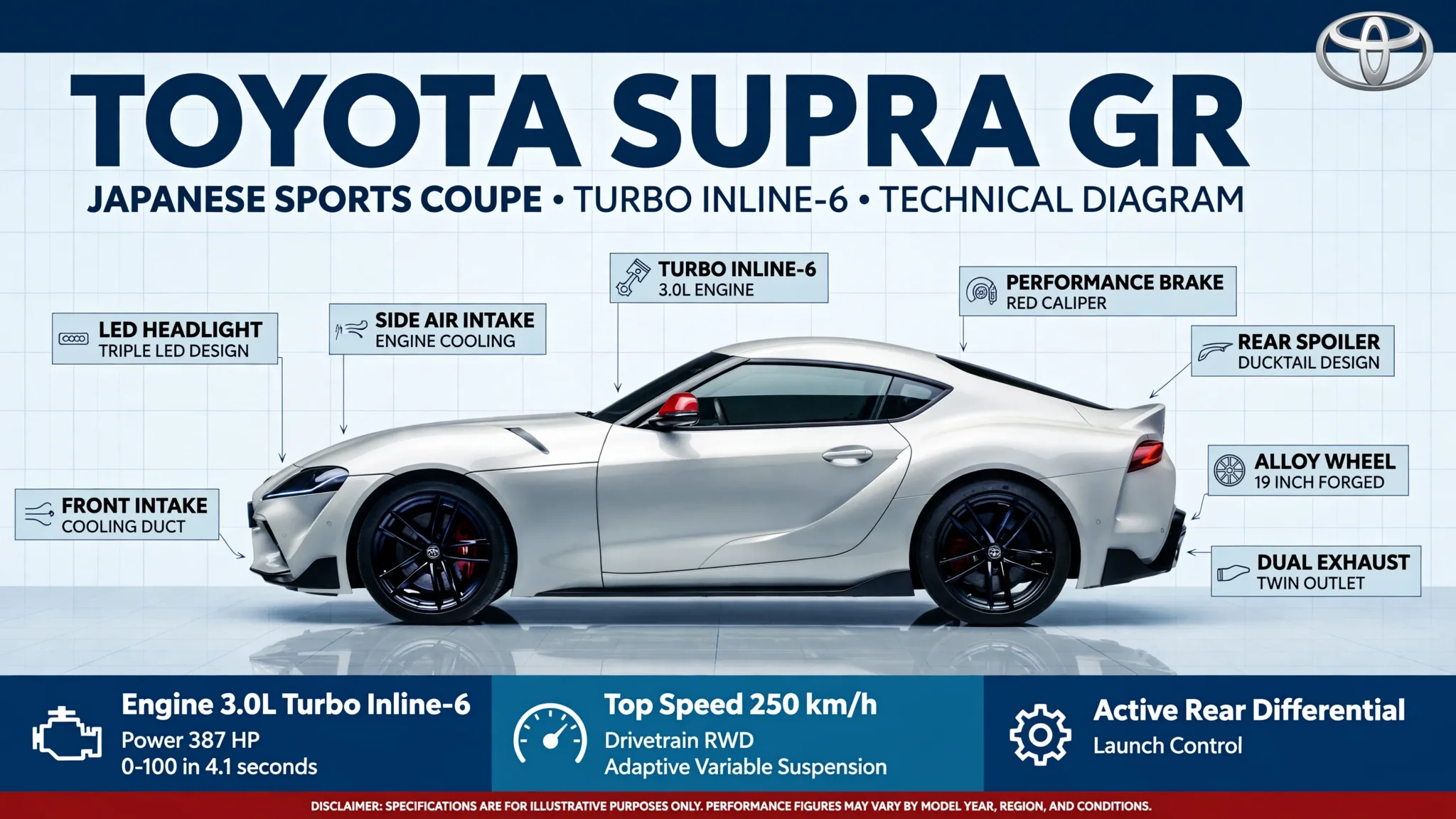
Toyota Supra GR Technical Diagram
In this post
Think of your favourite pair of trainers. They are not the most expensive shoes in the shop, and they are not made of gold, but they fit perfectly, they never let you down, and they make every walk feel a little better. The Toyota GR Supra is the sports car version of that idea. It does not try to be the fastest or the most extreme car on the road. It tries to be the one you actually want to drive, day after day, and it succeeds so well that car lovers all over the world talk about it like an old friend.
GR stands for Gazoo Racing, Toyota’s racing division, and the name tells you what the car is for. This is not a luxury cruiser with a sporty badge glued on. It is a small, light, two-seat coupe built from the ground up to be fun on a winding road. The diagram shows the recipe clearly: a long bonnet, a short tail, a low roof and a wide stance. It looks like a classic sports car because it follows the classic sports car rules, and sometimes the old rules are the best ones.
A sports car you can actually live with
One of the Supra’s greatest strengths is its size. It is compact, which means it fits in normal parking spaces, threads through city traffic without drama, and never makes you feel like you are driving a bus. The driving position is low and snug, with the seat close to the middle of the car, so you feel part of the machine rather than sitting on top of it. The bonnet stretches out ahead of you, and the view over it reminds you that this is a proper driver’s car, not a tall box on wheels.
The cabin is simple and focused. There are no gimmicks demanding your attention, just clear dials, a central screen and controls that work without a manual. Storage is limited, as in any two-seat coupe, but there is enough room for a weekend bag, and the rear hatch opens wide to swallow larger items. It is not a family car, and it does not pretend to be one. It is a car for one or two people who love driving, and it is honest about that.
That honesty extends to the price. Prices vary by market, year and options, but the Supra sits far below the supercar class while offering a large share of the fun. Running costs are also kinder than a supercar’s, with normal-sized tyres and servicing that will not shock you. For many young drivers, the Supra is the first proper sports car they can realistically dream about owning, and that dream matters. It keeps the sports car world open to new fans instead of locking it behind a fortune.
The turbo six
Under the bonnet sits a 3.0-litre turbocharged inline-six engine, making 387 HP. An inline-six has six cylinders lined up in a single row, and engineers love this layout because it runs smoothly and sounds wonderful. The single turbocharger pushes extra air into the engine, giving it strong pulling power across a wide range of speeds. The car reaches 100 km/h from rest in 4.1 seconds, and its top speed is 250 km/h.
What do those numbers feel like? In everyday driving, the engine is calm and flexible. You can cruise in a high gear at low revs, and the car will still pick up speed without fuss when you need it. On a fun road, the engine pulls hard from the middle of the rev range, with a smooth surge that never feels harsh or sudden. The exhaust note is a deep, even six-cylinder hum that grows into a satisfying growl as the revs rise. It will not wake the neighbours, but it will make you smile every time you press the pedal.
An 8-speed automatic gearbox handles the shifting, and it is quick and clever. It holds gears when you are driving hard and shifts early when you are cruising, so you rarely need to think about it. Paddles behind the steering wheel let you take over when you want to, and the changes are fast and smooth. Some drivers miss a manual gearbox, and Toyota has offered one in some versions, but the automatic suits the car’s easy-going character.
Balance is the secret
If you ask engineers what makes the Supra special, most will give you one word: balance. The engine sits behind the front wheels, close to the centre of the car, and the weight is spread almost evenly between the front and rear axles. A balanced car turns sweetly, without the nose diving wide or the tail swinging loose. The Supra changes direction like it is reading your mind, and it stays calm when the road gets bumpy or cambered.
Power goes to the rear wheels only, which is the traditional sports car setup. Rear-wheel drive lets the steering stay pure, because the front tyres only have to steer, not drive as well. It also lets skilled drivers play with the car’s balance on a track, though the stability systems will quietly catch mistakes on the road. An active rear differential helps put the power down cleanly when exiting corners, so the car grips and goes instead of spinning its tyres.
The suspension is adaptive, which means it can soften for rough roads and firm up for fast driving. In its soft setting, the Supra rides comfortably enough for a daily commute. In its firm setting, the body stays flat and the car feels locked onto the road. That split personality is rare. Many sports cars are either too stiff for daily life or too soft for fun. The Supra manages both, and that is why owners tend to keep them for years.
A car with a culture
No Supra story is complete without its fans. The Supra name goes back decades, and the current GR version arrived to huge excitement from people who grew up admiring earlier models. Owners meet at car shows, share driving tips online, and personalise their cars with wheels, wraps and small upgrades. That community is part of the car’s appeal. When you buy a Supra, you join a worldwide group of people who love the same thing you do.
That culture also means the car holds its appeal over time. It is not a fashion item that looks dated after one year. Its shape is clean and timeless, its engineering is proven, and its badge carries a reputation for reliability that few sports cars can match. Toyota’s name gives buyers confidence that the car will start every morning and keep going for years, which is not something every sports car maker can promise.
So who should buy one? Anyone who wants a real sports car without supercar money or supercar stress. It suits a young driver buying their first performance car, a weekend driver who wants fun without fuss, and an experienced driver who values balance over brute force. It will not carry a family, it will not tow a trailer, and it will not win a race against a 700 HP supercar. It was never meant to. It was meant to make driving fun, and on that simple test, it passes with flying colours.
If you ask me, the Supra is proof that a sports car does not need to be extreme to be great. It needs balance, a good engine, honest engineering and a shape that makes you look back at it after you park. The GR Supra has all four, and that is why, years after its launch, people are still talking about it, still photographing it, and still dreaming about owning one.
Common questions
What does GR mean?
GR stands for Gazoo Racing, Toyota’s motorsport division. The badge marks cars developed with racing knowledge, focused on driving fun rather than luxury alone.
How fast is the GR Supra?
It reaches 100 km/h from rest in 4.1 seconds and has a top speed of 250 km/h, from its 387 HP turbocharged inline-six engine.
Is the Supra good for daily driving?
Yes, more than most sports cars. It is compact, comfortable in its soft suspension setting, and cheaper to run than a supercar, though it only seats two people.
Is it a true Toyota?
Yes, it was developed by Toyota’s Gazoo Racing team, with Toyota tuning for the chassis, steering and driving feel, even though some mechanical parts were shared with a partner during development.