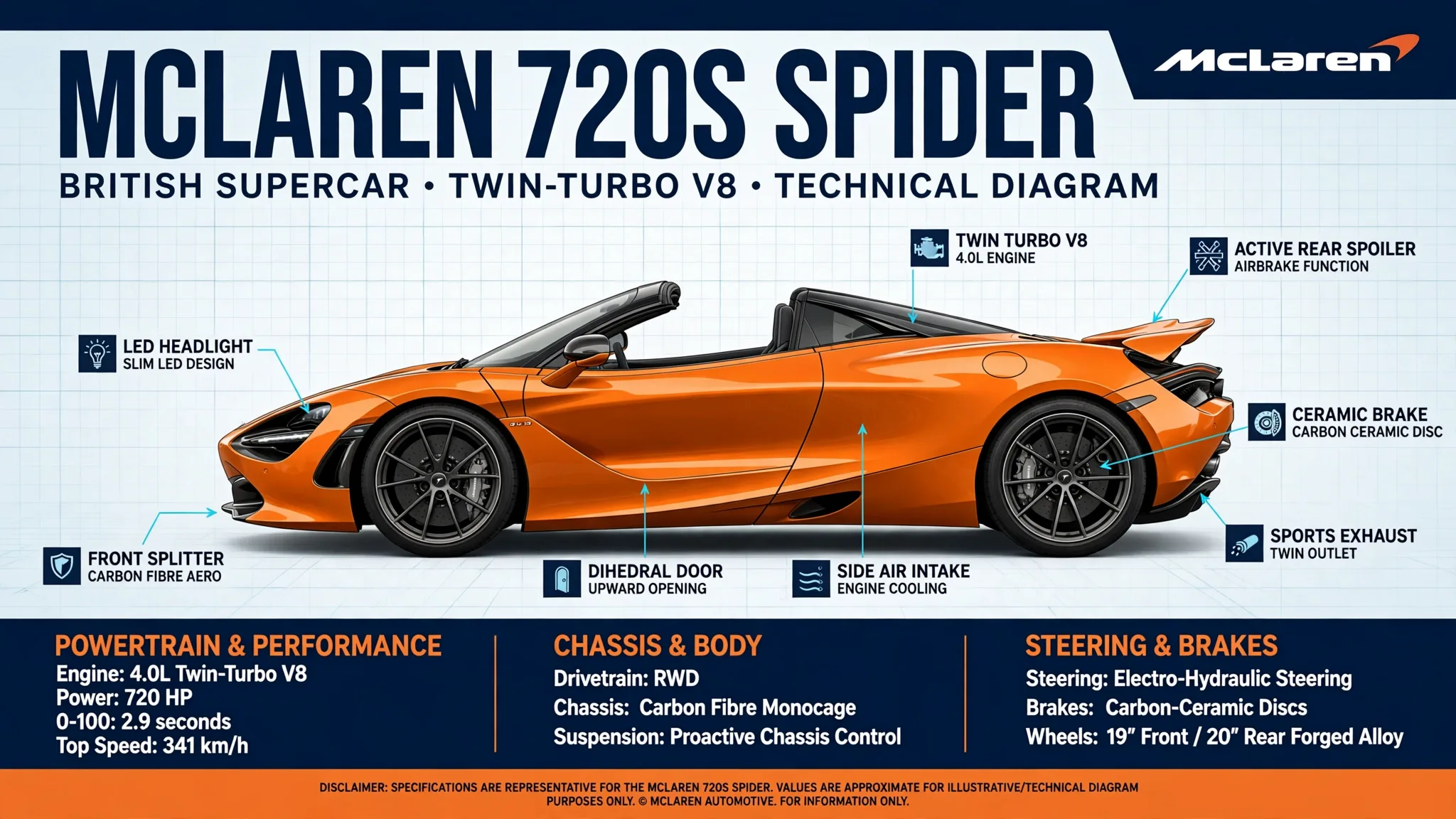
McLaren 720S Spider Technical Diagram
In this post
Picture this. You press one button, and the solid roof above your head starts to fold itself away. The sky opens up. The engine note, which was already loud, gets sharper and closer, like someone turned the volume up and removed the wall between you and the sound. That is the whole idea of the McLaren 720S Spider. It is a supercar that refuses to keep you locked inside a metal box.
McLaren built the 720S as a coupe first, and then cut the roof off without ruining the car. That sounds simple. It is not. Most cars lose strength when you remove the roof, and engineers have to add heavy metal to make the body stiff again. The Spider avoids that trap because of the way it is built from the start. Its heart is a carbon fibre tub called the Monocage, a single strong shell that holds the driver and the engine together. Because that tub is already so stiff, the open-top version barely needs extra weight. So you get the wind in your hair without giving up the sharp handling that made the coupe famous.
The roof that disappears
The Spider uses a retractable hard top, which means the roof is a solid panel, not a piece of cloth. When it is up, the car looks and feels like a proper coupe, quiet and sealed. When it is down, the car turns into a roadster, and you can fold it away in a matter of seconds, even while driving slowly. There is also a small glass panel in the roof that you can lower on its own, so you can let more engine sound into the cabin without opening the whole roof. It is a clever touch. On a normal drive through town, you can keep the roof up and enjoy the calm. On an open road, you drop it and the whole drive changes character.
Look at the diagram and you will see how low and wide the car sits. The shape is not just for show. Every curve pushes air where the engineers want it. The headlights sit in deep sockets that also channel air. The doors swing up and forward, a McLaren signature, and they make getting in and out easier in tight parking spots than a normal long door would. The side intakes feed cool air to the engine behind the seats. Nothing on the body is decoration for its own sake. It all has a job.
A V8 that does the talking
Behind the seats sits a 4.0-litre twin-turbocharged V8 engine. It makes 720 HP, which is where the 720 in the name comes from. Power goes only to the rear wheels, and the car can sprint from 0 to 100 km/h in 2.9 seconds. The top speed is 341 km/h. Those numbers put it in the fastest group of road cars on the planet, but numbers alone do not explain what it feels like.
A twin-turbo engine uses two turbochargers to push extra air into the engine, and extra air lets the engine burn more fuel and make more power. In older turbo cars, you pressed the pedal and waited a beat for the power to arrive. McLaren worked hard to remove that delay, so the Spider reacts almost the moment your foot moves. Around town, that means the car feels alive even at low speed. On a highway, it means overtaking takes a breath, not a plan.
The sound matters too. With the roof down, you hear the turbos whistle softly and the exhaust crackle when you lift off the pedal. It is not the deepest sound in the supercar world, but it is sharp and mechanical, like a precision tool doing its job at high speed. Some drivers love that. Others wish it sounded more like an old racing engine. Either way, nobody calls it boring.
What it feels like on the road
If I had one afternoon with this car, I would take the long way home, roof down, and find a road with smooth curves rather than a straight highway. That is where this car earns its name. The steering is light but full of information. You can feel what the front tyres are doing through your hands, and the car turns the moment you think about turning. It does not feel heavy or lazy. It feels alert, like an animal that is already awake before you move.
The suspension can be softened for normal roads or stiffened for fast driving. In its softest setting, the Spider rides better than most people expect from a supercar. It will still feel firm over big bumps, because the car sits so low, but it will not punish you on a normal road. In its firmest setting, the body stays almost flat through corners, and the car grips the road with a confidence that can surprise even experienced drivers.
Visibility is another quiet strength. The windscreen is wide, the pillars are thin, and the low nose lets you see the road ahead clearly. Reversing cameras and parking sensors help in town, but the honest truth is that a car this wide still needs care in narrow streets. You learn its size quickly, and after a day, parking stops feeling stressful.
The everyday question
Can you actually use a car like this every day? The honest answer is: more than you would think, but with limits. The front of the car can lift itself over speed bumps and steep driveways, which saves the nose from scraping. There is storage space in the nose and behind the seats, enough for a weekend bag or two, though not for a family shopping trip. Fuel use is high when you drive fast, and gentle when you cruise, which is true of every powerful car.
Prices vary by market, year and options, so there is no single number that fits every buyer. Running costs are supercar costs too: tyres, brakes and servicing all sit at the top end of the scale. That is part of the deal. Nobody buys a 720S Spider to save money. People buy it because it makes an ordinary road feel like an event.
The Spider also has a practical side that surprises people. The dihedral doors, which swing up, mean you can open them fully even when another car parks close beside you. The cabin is simple and driver-focused, with a screen that folds away to show only the essential numbers when you want to focus on driving. It is a car built by people who clearly love driving, and that love shows in small details everywhere.
So who is this car for? It is for someone who wants the speed of a top supercar but also wants the sky above them. A coupe is faster on paper by a tiny margin, but the Spider gives you something a coupe never can: the sound, the air and the feeling of being part of the road instead of watching it through glass. For many drivers, that trade is worth it many times over.
Common questions
Is the 720S Spider slower than the coupe?
Barely. The open-top version is only a fraction heavier, and its 0 to 100 km/h time of 2.9 seconds matches the coupe. On a normal road, no driver would feel the difference.
What does 720 HP actually mean?
HP stands for horsepower, a way of measuring how much work an engine can do. A normal family car has around 100 to 150 HP. The Spider has 720 HP, which is why it can reach 100 km/h in under three seconds.
Can the roof open while driving?
Yes, the retractable hard top folds away in a matter of seconds, and it can be operated at low speed. You do not need to stop the car and get out.
Is the car hard to drive in normal traffic?
It is easier than it looks. The steering is light, visibility is good, and the nose can lift for bumps. Its width and low seating still need care, but most drivers get used to it within a day or two.