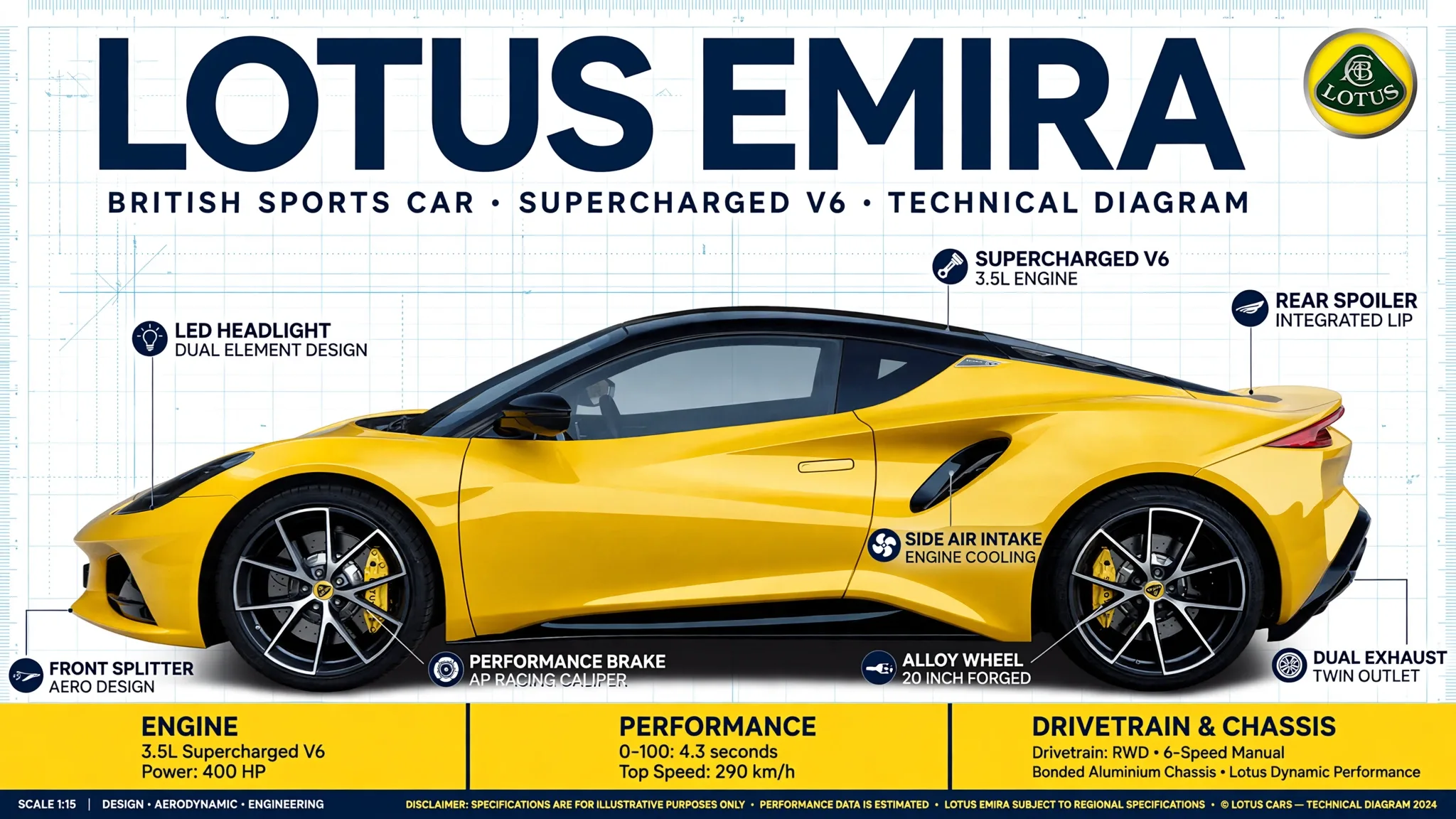
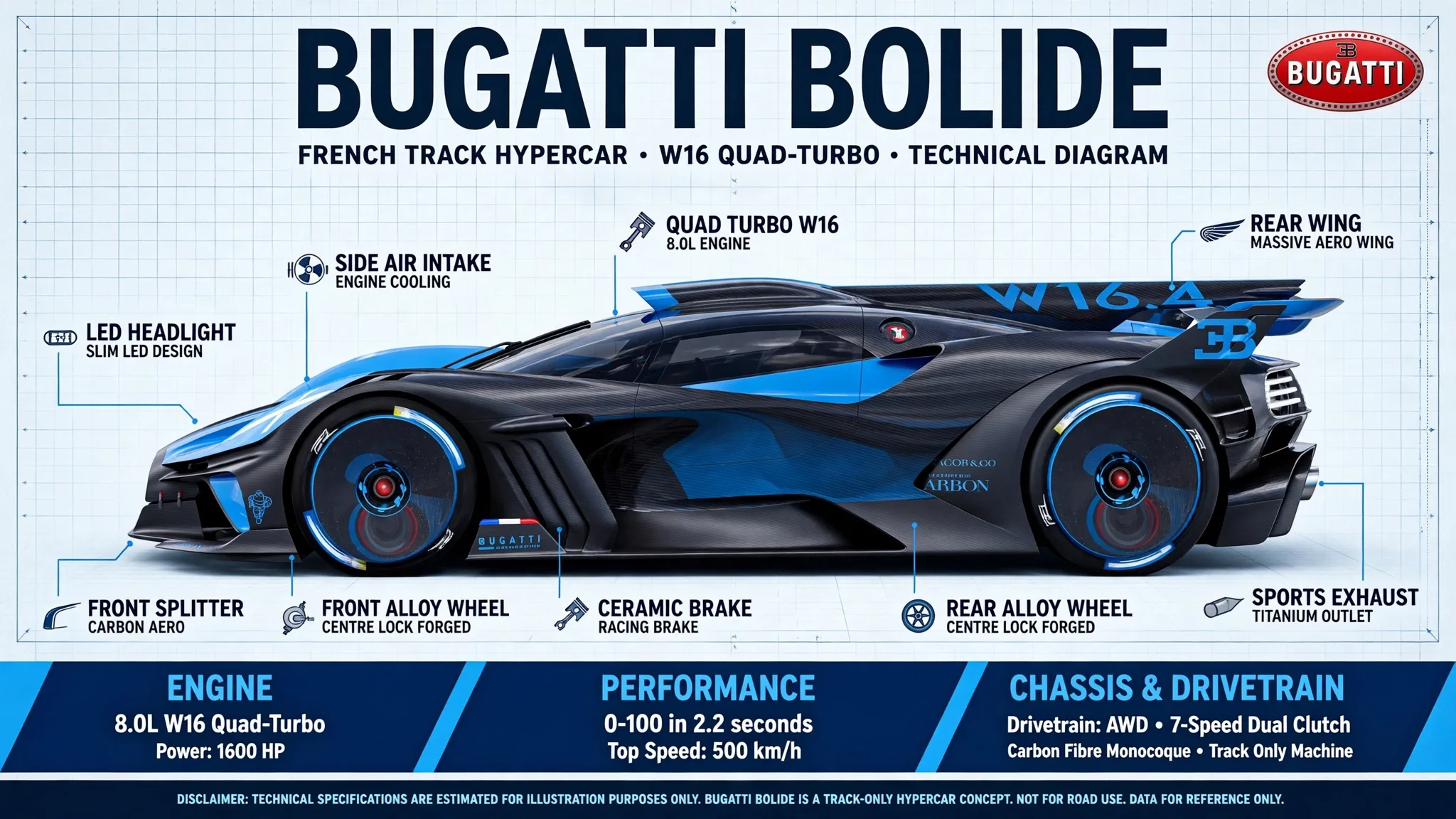
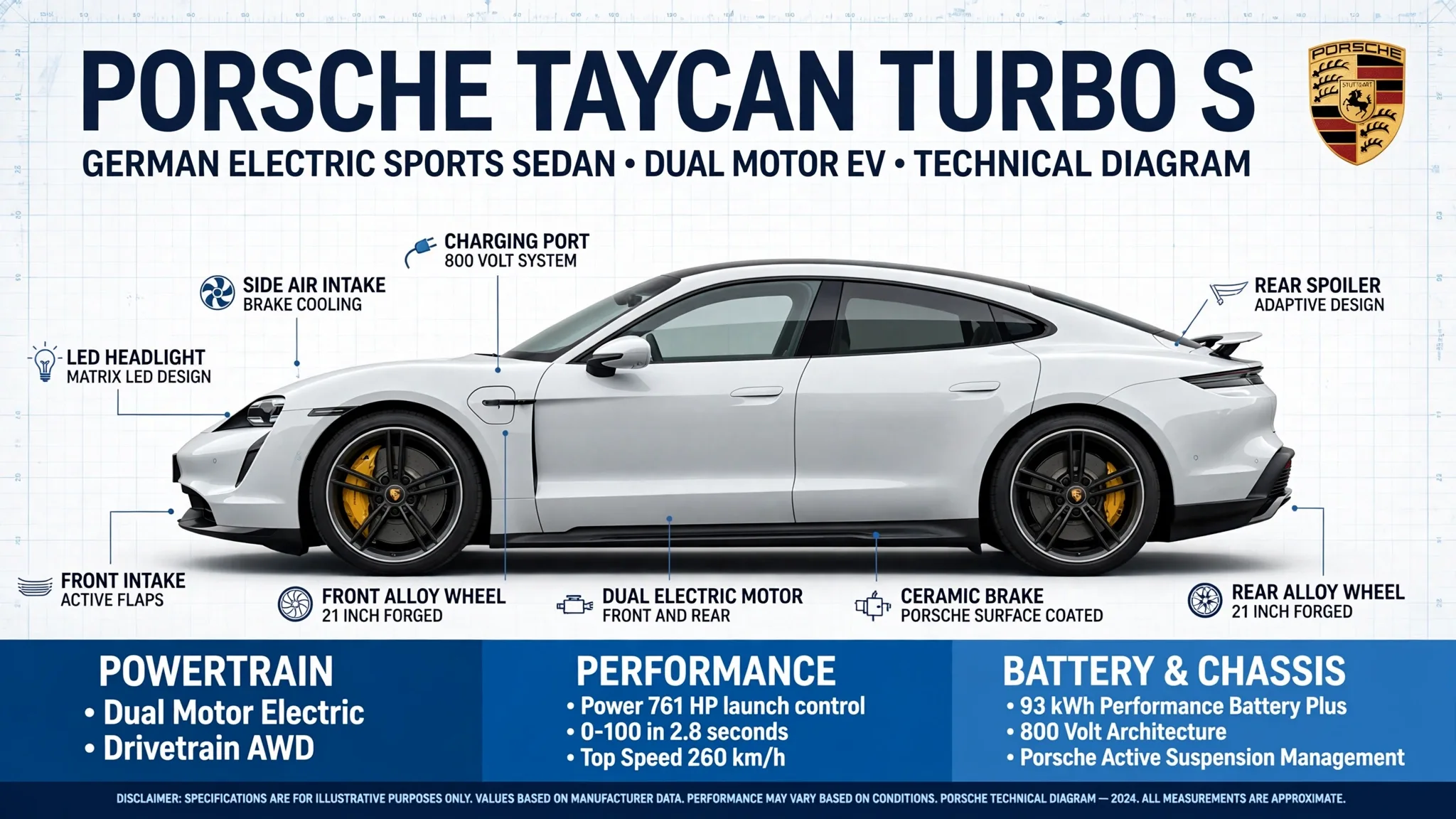
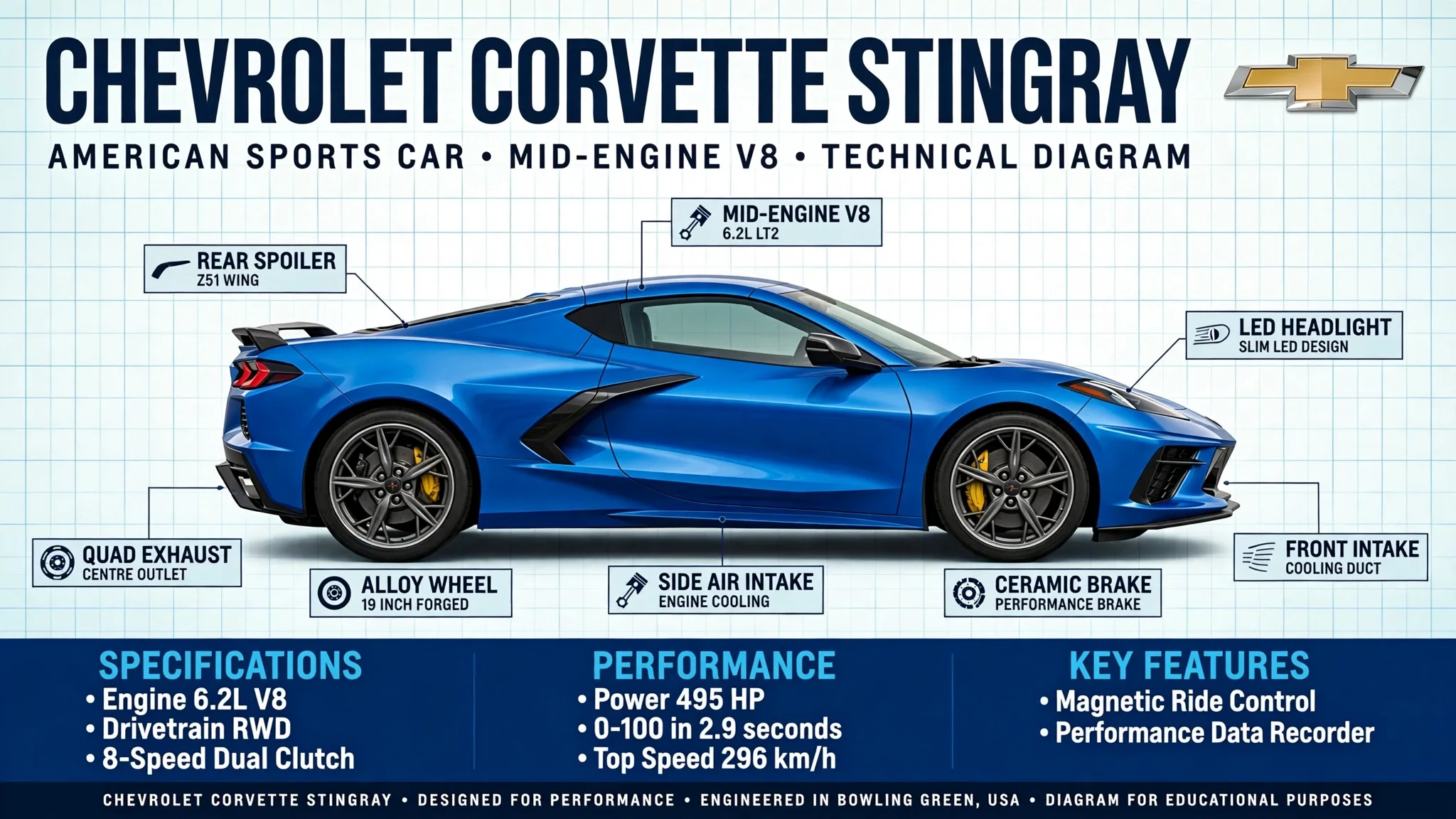
Chevrolet Corvette Stingray Technical Diagram
In this post
Picture a car that has looked almost the same way for seventy years. Long nose in front, big engine under that nose, and a driver sitting near the back. That was the Chevrolet Corvette, and people loved it exactly like that. Then, one day, the engineers did something nobody expected. They picked the engine up and moved it behind the seats.
That single change turned the Corvette into a different kind of machine. The car in our diagram is the result of that bold move. It is called the Corvette Stingray, the eighth generation of the Corvette family, known as the C8. It still looks like a Corvette, but the way it works has changed from the ground up. Let us walk through what makes it special, one part at a time.
A Familiar Name With a New Idea
The Corvette story began in 1953, when the first Corvette rolled out in America. For decades, every Corvette kept its engine in the front. Drivers got used to that shape: a long bonnet stretching ahead, and the feeling of sitting close to the rear wheels. It became part of the car’s character, almost like a signature.
The C8 broke that habit. Its 6.2-litre V8 engine now sits right behind the driver, in the middle of the car. Engineers call this a mid-engine layout. Think of it like carrying a heavy school bag. If you hold it in one hand, you lean to one side. If you wear it in the middle of your back, your balance feels natural. A mid-engine car works in a similar way. With the heavy engine near the centre, the car stays balanced when it turns, brakes, and speeds up.
This change also changed the shape of the car. The nose became shorter and lower, because there was no big engine to cover anymore. The sides grew wider air intakes, which pull cool air toward the engine. The back became broader, to hold the engine and give the car a strong, planted stance. From the outside, it looks lower and wider than older Corvettes, almost like it is crouching on the road.
The name Stingray has been part of Corvette history since the 1960s, and it fits this car well. A stingray moves smoothly and quickly through water, flat and silent, then suddenly fast. This Corvette carries that same spirit: calm at low speed, sharp the moment you ask for more.
What 495 Horsepower Really Means
Numbers on a diagram can look cold, so let us make them warm. Horsepower is an old measure of pulling power. One horsepower is roughly the work of one strong horse. This Corvette has 495 of them, all from a 6.2-litre V8 engine. That is a very large number for a car you can drive on a normal road.
What does it feel like? The diagram says this car can reach 100 kilometres per hour in 2.9 seconds. Try counting to three slowly. Before you finish the word “three”, the car is already at highway speed. That kind of push presses you gently back into your seat. It is not scary, but it is serious. It reminds you that a powerful engine is always waiting under your right foot.
The top speed is 296 kilometres per hour. That is far beyond any legal road speed, and nobody needs to drive that fast. What the number really tells you is how much strength the car holds in reserve. A car that can reach such speeds without strain will feel relaxed and confident at normal speeds too. It will overtake easily, climb hills without effort, and cruise for hours without feeling tired.
Power goes to the rear wheels only, which is called rear-wheel drive. In simple words, the back wheels push the car forward while the front wheels only steer. Many sports cars use this setup because it gives the driver a natural, connected feeling. When you press the accelerator out of a corner, you can feel the car pushing you forward from behind, like a gentle hand on your back.
A Seat That Hugs the Driver
Step inside a Corvette and the first thing you notice is that everything faces you. The dashboard bends around the driver like the walls of a small cockpit. Buttons, screens, and controls sit within easy reach. The passenger gets a comfortable seat too, but there is no doubt who the car is built around.
For me, the bravest thing about this Corvette is not the speed. It is the courage to move the engine after seventy years of doing it the other way. That decision changed the shape, the balance, and the soul of the car, and it took real confidence to make it.
The seats hold you firmly, which matters when the car turns fast. On a sharp bend, your body wants to slide sideways, but the shaped seats keep you in place. At the same time, the ride is not harsh. Chevrolet built this car to be used, not just admired. It has space for luggage in two places: a small trunk in the front, where the engine used to be, and another behind the engine. So a weekend trip is possible, not just a quick spin around the block.
The roof comes off on some versions, turning the car into an open-top cruiser. Driving with the sky above you, hearing the V8 sound clearly, is one of the simple pleasures this car offers. It is a sports car, yes, but it is also a car that fits into everyday life more easily than most cars with this much power.
The sound is part of the charm too. A V8 does not hum like a small car. It rumbles low at idle and grows into a deep roar as the revs climb. With the roof off, that sound fills the air around you, and it is easy to understand why people smile the first time they hear it.
Reading the Diagram Like a Map
A technical diagram can look busy at first, but it is really a map. Each label points to one part and tells you a small story about it. Start at the front and move slowly toward the back, the way your eyes would travel along the car itself.
At the front, you see slim headlights and a low nose. The lines show where air enters to cool the brakes and feed the engine. Along the side, a large intake scoops air toward the engine sitting behind the seats. At the wheels, the diagram names the brakes and the alloy wheels, which are strong but light. At the back, a small spoiler helps press the car onto the road at high speed, and four exhaust pipes let the V8 breathe out.
The bottom of the diagram gathers the key facts in one place: engine size, power, speed, and drive type. Reading it this way turns a poster into a lesson. You do not need to be an engineer to enjoy it. You only need curiosity, and a few minutes to follow the lines with your eyes.
The Corvette Stingray matters because it proves that even a legend can change. It kept its name, its spirit, and its V8 heart, but it moved the pieces around to become better. That is why people still talk about it, and why a simple diagram of it can teach so much about how cars work.
Common questions
What does Stingray mean on a Corvette? Stingray is a special name Chevrolet has used for sporty Corvette models since the 1960s. It stands for a flat, smooth, and quick character, like the sea animal of the same name.
Is the Corvette Stingray really that fast? Yes. It can reach 100 kilometres per hour in about 2.9 seconds, and its top speed is around 296 kilometres per hour. Those numbers come from its 495 horsepower V8 engine.
Can you drive a Corvette every day? Many owners do. It has two luggage spaces, a comfortable cabin, and a ride that is firm but not painful. It is wider and lower than a normal car, so tight parking needs care.
What is a mid-engine car? It is a car whose engine sits behind the seats, near the middle of the car, instead of under the front bonnet. This gives better balance and grip in corners.