Dodge Challenger SRT Technical Diagram
In this post
Big. Loud. Unapologetic. The Dodge Challenger SRT does not try to blend in. It does not try to be subtle. It rolls up like a linebacker in a tailored suit, and it wants you to look. Some cars whisper. This one speaks in a deep voice, and it means every word.
A Car That Refuses to Whisper
Stand next to a Challenger and the first thing you notice is size. It is wide. It is long. It has a presence that smaller sports cars simply cannot copy. The long hood stretches out in front of you like a runway. The roofline sits high and square. The whole shape looks like it drove straight out of 1970 and decided to stay.
That is no accident. The Challenger was born in 1970, in the golden age of American muscle cars, when big engines and bold styling ruled the road. The name went away for years. Then, in 2008, Dodge brought it back, and fans went crazy. The new car kept the old attitude but added modern brakes, modern safety, and modern comfort. It was the past, rebuilt for today.
The SRT badge sits at the top of that story. SRT stands for Street and Racing Technology, the team at Dodge that builds the wildest versions of its cars. When you see those three letters on a Challenger, you know this is not the polite version. This is the one that growls.
The Heart of the Beast
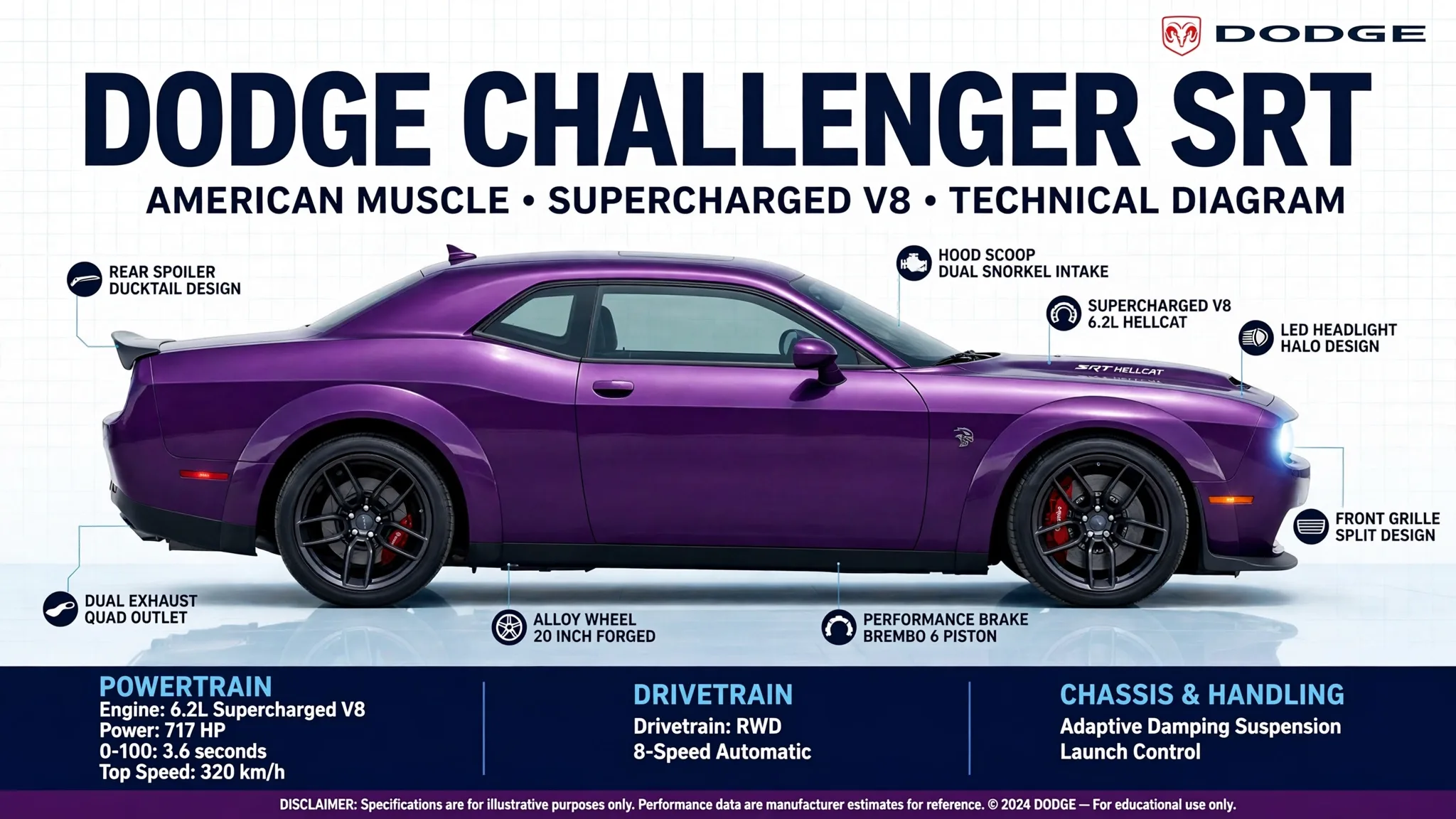
Lift the hood and you find the reason for all that noise. A 6.2-litre supercharged V8 sits in the engine bay. A supercharger is a pump that forces extra air into the engine, and more air means more power. A lot more power. This engine makes 717 HP.
Read that number again. Seven hundred and seventeen horsepower. That is more power than most race cars had a generation ago, and it lives in a car you can park outside a supermarket. The engine does not need to scream to make its point. At low speeds it rumbles. At full throttle it roars. People hear it coming from two streets away.
Power goes to the rear wheels only. That matters. It means the car feels alive when you accelerate, with the front end lifting slightly and the steering staying light in your hands. It also means the driver needs respect for the car. This is not a toy. It is a serious machine, and it rewards a calm, steady hand.
What 717 HP Actually Means
Numbers on a page can feel cold. So here is what they mean in real life. The Challenger SRT runs from 0 to 100 km/h in 3.6 seconds. Blink twice and you are already at highway speed. Its top speed is 320 km/h, which is supercar territory. A big, heavy, retro-styled coupe should not be able to do that. Yet here we are.
But speed is only half the story. The other half is theatre. The exhaust crackles when you lift off the accelerator. The supercharger whines softly under hard acceleration, like a distant siren. The seats hold you tight. The whole car feels like it is enjoying itself, and that feeling is catching. You find yourself smiling for no reason at all.
I have to be honest here: this is not the car I would pick for tight city streets or tiny parking spaces. It is wide, it is thirsty, and it demands room. But on an open road, with the sun out and the V8 singing, I struggle to think of anything that delivers more joy per mile.
Old Soul, New Muscles
The clever part of the Challenger SRT is how it mixes eras. The shape salutes 1970. The cabin does not. Inside you get comfortable seats, a modern touchscreen, and driving modes that change the car’s behaviour. One mode keeps things calm for daily driving. Another sharpens everything for a fast road. The car can be both a cruiser and a beast, and you pick which one with a button.
That split personality is why the Challenger survived while other muscle cars faded. It never tried to become a small European sports car. It stayed big, stayed bold, and stayed American. Fans loved it for that loyalty. When Dodge announced the end of this generation, collectors and fans rushed to buy the last ones, because they knew cars like this would not come again.
Prices vary by market, year, and options, so check local listings if you ever go hunting for one. Whatever the price tag says, the idea behind the car stays free to admire: build it big, build it loud, and never apologise for it.
What the Diagram Does Not Show
A diagram shows the outside of a car and its headline numbers. It cannot show what it feels like to sit inside one. So let us fill in that gap, because the Challenger SRT has a few surprises waiting in the cabin.
First, the back seat. Most coupes treat rear passengers as an afterthought, with legroom fit only for bags. The Challenger is different. Because the car is so large, adults can actually sit in the back without folding themselves in half. Four people can travel together in comfort, which makes this muscle car a genuine family car on weekends.
Second, the boot. It is big for a coupe, easily swallowing suitcases for a road trip or a full load of shopping. That matters, because a car this fun should not force you to leave things behind.
Third, the driving modes. A simple control lets you change the car’s character. In normal mode the steering is light, the suspension is soft, and the exhaust keeps its voice down. Switch to sport or track mode and everything sharpens: the throttle responds faster, the steering weights up, and the exhaust opens up fully. It is like having two cars in one body, and you pick which one you want with a button.
The brakes deserve respect too. Big Brembo brakes sit behind the wheels, built to stop this heavy, fast car again and again without fading. You will be glad of them the first time you need to slow down in a hurry from high speed. And the steering, while not as delicate as a small sports car’s, is honest and direct. It tells you what the front wheels are doing, which is exactly what you want when 717 HP is waiting under your right foot.
None of this shows up in a spec box. But it is the reason owners keep their Challengers for years instead of trading them in. The car is not just fast. It is also roomy, easy to live with, and full of small touches that make daily driving better.
Common questions
What does SRT mean on a Dodge Challenger? SRT stands for Street and Racing Technology. It is Dodge’s high-performance division, and its cars get the strongest engines, sharper suspension, and bigger brakes.
How fast is the Challenger SRT? It reaches 100 km/h in 3.6 seconds and has a top speed of 320 km/h. That is genuine supercar speed from a big muscle coupe.
Is the Challenger SRT practical for daily driving? It can be, with a big boot and four usable seats. But it is wide and uses a lot of fuel, so it suits open roads better than crowded city centres.
Why is the Challenger so popular? It keeps the classic 1970 muscle car shape while adding modern comfort and safety. Fans love it because it stayed true to its roots instead of shrinking into a generic sports car.