Ford Mustang GT Technical Diagram
In this post
Some cars you hear before you see them. The Ford Mustang GT is one of them. A deep rumble rolls down the street, heads turn, and then the long hood and fastback shape come into view. You do not need to be a car expert to know what it is. Children point at it. Adults smile at it. That kind of fame is rare, and the Mustang has carried it for sixty years.
A Shape That Never Really Left
The first Mustang appeared in 1964, and it changed Ford’s fortunes overnight. It was small enough for everyday use, stylish enough to feel special, and cheap enough for young buyers to actually afford. People called this new kind of car a pony car, and the Mustang gave the whole class its name.
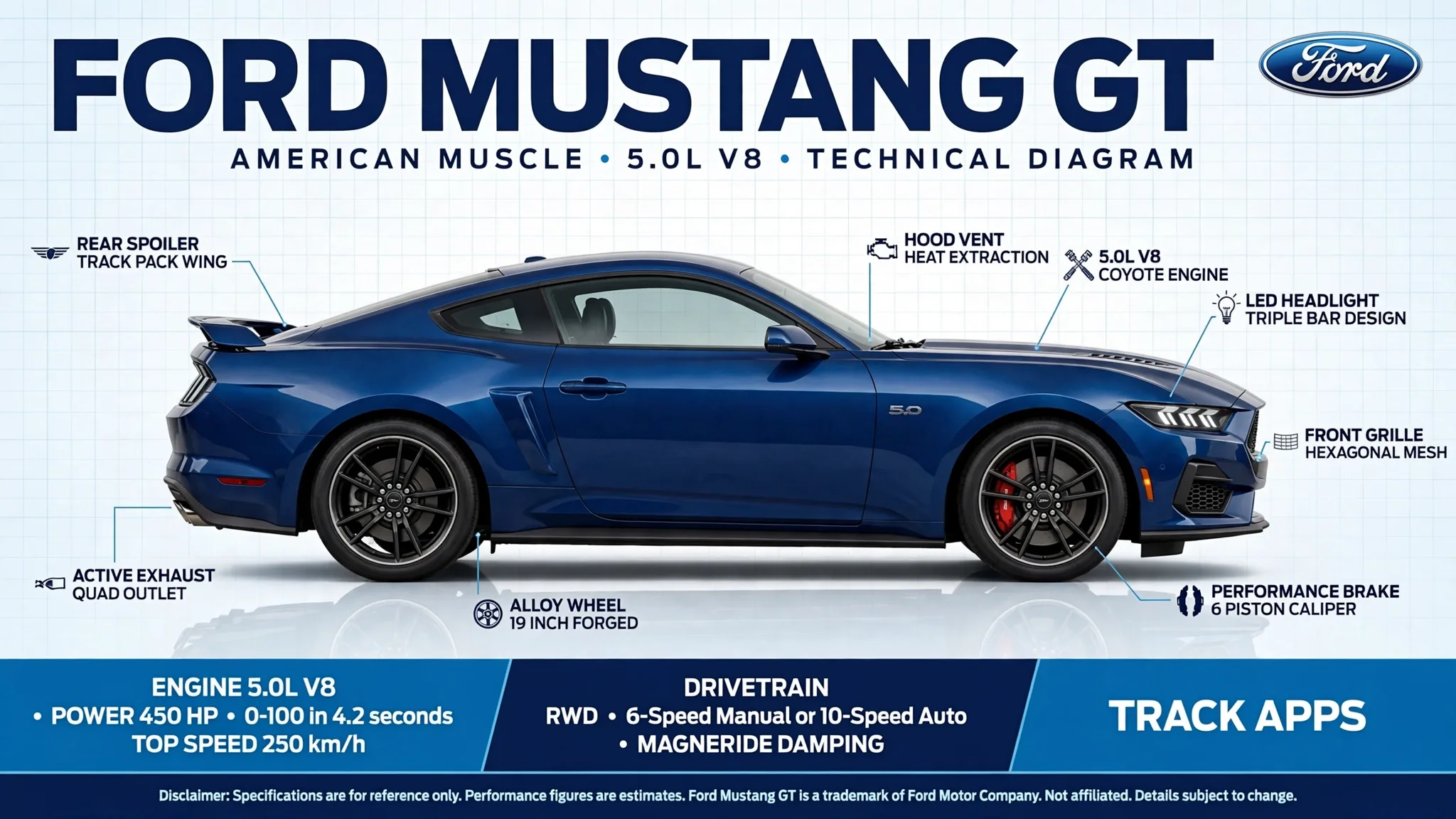
The GT badge has always meant the stronger, sharper version of the car. Over the decades the Mustang grew bigger, faster, and more advanced, but it never lost its basic shape. Look at the diagram and you can trace the family line: a long hood at the front, a short rear deck, and a roofline that slopes down like a runner leaning forward. The headlights are narrow and modern now, and the grille is wide and confident, but the attitude is the same as it was in the 1960s.
Ford has kept the Mustang in production without a break since that first year. Few cars on earth can say that. It survived fuel crises, changing tastes, and a whole world of new rivals, because each new version kept the promise of the first one: a fun, bold car that ordinary people could dream about.
What Sits Under the Hood
Open the hood of a Mustang GT and you find a 5.0-litre V8 engine. That number matters to fans, because a V8 is becoming a rare thing in new cars. Most modern cars use smaller turbocharged engines, which are clever and quick, but they do not sound or feel like a big V8. The Mustang GT keeps the old recipe alive: eight cylinders, no turbo, and a voice that gets louder as the revs climb.
The engine makes 450 HP. That is a lot of power for a car you can drive to work every day, and it is the reason the GT feels so alive. Press the accelerator gently and the car moves with ease. Press it hard and the car pushes you back into your seat while the exhaust note fills the cabin. The power goes to the rear wheels only, which is the classic muscle car layout. It makes the car feel playful in corners and honest in the way it talks to the driver.
Buyers can pick a manual gearbox, for people who love changing gears themselves, or an automatic that shifts fast and smoothly. Either way, the car keeps its character. It is not trying to be a silent luxury car or a racetrack weapon. It is trying to be a Mustang, and it succeeds.
Numbers That Tell the Story
The diagram lists the key figures, and they are worth reading slowly. The Mustang GT runs from 0 to 100 km/h in 4.2 seconds. Think about that for a second. Four seconds is about the time it takes to read this sentence out loud, and in that time the car has already reached highway speed. The top speed is 250 km/h, which is far beyond anything you would ever need on a public road, but it tells you how much strength the car holds in reserve.
I have always thought the Mustang’s real magic is not the top speed at all. It is the way the car makes an ordinary drive feel like a small event. A trip to the shops becomes a little louder, a little brighter, and a little more fun. That feeling is hard to measure, yet it is the reason people keep buying this car year after year.
Those numbers also explain why the GT sits in the sweet spot of the Mustang range. Cheaper versions are fine cars, but they cannot match the V8’s sound or punch. The wildest versions cost far more and demand more skill. The GT gives you the full Mustang experience without asking you to be a racing driver.
Why People Still Point at It
Part of the Mustang’s fame comes from the screen. It has starred in films, television shows, and countless posters on bedroom walls. But fame alone does not keep a car alive for six decades. The real reason is simpler: the Mustang makes people feel something.
It is also a car that welcomes everyone. You can spot one outside a school, outside an office, or parked next to cars that cost ten times as much, and it never looks out of place. It belongs to teenagers dreaming big and to grandparents remembering their first car. Very few machines manage that trick.
Prices vary by market, year, and options, so it is wise to check local listings before dreaming too hard. But the idea stays the same wherever you live: a V8, rear-wheel drive, and a shape that turns heads. That combination is getting rarer every year, which only makes the Mustang GT more special.
Living With a Mustang Every Day
It is easy to picture a Mustang GT as a weekend toy, something that only comes out when the sun shines. The truth is more ordinary, and more likeable. Most owners drive theirs every day, and the car handles normal life better than its wild looks suggest.
The seats are comfortable for long drives, and the driving position is high enough that you can see clearly over traffic. The boot holds a weekly shop without a fight, and the back seats work fine for children or for adults on short trips. The controls are simple: big dials, clear buttons, and a touchscreen that does its job without demanding a training course. Nothing about the cabin tries to confuse you.
Fuel use is the honest trade-off. A big V8 drinks more than a small family hatchback, especially in town, so you will visit petrol stations more often. The ride is also firmer than a soft saloon, because the suspension is tuned for fun rather than floating comfort. Most owners accept both happily, because the car pays them back every time the road opens up.
Parking needs a little care, since the hood is long and the car is wide, but cameras and sensors help. In rain the rear-wheel drive asks for a gentle right foot, which is good advice in any powerful car. Treat it with respect and it treats you well back. That is the daily deal of Mustang ownership: a small amount of extra effort, repaid with a large amount of extra joy.
Common questions
Is the Mustang GT a good everyday car? Yes, for most people it is. It has four seats, a usable boot, and normal controls. The ride is firm, and fuel use is higher than a small family car, but it works fine as a daily driver.
What does GT mean on a Mustang? GT stands for Grand Tourer, and on the Mustang it marks the stronger V8 version. It sits above the standard models and below the most extreme track versions.
Is the Mustang GT fast? Very. It reaches 100 km/h in 4.2 seconds and has a top speed of 250 km/h. That is sports car speed in a car you can buy and drive anywhere.
Does the Mustang GT only come with a manual gearbox? No. You can choose a manual gearbox or an automatic. Both suit the car, so the choice comes down to what you enjoy driving.