Maserati MC20 Cielo Technical Diagram
In this post
Modena is a small city in northern Italy, and for more than a century it has produced some of the most emotional cars on earth. Walk its streets and you will find workshops, museums and cafés where people talk about engines the way other towns talk about football. The Maserati MC20 Cielo was born in that world, and it shows. Cielo means sky in Italian, and this car wears that name honestly. It is the open-top version of the MC20 coupe, a supercar that lets you fold the roof away and drive under the open sky.
I think the Cielo’s best trick is how little it gives up for that open sky. Many open-top supercars feel like a compromise, softer and heavier than the coupe they came from. The Cielo was designed from the start to be both, so the body stays stiff and the weight stays low. You get the wind, the sun and the full sound of the engine, without losing the sharp responses that make the coupe special. That balance is the whole point of the car.
A trident with a long memory
Maserati’s badge is a trident, inspired by the fountain of Neptune in Bologna, and the company has used it since 1914. Over the decades, Maserati built racing cars, grand tourers and luxury saloons, and its name became linked with Italian style and speed. The MC20 marked a fresh start for the company, a return to building a true mid-engined supercar after years away from that arena. The Cielo followed as the open version, carrying the same engineering with a roof that opens.
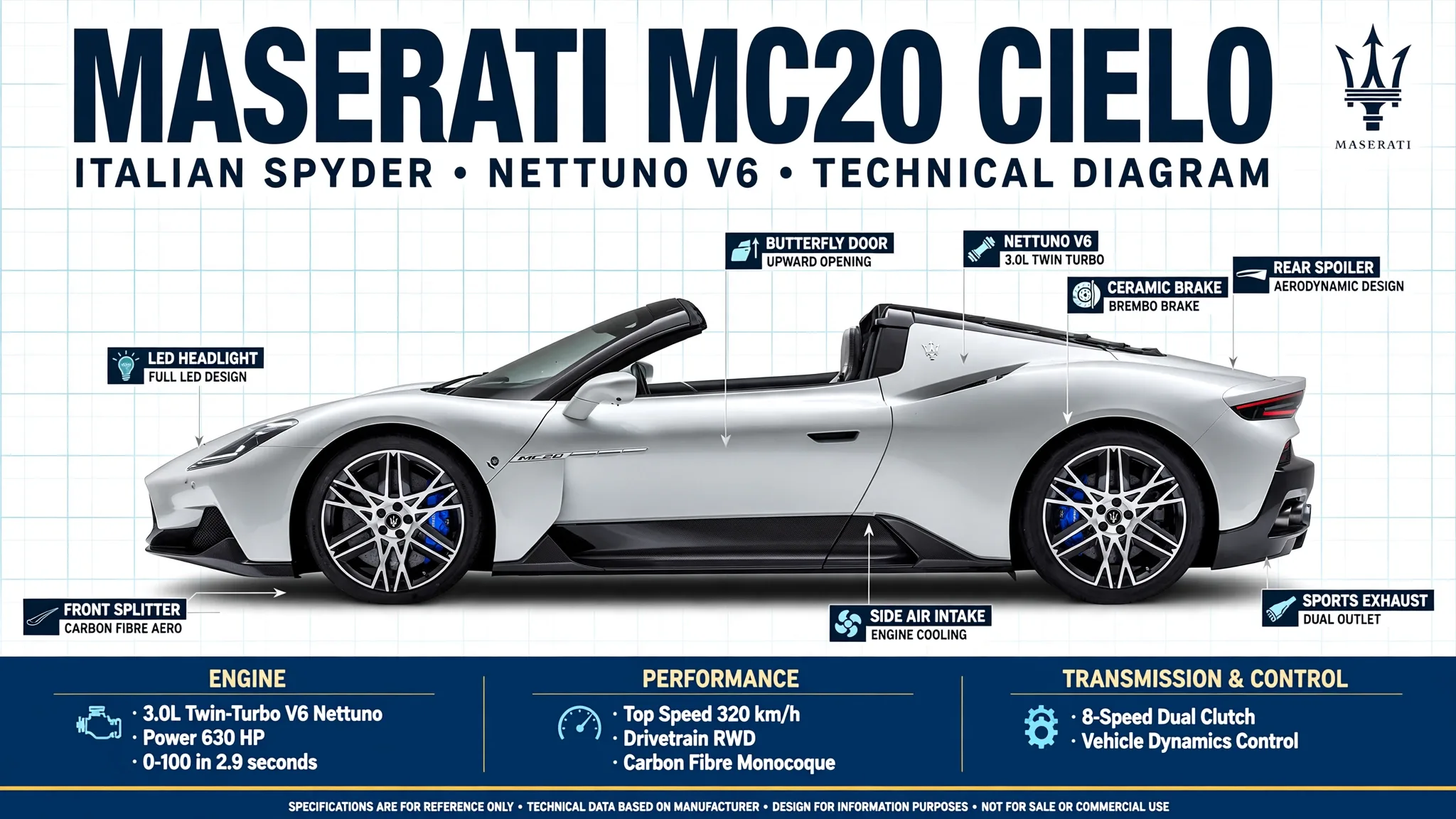
The body is built around a carbon fibre monocoque, a single rigid shell made from woven carbon threads set in resin. Carbon fibre is much lighter than steel and far stronger for its weight, which is why racing cars and supercars rely on it. In the Cielo, that shell does two jobs at once. It protects the driver in a crash, and it keeps the car stiff when the roof is open, so the steering stays precise and the body does not flex over bumps. Engineers call this stiffness the backbone of handling, and the Cielo has it in abundance.
The roof itself is a retractable glass panel that folds away in a matter of seconds. When it is closed, the glass lets light into the cabin and the car feels almost like a coupe. When it is open, the car becomes a true roadster. There is something deeply Italian about that idea: a car that changes its character with the weather, built for roads that run beside the sea and through hills, where the sky is part of the journey.
The Nettuno engine
At the centre of the car, behind the seats, sits the Nettuno engine. Nettuno is the Italian name for Neptune, the sea god whose trident sits on the badge, so the name is a quiet nod to the company’s history. It is a 3.0-litre twin-turbocharged V6, and it makes 630 HP. Power goes to the rear wheels, and the car sprints from 0 to 100 km/h in 2.9 seconds. The top speed is 320 km/h.
A V6 has six cylinders arranged in two banks of three, and the twin turbos push extra air into the engine to raise its power. What makes the Nettuno unusual is a combustion system borrowed from racing, which uses a small pre-chamber to burn fuel more completely. In plain words, the engine squeezes more energy from every drop of fuel, which means more power without a bigger engine. On the road, that shows up as instant response. Press the pedal and the car surges forward without hesitation, whether you are leaving a village or overtaking on a highway.
The sound is pure Maserati. It is higher and more urgent than a big V8, with a sharp edge that rises as the revs climb. With the roof open, that sound fills the cabin and bounces off stone walls and trees along the road. It is the kind of sound that makes passengers smile before they even look at the speedometer.
Craft, tech and the drive
Step inside and the Cielo feels more like a tailored suit than a racing machine. The seats hold you firmly without squeezing, the steering wheel is compact, and the screens are kept simple so the driver can focus on the road. Maserati chose quality materials and clean lines over flashy decoration. The result is a cabin that feels calm at speed, which matters on a long drive when noise and vibration can tire you out.
An 8-speed dual-clutch gearbox handles gear changes. A dual-clutch gearbox uses two clutches, one for odd gears and one for even gears, so the next gear is already waiting before you need it. Changes happen in a fraction of a second, with barely a pause in power. In automatic mode, the car shifts smoothly in traffic. In manual mode, paddles behind the steering wheel let the driver take control, and the car obeys instantly.
Vehicle dynamics control ties everything together. Sensors watch the car’s speed, steering angle and grip, and the system adjusts the suspension, brakes and power delivery to keep the car stable. The driver can choose modes for wet roads, normal driving, sport and full race settings. In the gentlest mode, the Cielo is easy and forgiving. In the sharpest mode, it becomes alert and aggressive, with faster responses and a louder exhaust note. That range is what makes the car usable in real life rather than only on a race track.
Prices vary by market, year and options, so no single figure describes every Cielo. Running costs match the supercar class, from tyres to servicing, and buyers should expect that. What the car gives back is an experience that few machines can match: Italian design, racing-bred engineering and the open sky, all in one package.
Imagine a coastal road in the early evening. The roof is down, the sea is on one side and low hills on the other, and the Nettuno engine is singing behind your shoulders. The steering is light in your hands, the car follows the curves without effort, and the whole world smells of salt air and warm stone. That is the drive the Cielo was built for, and it is a drive that stays with you long after you park the car and walk away.
Common questions
What does Cielo mean?
Cielo is the Italian word for sky. The name marks this as the open-top version of the MC20, with a retractable glass roof that folds away in seconds.
How fast is the MC20 Cielo?
It reaches 100 km/h from rest in 2.9 seconds and has a top speed of 320 km/h, from its 630 HP twin-turbo V6 engine.
Is it very different from the MC20 coupe?
The engineering is largely the same, including the carbon fibre body and the Nettuno engine. The Cielo adds the folding roof and a small weight increase, with almost no loss in performance.
Can you drive it every day?
It is possible, with a comfortable cabin and easy driving modes, but it remains a two-seat supercar with limited luggage space and supercar running costs.